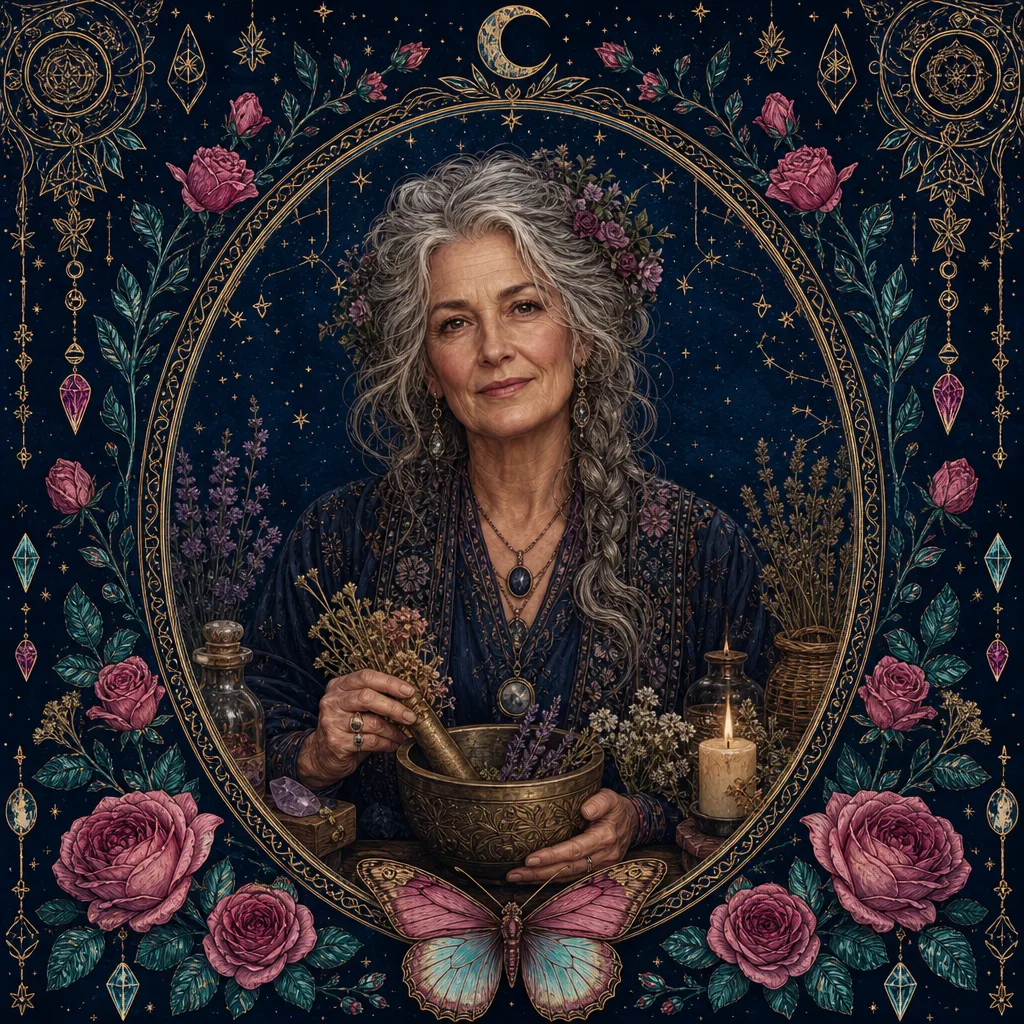
Folk Magick Practitioners
Granny Witch
Also called granny woman, yarb doctor
A granny witch is a traditional Appalachian folk healer and practitioner of folk magic who serves their mountain community as a herbalist, midwife, charm-worker, and keeper of practical magical knowledge. The role is deeply rooted in the Scots-Irish, English, German, and Cherokee-influenced culture of the southern Appalachian mountains.
- Tradition
- Southern Appalachian folk magic and mountain healing tradition
- Standing
- Open
A profile of the Granny Witch
The mountain community's indispensable woman: the one who brings you into the world, tends you when you are sick, and knows exactly what to do when trouble is not natural.
- Loves
- hand-harvested mountain herbs, old charm-verse passed word of mouth, the particular knowledge of a plant's season, a community that trusts her, a well-stocked stillroom.
- Hobbies and pastimes
- drying and bundling medicinal plants, reading weather signs and natural omens, keeping a remedy journal, attending births.
- Dream familiar
- A tortoiseshell cat who appears at the door of anyone who needs sending for the granny witch, and who has never once been wrong.
- Found in their element
- Found on her porch in the mountain morning, shelling beans or bundling herbs, listening to whoever has walked up the holler to find her.
- Signature objects
- a worn apron with deep pockets, a bundle of dried black cohosh, a hand-copied charm book, a birthing stool, jars of salve in careful rows.
A granny witch is an Appalachian folk practitioner who combines herbalism, midwifery, charm-working, and healing magic into a role of profound community service. The granny witch was the practical expert at the heart of mountain community life: the person who brought babies safely into the world, treated illness when no doctor was available, identified the cause when sickness defied natural explanation, and held the accumulated plant and magical knowledge of the mountains in trust for her neighbours.
The term is predominantly but not exclusively feminine — the great majority of documented granny witches were women, though men working in the same tradition might be called yarb doctors or simply healers. The role emerged from the confluence of Scots-Irish, English, German, and Cherokee cultural streams that shaped Appalachian mountain communities from the eighteenth century forward, and it bears the mark of each.
The work
Herbal medicine was the granny witch’s primary offering and the foundation of her community authority. Mountain pharmacopoeia was detailed, precisely observed, and seasonally demanding: knowing which plants were healing, which were harmful, where they grew, and when they were most potent required years of learning and ongoing attention. The granny witch typically knew hundreds of plants by name and use, and her preparation methods — teas, poultices, tinctures, salves, and steam treatments — reflected generations of accumulated trial and knowledge.
Midwifery was often inseparable from the healing role. The granny woman was present at births throughout a community, managing labour, addressing complications, and providing postpartum care for mother and child. This responsibility gave the granny witch a relationship of deep intimacy and trust with the families she served.
Charm-work addressed the problems that herbs alone could not. Verbal charms — often short rhyming verses invoking scripture or specific spiritual forces — were used for stopping bleeding, healing burns, easing toothache, treating thrush in infants, and addressing conditions understood to have a supernatural dimension. These charms were frequently passed down within families, sometimes with the stipulation that they must be taught across gender lines to retain their power.
Protective work included diagnosing and treating the evil eye, lifting curses, providing charms to hang in homes or barns, reading signs and omens to guide decision-making, and consulting on matters of luck, love, and uncertain futures. Divination methods in the tradition included reading the shapes of molten lead dropped in water, interpreting dreams, and reading natural signs.
History and tradition
The granny witch tradition developed in the southern Appalachian mountains — primarily the region encompassing western North Carolina, eastern Tennessee, western Virginia, and neighbouring areas — from the late eighteenth century onward as Scots-Irish and English settlers encountered German-speaking communities and formed complex relationships with the Cherokee and other indigenous peoples of the region.
Each of these cultural streams contributed to the tradition. Scots-Irish women brought a heritage of herb knowledge, charming, and second sight. English settlers carried cunning-craft traditions and charm-verse structures. German-speaking communities brought Pow-wow and Braucherei, including their characteristic Bible-verse charms. And the plant knowledge of the Cherokee, shared under the pressures of two neighbouring peoples living in the same landscape, shaped what Appalachian herbalism understood about the mountain plants themselves.
Documentation of the granny witch tradition comes from multiple sources: the Foxfire project’s collection of mountain knowledge in the 1970s and onward, academic folklorists who recorded granny witches in their own words, local history projects, and more recently contemporary practitioners who have made recovery and documentation part of their practice.
Walking this path
The granny witch tradition is open, passed through family inheritance, mentorship, and the kind of sustained attention to place and plant that the mountain tradition demands. No secret initiation guards it, and the historical granny witch was defined by knowledge and community recognition rather than formal credentials.
Working in this tradition today calls for deep engagement with the Appalachian cultural context. The granny witch”s knowledge is place-specific: rooted in the plants, the land, the particular cultural confluence of the southern mountains. Practitioners who bring genuine curiosity and respect to that specificity will find a rich and living tradition. Reading the Foxfire volumes, studying Appalachian folklore scholarship, and learning the plant community of the region provide real grounding.
Herbalism within this tradition carries ethical weight: plants must be learned carefully, harvested sustainably, and applied with accurate knowledge. The granny witch’s authority rested on her results, and that standard remains the one worth meeting. Many contemporary practitioners combine this tradition with formal herbal study, midwifery training, or both.
The role holds naturally beside other folk-magic paths. The granny witch and the Pow-wow doctor stand in the same broad stream of American folk healing, and practitioners may work in both frameworks. The tradition also connects readily to Hoodoo influence in southern Appalachian areas where those streams crossed, and historically they did cross, leaving traces in both traditions.
In myth and popular culture
The Appalachian folk healer and charm-worker has appeared in American regional literature and folklore since the nineteenth century, often figured as a figure of community authority in ways that complicate the stereotypical witch of Gothic fiction. Mary Noailles Murfree, writing as Charles Egbert Craddock, depicted Appalachian mountain life in fiction such as In the Tennessee Mountains (1884) and included healer and wise-woman figures whose knowledge of plants and community stood apart from the lowland world. Later, the Foxfire project, a series of oral-history magazines and books produced by students at Rabun Gap-Nacoochee School in Georgia beginning in 1966 under educator Eliot Wigginton, documented granny-witch and granny-woman knowledge directly from practitioners still living, creating a valuable primary record of the tradition in the twentieth century.
In twentieth-century Appalachian fiction, the figure of the knowing old woman recurs as a figure of genuine authority. Harriette Arnow”s The Dollmaker (1954) centres on Gertie Nevels, an Appalachian woman whose knowledge of carving and of the land embodies a kind of practical folk wisdom; while not explicitly a granny witch, the character draws on the same cultural tradition. Ron Rash, whose fiction is set in the southern Appalachian mountains, includes herbalists and healers among his community characters, and his novel Serena (2008) and story collections draw on Appalachian folk belief in ways that reflect the tradition”s actual texture.
The figure has received new attention in popular culture through television and fiction engaging with Appalachian culture more broadly. The television series Justified (FX, 2010-2015), set in rural Kentucky, depicted a community in which older folk practices and the authority of older women within that community are treated as real social forces. More directly, the contemporary witchcraft publishing revival has produced memoirs and practice guides by Appalachian practitioners such as Becky Beyer, whose writing on mountain folk magic has done significant work in presenting the granny witch tradition to a contemporary audience on its own terms rather than through romanticised or Gothic filters.
People also ask
Questions
What did a granny witch do in her community?
The granny witch was the community's primary resource for healing and obstetric care, plant medicine, protective charms, and divination. She delivered babies, treated illness with herbs and verbal charms, diagnosed bewitchment or the evil eye, removed curses, and preserved the practical knowledge that kept mountain families alive through hard seasons. She was trusted rather than feared, consulted rather than avoided.
What is the difference between a granny witch and a granny woman?
The terms overlap substantially in Appalachian usage. "Granny woman" more specifically designated the midwife role, while "granny witch" acknowledged the magical and charming dimension more explicitly. In practice, many women held both roles simultaneously, and the same individual might be called by either title depending on why she was being consulted at a given moment.
What plants did granny witches use?
The granny witch's botanical knowledge was vast and specific to the Appalachian plant community. Common healing plants in the tradition include black cohosh, bloodroot, boneset, ginseng, mullein, pennyroyal, slippery elm, and wild ginger. The tradition blended plants from Scots-Irish, English, German, and Cherokee herbal knowledge -- each community having contributed to the shared mountain pharmacopoeia over generations.
Did granny witches practice Christianity?
Most historical granny witches operated within a Christian framework, often drawing on Biblical verses and prayer as components of their charm-work in the same way that Pow-wow doctors did. This was not seen as a contradiction: the healing power was understood as God-given, and charms invoking scripture were a practical use of sacred language. Some granny witches also held older folk beliefs about spirits, signs, and omens alongside their Christianity.
Is the granny witch tradition still alive?
Yes. Practitioners in the Appalachian region and those with Appalachian heritage continue to work in this tradition, and there has been renewed interest in documenting and preserving the granny witch's knowledge base. Authors including Becky Beyer and the work coming out of the Foxfire project have contributed significantly to this preservation effort.