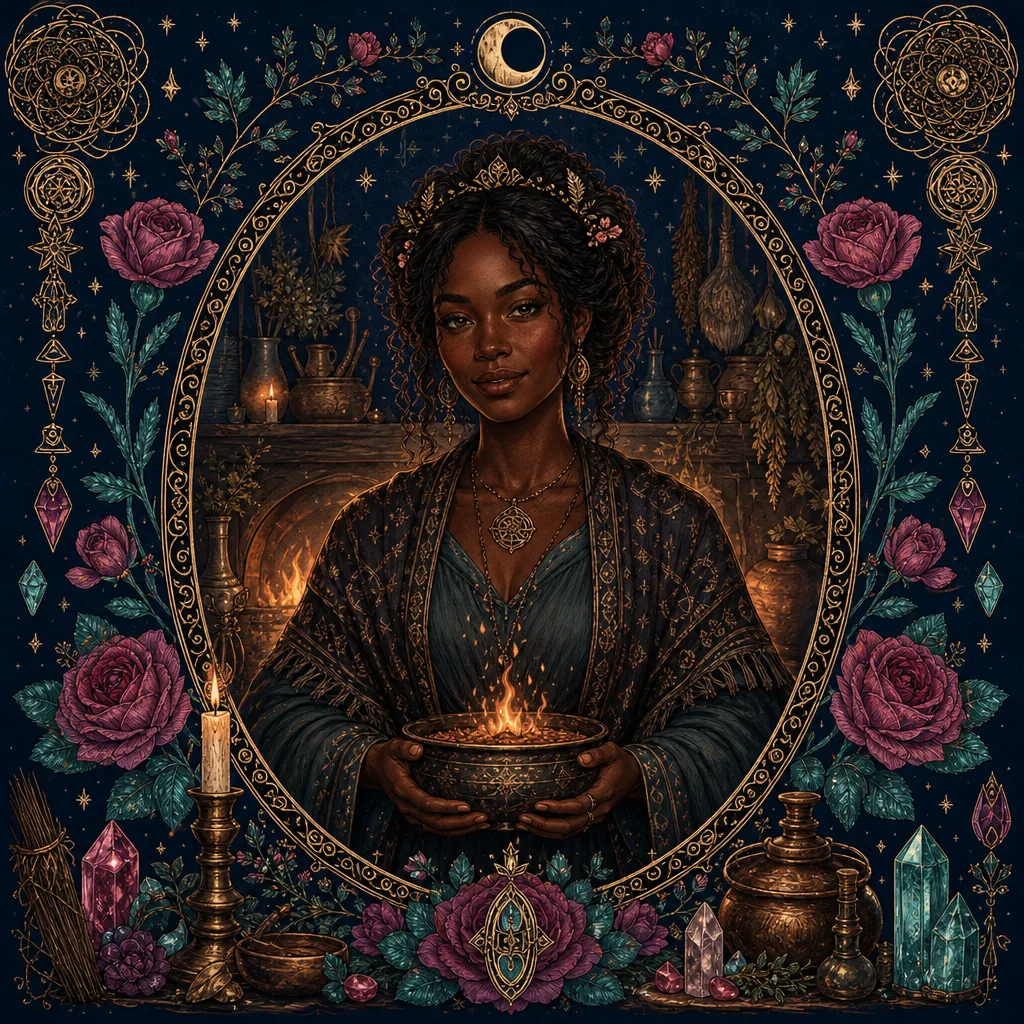
Witches & Their Paths
Hearth Witch
Also called Hearth Keeper, Home Witch
A hearth witch is a practitioner who centres their practice on the hearth as a sacred and magical space, tending the fire as a spiritual act and weaving magic through the maintenance, blessing, and honouring of the home's central warmth.
- Tradition
- European hearth-cult and domestic spirit tradition, from Roman Vesta to Norse Frigg
- Standing
- Open
A profile of the Hearth Witch
A keeper of sacred fire who understands the home as a living spiritual entity, tended with the same devotion that temple priests brought to the altars of gods.
- Loves
- the particular sound of a fire settling, beeswax candles that smell of summer hives, an oven that holds heat well, the ritual of morning fire-lighting, seasonal baking tied to the festival calendar.
- Hobbies and pastimes
- learning traditional hearth blessings, fire divination and reading flame behaviour, perfecting a ritual bread recipe, cultivating a perpetual sourdough starter.
- Dream familiar
- A marmalade cat who sleeps beside every fire it can find and has appointed itself guardian of the threshold between the warm hearth and the cold outside.
- Found in their element
- Found in the kitchen in the last hour before the household wakes, tending the morning fire and making the first offering of the day before anyone else is up.
- Signature objects
- a cast-iron pot passed through family, a small offering dish kept beside the stove, a Brigid's cross hung at the hearth, a flame that is never left to go out carelessly, a dedicated taper for the daily morning lighting.
A hearth witch is a practitioner whose magical and spiritual life centres on the hearth, the home”s fire or its modern equivalent, treated as the living sacred core of the domestic space. Tending the hearth is a devotional act, the offering of portions of every meal is a relationship-maintaining practice, and the quality of the fire”s light and warmth is understood as reflecting the spiritual health of the home itself.
The hearth has been the sacred centre of the home in cultures across Europe and beyond for as long as people have built permanent dwellings. The Roman Vesta, the Greek Hestia, the Lithuanian Gabija, the Irish Brigid in her fire aspect, and the Norse household wights who gathered around the fire all speak to a universal recognition that the household flame is something more than a heat source: it is the point around which the family”s life organises, the place of welcome and nourishment, and the home”s visible spirit.
The work
The hearth witch tends their fire or flame as a daily act of devotion. Whether working with a wood-burning fireplace, a pellet stove, a gas range, or a candle on the kitchen shelf, the quality of attention brought to the flame distinguishes the hearth witch”s relationship with it from mere practical use. The flame is greeted in the morning, thanked at night, and given the first portion of every cooking or brewing session before the family is served.
Building a relationship with the hearth spirit, the living presence associated with the home”s fire, is the foundational spiritual work. This relationship is established through consistent offering, spoken acknowledgment, and receptive attention to what the fire offers back: the quality of its burning, the shapes it forms, the way it responds to conditions in the home. Many hearth witches develop a strong sense of the hearth spirit”s character over years of daily contact.
Fire divination, called pyromancy, is natural territory for the hearth witch. Reading the fire”s behaviour for omens, the colour of a flame, the way it rises or sputters, the direction it leans, the images formed in coal or ash, is a practice documented across many cultures and one that develops with patient observation over time.
Cooking and brewing over or near the hearth carries particular power in hearth witch practice. The practitioner who cooks with awareness of the fire as an active participant, whose heat transforms raw ingredients into something new, works with a three-way collaboration between themselves, the fire, and the ingredients rather than simply using heat as a tool.
Seasonal fire practices are important. Many hearth witches observe fire festivals with particular seriousness: Imbolc as Brigid”s fire-blessing and hearth rekindle, Beltane with its traditional need-fire and the relighting of household flames from the communal fire, Samhain as the time to tend the hearth for the returning dead. These seasonal punctuations tie the domestic fire to the larger wheel of the year.
History and tradition
The sacred hearth fire is among the most ancient and universal religious concepts in the archaeological and textual record. In ancient Rome, Vesta”s temple in the Forum contained a perpetual flame tended by the Vestal Virgins, and every Roman household maintained its own equivalent in the form of the Lar familiaris, the household spirit, and the hearth fire associated with it. The extinguishing of a household fire was an inauspicious event requiring ritual restarting.
In Greek tradition, Hestia, the eldest of the Olympian gods, received the first and last portion of every sacrifice precisely because the home”s fire was understood as the origin and return point of all religious life. Every Greek colony carried fire from its mother city”s hearth to establish the connection between old home and new.
In Irish tradition, the Brigid”s cross placed at the hearth on St Brigid”s Day on the first of February maintained a folk custom of hearthside protection and welcome that predates its Christian framing. The perpetual fire of the goddess Brigid was maintained at Kildare until the Reformation and has been symbolically revived by the Brigidine Sisters since 1993.
Walking this path
The hearth witch begins by choosing one flame to tend with daily intentionality. Even a single candle on the kitchen shelf, greeted in the morning and thanked at night, with a drop of oil offered before cooking, establishes the fundamental practice. From that small beginning, the relationship develops organically as the practitioner notices what the fire seems to respond to and what the home feels like when the practice is maintained versus neglected.
Reading in the history of hearth and fire cult provides both historical grounding and practical inspiration. Stephanie Woodfield”s work on Celtic deities, the Roman sources on Vesta, and the Lithuanian folk records on Gabija all provide models of what sustained hearth practice looks like. Learning one or two traditional hearth blessings from relevant folk traditions and using them regularly is a simple and powerful way to connect the personal practice to the wider tradition.
The hearth witch path overlaps substantially with kitchen witchcraft and cottage witchcraft and sits naturally alongside green witchcraft, seasonal practice, and any form of home-based spiritual work. The fire is ancient, and it is always ready to be tended.
In myth and popular culture
The sacred hearth and its divine guardian appear in myth with unusual consistency across cultures, suggesting that the recognition of fire as the home”s spiritual centre is one of the oldest religious ideas in the human record. Hestia in Greek mythology is the firstborn of the Titans” children, elder to Zeus himself, yet she appears rarely as a character in myths that concern divine conflict or adventure; her domain is precisely the stillness and continuity of the home fire, which makes her the foundation of all domestic life rather than a protagonist in stories about its disruption. The Roman Vesta was her direct equivalent, and the Vestal Virgins who tended her temple flame in the Forum held a social position of extraordinary privilege and consequence: a Vestal”s presence could stop an execution, and the extinction of her temple fire was understood as a national emergency.
In Norse tradition, the concept of the household fire as a protected sacred space appears in the figure of the eld (hearth fire) and in the role of household wights who gathered at the home”s centre of warmth. Frigg, goddess of the home and marriage, is the divine patron whose influence is felt in the well-run household rather than in dramatic intervention, and she appears in the Prose Edda primarily in domestic and relational contexts. The Lithuanian goddess Gabija, whose household fire cult survived in folk practice into the twentieth century, is one of the most directly documented hearth deities in European tradition, with specific protocols for fire tending, extinction, and relighting still recorded in Lithuanian ethnographic sources.
In literature, the hearth as sacred centre appears in Louisa May Alcott”s Little Women (1868), where the March family”s domestic fire serves as the emotional and moral centre of the household in ways that echo hearth-cult thinking without naming it as such. Tolkien”s Lord of the Rings (1954-1955) presents the hobbit hole”s fireplace and the fire on the hearth of Bag End as markers of home, safety, and the value of the domestic world against which the entire adventure is measured. In contemporary witchcraft publishing, Juliet Diaz”s Witchery (2019) and Arin Murphy-Hiscock”s The House Witch (2018) helped establish hearth witchcraft as a named contemporary practice with a specific literature, building on a recognition that the path had always existed without always having a settled name.
People also ask
Questions
How is a hearth witch different from a cottage witch or kitchen witch?
The three paths are related and overlap considerably. The cottage witch tends the whole home as a sacred entity. The kitchen witch focuses on cooking and food preparation as the magical act. The hearth witch's specific centre is the fire, the stove, or the equivalent hearthspace as a living spiritual presence, and the practice of fire-keeping as devotion. A hearth witch may also cook and tend the whole home, but the fire relationship is primary.
What if I don't have a fireplace?
Most contemporary hearth witches work with a wood stove, a gas stove, a candle, or any controlled flame as the hearth's stand-in. What matters is the quality of relationship with the fire and the intention brought to tending it, not the architectural form. A single candle tended with ritual attention at the kitchen stove fulfils the hearth witch's function.
Who are the hearth deities that hearth witches commonly work with?
Vesta from Roman tradition is the most prominent: the goddess of the sacred hearth fire, whose flame was maintained perpetually in Rome by the Vestal Virgins. Hestia is her Greek equivalent. Brigid, the Irish goddess of fire, healing, and craft, is widely honoured. Frigg in Norse tradition is associated with the home and its keeping. Gabija in Lithuanian tradition is a specifically domestic fire goddess still honoured in some families today.
What is a perpetual flame practice?
A perpetual flame practice involves maintaining a continuous fire or flame as a devotional act, relighting it from itself or through a dedicated ritual if it goes out. In Roman religious practice, the sacred flame of Vesta was maintained continuously. Many hearth witches today maintain a candle or oil lamp that is kept burning as long as safely possible and relighted with ceremony. The continuous flame represents the unbroken thread of hearth presence in the home.
What offerings does a hearth witch make?
Traditional hearth offerings across European cultures include the first portion of any cooked food, a drop of oil or fat, a pinch of salt, a small portion of drink, and the dedication of baking and cooking acts to the hearth spirit or deity. Many hearth witches maintain a small dish near the stove where portions of meals are left before the family eats. These offerings honour the hearth as a living being rather than a piece of equipment.