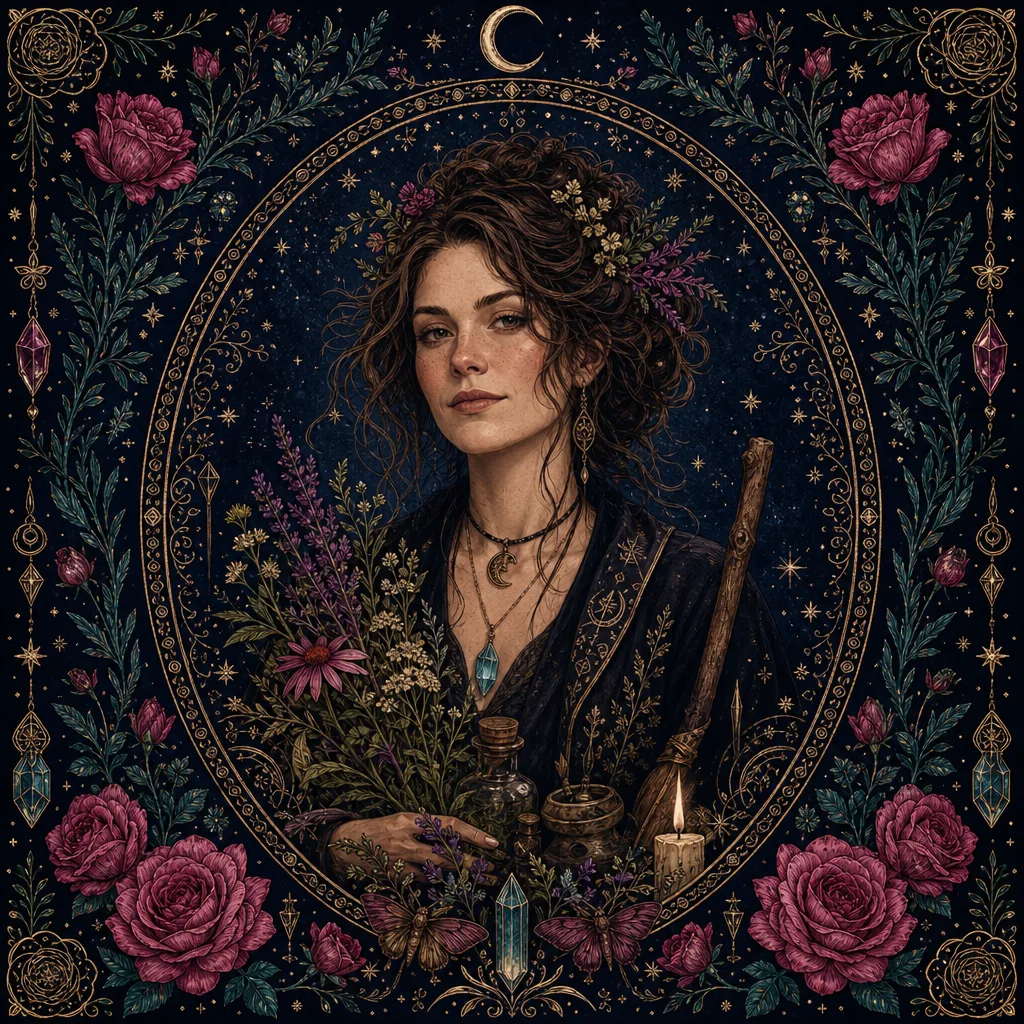
Witches & Their Paths
Hedge Witch
Also called Hedgewitch, Hedge Rider
A hedge witch is a solitary practitioner who works at the boundary between the ordinary world and the spirit realm, drawing on plant knowledge, trance, and folk magic.
- Tradition
- British and northern European folk witchcraft, with modern revival
- Standing
- Open
A profile of the Hedge Witch
A solitary walker at the edge of the known world, equally at home in the village and in the wild beyond the hedge, with one foot always in the spirit realm.
- Loves
- dusk in overgrown places, a murmur of drums for going under, elder trees old enough to have opinions, local spirits who remember the old names, a wild-gathered medicine cabinet.
- Hobbies and pastimes
- hedge-riding at liminal hours, mapping local spirit terrain, learning traditional plant lore, working with trance and dream.
- Dream familiar
- A hare who appears at the edge of the field at dawn and vanishes at the precise moment the hedge-riding begins, then reappears to mark the return.
- Found in their element
- Found at the edge of things: where the wood meets the field, where the road crosses the stream, where the cultivated world ends and the wild starts up again.
- Signature objects
- a staff cut from hawthorn or elder, a besom for threshold sweeping, a collection of found bones and feathers, a worn journal of spirit encounters, mugwort in every pocket.
A hedge witch is a practitioner who works deliberately at the boundary between the everyday world and the spirit realm, using trance, plant knowledge, and accumulated folk wisdom to cross that threshold and return with healing, guidance, or practical aid. The name points to the old meaning of the hedge: the physical and symbolic edge of the known world, where the village ended and the wild began.
The hedge witch does not typically belong to a coven, follow a structured religious system, or seek formal initiation. Solitary practice is the norm, rooted in personal relationship with place, plant, and spirit rather than in doctrine. This makes hedge witchcraft one of the most adaptable and geographically portable of the witchcraft paths, even as its deepest expression is always local.
The work
The central skill of the hedge witch is the ability to shift consciousness in a controlled way, moving awareness across the hedge into what many practitioners call the spirit world, the otherworld, or simply the other side. This hedge-riding or spirit-flight has equivalents in shamanic traditions worldwide, though the hedge witch works within a northern and western European folk framework rather than a strictly shamanic one. Methods include rhythmic drumming, breathwork, plant allies, deep meditation, and dream incubation.
Plant knowledge is essential. Most hedge witches cultivate a relationship with herbs that goes beyond their medicinal chemistry: they communicate with plant spirits, learn the traditional lore of each plant, and understand which plants serve as allies for crossing, healing, or protection. Mugwort, elder, yarrow, and hawthorn appear repeatedly in this work because they sit at their own kinds of boundary, between life and death, between realms, between seasons.
Practical craft includes making tinctures and teas, preparing sachets and charm bags, working with bones and feathers gathered from the land, and creating boundary markers for the home and garden. A hedge witch might sweep a threshold with a besom, hang dried herbs above a doorframe, or bury a charm at the crossroads. The work is tactile, plant-scented, and intimately tied to the local landscape.
History and tradition
The hedge witch as a specific named figure in English folk memory is difficult to document in primary sources before the twentieth century, though the practice it describes is genuinely old. Wise women and cunning men across Britain and Europe were sought out for healing, protection charms, and communication with the dead. The phrase “hedge rider” appears in some medieval church records as a description of women believed to fly out at night, connecting the role to the old European tradition of nocturnal spirit flight documented by historians such as Carlo Ginzburg.
The modern use of “hedge witch” as a self-identifier became common in the 1980s and 1990s, particularly in Britain and North America, as an alternative to Wicca for practitioners drawn to solitary, folk-rooted, non-initiatory work. Rae Beth’s 1990 book Hedge Witch was influential in shaping the contemporary understanding of the path, framing it as a solo, nature-based practice oriented toward spirit contact and herbal knowledge rather than ceremonial structure.
That modern framing does not diminish the genuine thread connecting contemporary hedge witches to the village healers, wort-gatherers, and spirit-seers of earlier centuries. The tools and names have shifted; the fundamental orientation toward the boundary has not.
Walking this path
Most people come to hedge witchcraft through a pull toward nature, plants, or the idea that the world is more populated with intelligent presences than mainstream culture acknowledges. There is no formal entry point, no initiation, and no required syllabus. The hedge witch learns by doing: by spending time outdoors, by beginning to study one plant at a time, by attempting trance work and recording what happens.
The path does ask something serious of those who walk it. Working with altered states and spirit contact requires discernment, a stable sense of self, and the willingness to spend years building competence rather than performing it. A hedge witch who works with plant allies needs to understand those plants deeply, including their physical effects and their contraindications. Respect for the beings encountered in the spirit world matters as much as any technique.
Hedge witchcraft sits comfortably alongside other paths. A hedge witch may also be a devotional polytheist, a kitchen witch, a green witch, or a practitioner of a family folk tradition. The label describes a particular set of practices and an orientation toward the liminal; it does not require abandoning anything else that is true.
In myth and popular culture
The night-flying witch who crosses into the spirit world is one of the oldest figures in European folk belief and one of the most thoroughly documented by historians. Carlo Ginzburg”s Ecstasies: Deciphering the Witches” Sabbath (1991) traces the figure of the spirit-faring witch across medieval and early modern trial records, arguing for a continuous tradition of nocturnal spirit flight in which women believed themselves to travel in the company of a divine figure, under names such as the Lady of the Game or Diana, to a meeting place where knowledge was exchanged. The participants in this tradition were not understood by themselves or by their neighbours as evil; they were understood as having a gift that the community could use. This is the hedge witch”s oldest documented form.
In classical antiquity, the figure of the night-flying spirit-traveller appears in Roman sources including Apuleius”s The Golden Ass (c. 170 CE), whose protagonist encounters witches with the power to transform themselves and move through spirit states, and whose descriptions of the practices he witnesses draw on genuine folk belief. Ovid”s Metamorphoses and Fasti include similar figures, and the strix of Roman tradition, a woman believed to fly at night and communicate with the dead, is a version of the same archetype filtered through the fears rather than the understanding of an urban literary culture.
In contemporary fiction, the hedge witch appears most recognisably in the figure of Granny Weatherwax in Terry Pratchett”s Discworld novels, particularly Equal Rites (1987), Wyrd Sisters (1988), and the subsequent Witches subseries. Pratchett”s Granny is a solitary practitioner of what she calls Headology, a form of folk magic rooted in practical understanding of people, plants, and communities rather than ceremonial structure, who also practices Borrowing, an explicit form of hedge-riding in which she sends her consciousness into animals and returns. The characterisation is unusually accurate about the hedge witch”s temperament and methods and is clearly informed by genuine folk-magic research. Susanna Clarke”s Jonathan Strange and Mr Norrell (2004) depicts English magical tradition in the nineteenth century, and the fairy roads and liminal crossings that feature in the novel draw on the same body of northern European spirit-flight folklore that underlies hedge witchcraft, though translated into a literary and historical rather than a contemporary witchcraft context.
People also ask
Questions
What does a hedge witch actually do?
A hedge witch works with plant medicine, spirit communication, and trance journeying. In daily life this looks like tending a herb garden, crafting remedies, making charms, and developing relationships with local spirits. Ritual work often involves deliberate altered states used to cross into the spirit world and return with knowledge or healing.
Is a hedge witch the same as a Wiccan?
No. Hedge witchcraft predates Wicca and does not require initiation, a coven, or a specific theological framework. Wiccans follow a structured religion founded in the twentieth century; a hedge witch may hold any spiritual worldview or none, as long as the practical work remains the centre.
Where does the word "hedge" come from?
In pre-modern Britain and Europe the hedge was the physical boundary between the village and the wild, between the cultivated and the unknown. A witch who could cross that boundary in spirit, and return safely, was called a hedge witch or hedge rider. The hedge represents the liminal threshold, not a garden barrier.
Do hedge witches work with a tradition or teach themselves?
Most hedge witches are self-taught, working from old herbals, folklore studies, and direct experience. Some find mentors, and some draw on reconstructed folk-magic systems from their own ancestry. The path rewards careful observation of nature and a willingness to sit with ambiguity rather than ready-made answers.
Can a hedge witch also be a green witch or kitchen witch?
Yes. Most witchcraft-path labels describe emphasis rather than exclusive membership. A hedge witch who cooks magical food is also practicing kitchen witchery; one who specialises in plant spirits overlaps with green witchcraft. Holding more than one label is normal and encouraged.