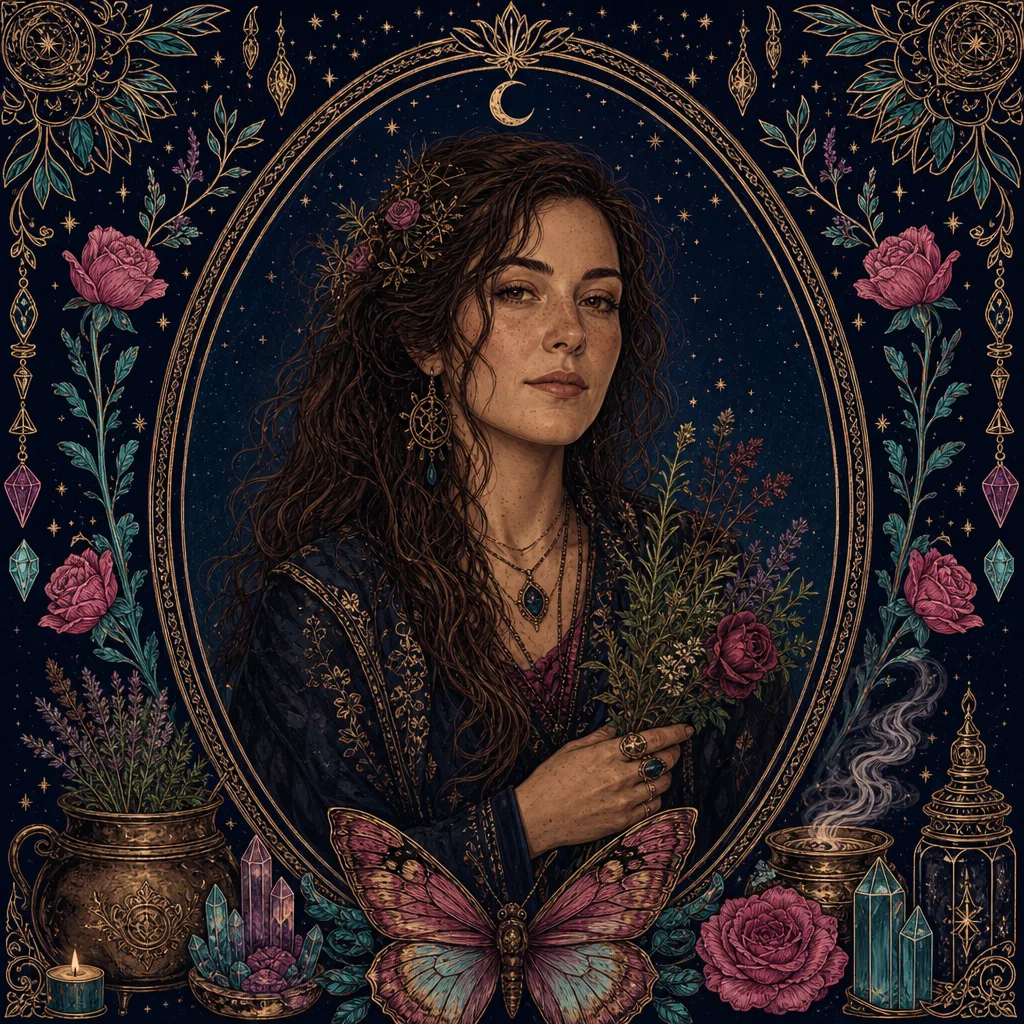
Witches & Their Paths
Hereditary Witch
Also called Traditional Family Witch, Family Witch
A hereditary witch is a practitioner who has received magical knowledge, practices, and sometimes spiritual callings through direct family lineage across one or more generations.
- Tradition
- Family-transmitted folk magic traditions across many cultures
- Standing
- Open
A profile of the Hereditary Witch
A practitioner who carries living knowledge in their hands, passed through family as naturally as a surname or a cooking method, and who takes the weight of that inheritance seriously.
- Loves
- a family grimoire with multiple hands in it, old recipes that are clearly also spells, regional plant knowledge specific to one county, the particular prayers the family used, ancestor portraits with a knowing look.
- Hobbies and pastimes
- interviewing elderly relatives about what they remember, researching regional folk traditions, maintaining ancestral grave sites, reconstructing broken transmission chains.
- Dream familiar
- A grandmother's cat, long dead, who still sits at the foot of the bed when ancestral work is underway and who smells faintly of the herbs that were always drying in that kitchen.
- Found in their element
- Found at the kitchen table with old letters and a cup of tea, working out what the previous generation knew and trying to fill in what time has taken.
- Signature objects
- a ritual tool inherited from a grandparent, a hand-sewn charm bag that predates living memory, a family Bible with marginalia that is clearly magical, seeds saved from the ancestral garden, a protective object hung in the same doorway for generations.
A hereditary witch is a practitioner whose knowledge of magic has been passed down through family lineage, received from parents, grandparents, or more distant ancestors who practiced folk magic, witchcraft, or related traditions. The defining feature of the hereditary witch is not the category of magic they practice but the route by which that magic reached them: through blood and family, through the kitchen table and the bedside teaching, through a grimoire tucked in a drawer or a recipe spoken aloud while herbs were dried.
The transmission may be explicit, a grandparent who sat down and deliberately taught the craft, or it may be implicit, a household in which certain plants were always used for certain purposes, in which the phases of the moon were noted, in which prayers to ancestors were spoken at meals. Both count. The hereditary witch is the one who recognises this inheritance and chooses to carry it forward.
The work
The practices of a hereditary witch are not defined by the label but by whatever tradition flows through their particular family. A hereditary witch from an Irish rural background might work with fairy mound lore, holy well offerings, and the specifics of Brigid”s day customs as practiced in their county. One from southern Italy might carry the tradition of malocchio cures, specific prayers to particular saints, and horn-and-cord protective work. One whose family came from eastern European Jewish communities might work with folk medicine and protective inscription practices rooted in that specific culture.
This specificity is one of the hereditary path”s greatest gifts. Where an eclectic practitioner builds a practice from many sources, the hereditary witch has a coherent, place-rooted tradition that has been tested and refined across generations and adapted to the actual conditions of a particular family and landscape. The formulas work not just because they are magically sound but because they have been verified by generations of use in the same context.
Maintaining a family grimoire is important to many hereditary witches, continuing a written record that may already span generations. Ancestral communication is often central, since the magical knowledge and the ancestors who carried it are not always clearly separated in family folk traditions. Offerings to family dead, consultation of ancestors before major workings, and tending of family graves are common elements.
History and tradition
The idea that magical knowledge runs in family lines is documented in the historical record across many cultures. In Scotland, the second sight was widely held to run in families, passing from parent to child in ways that felt more like inheritance than choice. In the cunning-folk tradition of England, practitioners often identified family members who also had the gift, and court records from witch trials sometimes show clusters of accused within family groups, reflecting both the social nature of accusation and the real transmission of folk practice through families.
In southern Europe, the practitioners of folk healing and magical protection, the strega of Italy, the bruja or bruxo of the Iberian peninsula, often worked within family lines where knowledge was kept close and passed carefully. The specificity of regional practice in these traditions, the particular prayers, the exact materials, the timing tied to local saints” days, reflects transmission through families embedded in specific places over long periods.
The romanticisation of hereditary witchcraft in modern neopagan culture has sometimes led to exaggerated or fabricated lineage claims. Historians of witchcraft such as Ronald Hutton have documented extensively that many claims of ancient family traditions do not hold up to scrutiny. This does not mean genuine family transmission is rare; it means it is worth approaching honestly, valuing what is actually there rather than inflating it.
Walking this path
The hereditary witch”s primary work is recovery and continuation. This begins with asking questions of living family members, seeking out whatever has survived in memory, in objects, in custom, and in the stories told about what earlier generations believed and did. Family elders who dismiss their practices as “just superstition” or “old-fashioned” are often describing a genuine magical tradition that has been demoted under cultural pressure.
Historical and regional research enriches this recovery work. Learning the specific folk traditions of the region and community from which one”s family came, the particular plant knowledge, protective customs, religious folk practices, and spirit lore of that place, provides a framework into which surviving family fragments can be placed and understood.
Where the chain of transmission has been broken, some practitioners choose to blend their recovered family tradition with broader study, filling gaps with related traditions or with eclectic practice while maintaining their family thread as the primary orientation. This is honest and legitimate work, especially given the disruptions to folk tradition caused by migration, urbanisation, religious suppression, and cultural assimilation across the last several centuries.
In myth and popular culture
The idea that magical power and knowledge run through bloodlines is one of the most persistent motifs in world mythology and folk tradition. In Norse mythology, the volva, the seeress who can prophesy and work seid magic, appears in sagas as a figure whose gift is sometimes described as inherited, and the Eddic poem Voluspa presents a speaker who commands the accumulated knowledge of all ages, a figure whose authority is rooted in lineage as much as in individual ability. The Irish mythology of the Tuatha De Danann similarly presents magical and divine lineage as a source of specific inherited capacities.
In Scottish folklore, the second sight was widely documented as running in family lines by folklorists and travellers from the seventeenth century onward. Martin Martin”s A Description of the Western Islands of Scotland (1703) recorded extensive accounts of second-sight inheritance, noting the frequency with which the gift appeared across generations of the same family. The Reverend Robert Kirk”s The Secret Commonwealth of Elves, Fauns and Fairies (1691) similarly treats the faculty as something some families simply have, without treating this as remarkable in itself.
In literature, the hereditary witch appears as a figure of both authority and burden in Nathaniel Hawthorne”s The House of the Seven Gables (1851), whose central family carries an inherited curse and an inherited capacity for second sight, though the novel frames these through a Protestant moral lens that complicates any straightforward reading. In popular fiction, the multigenerational witchcraft family is a staple of the genre, from the Owens women of Alice Hoffman”s Practical Magic (1995) and its sequels, whose specific family spells and prohibitions have passed down through generations, to the fictional Halliwell family of the television series Charmed (The WB, 1998-2006), whose Power of Three depends explicitly on genetic inheritance. The television series Salem (WGN America, 2014-2017), though heavily fictionalised, uses the idea of hereditary magical lineage in colonial New England as its central premise. What distinguishes the best literary treatments of the hereditary witch is the attention given to the weight of inheritance rather than its glamour: the sense that carrying a family tradition forward is work, not a birthright that arrives complete.
People also ask
Questions
What is passed down to a hereditary witch?
What passes through family lines varies enormously. It may include specific spell formulas and recipes, knowledge of local plants and their uses, a family grimoire, a particular relationship with ancestral spirits or a family-line deity, ritual tools, or simply a worldview in which magic is treated as real and normal. Not all of these elements need to be present for a lineage to be genuine.
Do you have to be born into a witchcraft family to be a hereditary witch?
By definition, yes: hereditary witchcraft refers specifically to knowledge received through family. However, many people discover family magical traditions in adulthood, finding that grandparents or great-grandparents practiced folk magic that was not named as such. Recognising and continuing that thread is a valid form of hereditary practice even when the transmission was indirect.
What if the family tradition was mostly lost?
Partial transmission is common, since folk magic has been suppressed, migrated, or simply forgotten across many family lines. A practitioner working to recover and reconstruct their ancestral magical tradition, supplementing memory and surviving fragments with historical research, is doing something real and meaningful even if the chain of direct teaching was broken.
Are hereditary witches automatically more powerful or legitimate?
No. The claim to hereditary lineage does not confer automatic authority, power, or spiritual status, and the witchcraft community has seen considerable romanticisation and fabrication of family witch lines. The quality of practice and the depth of relationship with one's tradition matter more than any lineage claim.
Can someone without a witchcraft family become as skilled as a hereditary witch?
Absolutely. Skill, dedication, and genuine relationship with the spirit world and with magical practice are built through work over time, regardless of origin. Many accomplished practitioners began with no family tradition whatsoever. Hereditary transmission is one valid way into practice, not the only valid way.