Scholars & Mystics
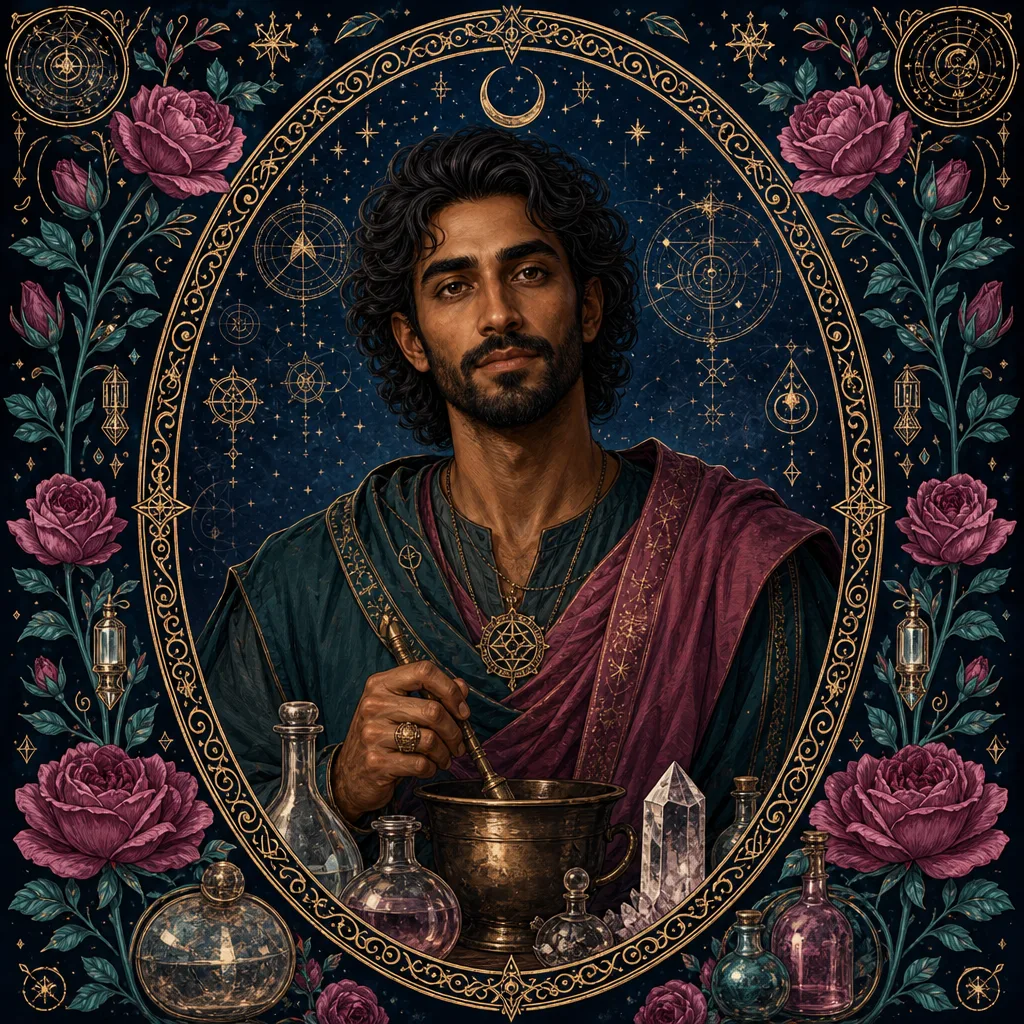
Hermetic Philosopher
Also called Hermeticist, philosopher of Hermes
A Hermetic philosopher is a practitioner and student of Hermeticism, the philosophical and spiritual tradition attributed to Hermes Trismegistus (Thrice-Great Hermes) and transmitted through a body of texts that present a vision of the cosmos as a living, ensouled whole in which the human mind participates in divine consciousness. The tradition encompasses cosmology, philosophy, magic, alchemy, and mystical practice.
- Tradition
- Hellenistic Egyptian, 2nd to 3rd century CE; revived in Renaissance Florence and again in the 19th-20th century esoteric revival; living tradition today
- Standing
- Open
A profile of the Hermetic Philosopher
A scholar-mystic who reads the cosmos as a living text written in correspondences and light, and who is entirely serious about the idea that the mind that studies the universe is made of the same substance as the universe it studies.
- Loves
- annotated Renaissance editions of Ficino, a well-calibrated astrolabe, the Emerald Tablet in every translation, late Neoplatonism and its mystical turn, alchemical emblems decoded over months.
- Hobbies and pastimes
- laboratory alchemy and spagyrics, astrological chart analysis as spiritual practice, studying the Greek Magical Papyri, Kabbalah in its relationship to Hermetic cosmology.
- Dream familiar
- An ibis who has read everything attributed to Thoth and who will sit motionless for hours while the philosopher works, then offer a single correction in flawless Greek.
- Found in their element
- Found at a desk layered with open books and manuscripts at an hour most people would call unreasonable, working out the correspondence between a planetary sigil, an alchemical operation, and a passage from Plotinus.
- Signature objects
- the Corpus Hermeticum, heavily glossed, a retort or alembic for laboratory work, a celestial globe or orrery, parchment copies of planetary seals, a philosophical notebook spanning decades.
A Hermetic philosopher is a practitioner and student of Hermeticism, the ancient philosophical and spiritual tradition attributed to Hermes Trismegistus, the legendary synthesis of the Greek god Hermes and the Egyptian god Thoth. The tradition presents a vision of the cosmos as a living, intelligible whole animated by divine mind, and it offers the human soul a path of ascent through knowledge, practice, and contemplation back to its divine source. Hermetic philosophy encompasses cosmology, theology, practical magic, alchemy, and a distinctive form of mystical philosophy, and it has been one of the most generative streams in the Western intellectual and spiritual tradition for more than two thousand years.
The core of the Hermetic vision is the principle that mind underlies and pervades all reality. The universe is not a mechanical system but a divine thought, and the human mind, precisely because it participates in the same divine intelligence that created the cosmos, can know that cosmos from within. This principle, summarised in the phrase “as above, so below,” means that every level of reality reflects every other, and that the movement of the heavens, the operation of forces in the natural world, and the inner workings of the human soul are all expressions of the same divine order that a trained mind can read.
The work
The Hermetic philosopher’s work combines rigorous study with contemplative practice and, for many, practical application in alchemy, astrology, and ceremonial magic. Study of the primary texts, the Corpus Hermeticum, the Asclepius, and the Emerald Tablet, is foundational. These texts are relatively short but inexhaustibly deep, and most serious students read them repeatedly over the course of years, finding new dimensions each time as their understanding matures.
Contemplation of the cosmological vision in the Hermetic texts is itself a practice: sitting with the description of how mind generates intellect, which generates soul, which generates matter, and allowing this not just to be understood intellectually but to be felt as a description of one’s own moment-by-moment existence. The Hermetic path of gnosis, direct experiential knowledge of the divine ground, requires this contemplative dimension alongside the intellectual.
Many Hermetic philosophers practice alchemy as the art that enacts Hermetic cosmological principles in material form. The operations of the laboratory are understood as working with the same divine forces that the cosmological texts describe, and the transformation of matter is inseparable from the transformation of the practitioner. Astrology is similarly integrated: reading the celestial correspondences is another way of reading the divine mind that is expressed simultaneously above and below.
The Hermetic tradition also encompasses a body of practical magic documented in texts such as the Greek Magical Papyri, which overlap with the philosophical tradition and show its practitioners working with specific rituals, invocations, and sympathetic operations to engage with the divine powers whose principles the philosophy describes.
History and tradition
The Hermetic Corpus was composed in Greek in Hellenistic Egypt, probably between the 1st and 3rd centuries CE, in an intellectual environment where Greek philosophy, Egyptian religion, Jewish mysticism, and early Christianity all intersected productively. The texts were likely composed within loosely associated circles of practitioners who drew on all these currents in developing a path of mystical ascent through knowledge.
The tradition was partially lost in the West after late antiquity but preserved in Byzantine manuscripts. In 1463 a manuscript of the Corpus Hermeticum reached Cosimo de’ Medici in Florence, and Marsilio Ficino was commissioned to translate it immediately, completing it before his translation of Plato. Renaissance scholars believed these texts to be immensely ancient, the work of a pre-Mosaic prophet, and this belief gave Hermetic philosophy enormous prestige. Giovanni Pico della Mirandola, Giordano Bruno, and Heinrich Cornelius Agrippa all worked substantially within the Hermetic framework.
Isaac Casaubon’s demonstration in 1614 that the Hermetic texts were composed in late antiquity rather than being pre-Mosaic undermined their historical authority but did not end their influence, which continued through Rosicrucianism, Freemasonry, and into the 19th and 20th-century occult revival. The Hermetic Order of the Golden Dawn placed Hermetic philosophy at the centre of its synthesis, and figures including Aleister Crowley, Dion Fortune, and later practitioners have continued to work with and extend the tradition.
Walking this path
Beginning students are well served by Clement Salaman et al.’s translation and commentary on “The Way of Hermes,” which presents the core Hermetic texts accessibly. Brian Copenhaver’s scholarly translation of the “Corpus Hermeticum” provides the standard critical edition in English. Gary Lachman’s “The Quest for Hermes Trismegistus” offers historical context. The “Emerald Tablet” in the version collected and commented on by Dennis William Hauck provides an entry into the alchemical dimension.
Studying Neoplatonic philosophy alongside the Hermetic texts deepens understanding considerably, because the two traditions share so much intellectual vocabulary and spiritual aspiration. Plotinus’s “Enneads” in particular illuminate the Hermetic vision of mind and the soul’s ascent with extraordinary precision.
The Hermetic philosopher”s path is one of integration: integrating study and practice, material and spiritual, intellectual understanding and lived experience. The tradition describes a way of knowing that transforms the knower, and this transformation, the ascent of the soul through increasing participation in divine mind, is the tradition”s true and lasting aim.
In myth and popular culture
Hermes Trismegistus, the tradition”s legendary founding figure, is himself a mythological synthesis: the product of the Hellenistic habit of identifying the Greek Hermes with the Egyptian Thoth, two deities who shared the domain of writing, knowledge, and the passage of souls between worlds. Both were gods of communication at the boundary of life and death, and the synthesis into Trismegistus produced a figure who embodied the union of Greek philosophical method with Egyptian magical and priestly knowledge. The name appears in texts from at least the second century CE, and the figure attracted an entire literature of dialogues, hymns, and technical treatises across late antiquity.
In the Renaissance, Hermetic philosophy became inseparable from the intellectual ambitions of the Florentine Academy under Marsilio Ficino, and its influence spread through the most creative minds of the period. Giovanni Pico della Mirandola”s Oration on the Dignity of Man (1486), often called the manifesto of Renaissance humanism, is as much a Hermetic as a humanist text in its vision of the human being as occupying a unique position in the cosmic hierarchy, capable of ascending or descending through the levels of being by choice and cultivation. Giordano Bruno, whose philosophical writings drew heavily on Hermetic cosmology, was burned by the Inquisition in 1600 partly for positions derived from his reading of the tradition; his identification of the cosmos as infinite and animated by divine mind follows directly from the Hermetic texts.
In literature and fiction, the Hermetic philosopher appears most recognisably in figures who combine scholarly obsession with genuine mystical aspiration. Umberto Eco”s Foucault”s Pendulum (1988) is the most sustained literary treatment of Hermeticism in contemporary fiction, tracing the tradition from its ancient origins through its Renaissance flowering and into modern esoteric culture with a mixture of genuine erudition and comic satire, though the novel is as much a critique of conspiracy-minded Hermeticism as it is a celebration of the tradition. Patrick Harpur”s novel Mercurius (1990) and his non-fiction work Daimonic Reality (1994) treat the Hermetic vision of an ensouled cosmos with more straightforward sympathy. In games, the White Wolf roleplaying game Mage: The Ascension (1993) includes the Order of Hermes as one of its central magical factions, and while the game”s version of Hermeticism is filtered through twentieth-century occultism, it introduced the tradition”s core vocabulary, including the principle of correspondence and the concept of the magician as one who imposes their will on reality through understanding its underlying laws, to a generation of players who subsequently sought out the primary sources.
People also ask
Questions
What is the Hermetic Corpus?
The Hermetic Corpus is a collection of Greek and Latin texts attributed to Hermes Trismegistus, most composed in Egypt between the 1st and 3rd centuries CE. The most important is the Corpus Hermeticum, a series of dialogues between Hermes and divine figures that presents Hermetic cosmology, theology, and the path of the soul's return to God. The Asclepius, also attributed to Hermes, was preserved in Latin translation throughout the Middle Ages.
What does "as above, so below" mean?
This phrase condenses the first principle of the Emerald Tablet, one of the most important short texts of the Hermetic tradition. It states that what occurs on higher planes of reality is reflected on lower planes, and vice versa. This principle of correspondence underlies virtually all of Western esoteric practice, from astrology (celestial patterns reflected in earthly events) to alchemy (the macrocosm reflected in the microcosm of the alchemist's vessel).
Who was Hermes Trismegistus?
Hermes Trismegistus (Thrice-Great Hermes) is a legendary figure combining the Greek god Hermes with the Egyptian god Thoth, both associated with wisdom, writing, and the transmission of divine knowledge. Renaissance scholars believed him to be an ancient Egyptian prophet who lived before Moses; modern scholarship dates the Hermetic texts to the 1st to 3rd centuries CE. The figure is understood as a divine teacher rather than a historical individual.
What are the Seven Hermetic Principles?
The Seven Hermetic Principles were popularised by the pseudonymous "Three Initiates" in "The Kybalion" (1908): Mentalism (all is mind), Correspondence (as above so below), Vibration (everything moves), Polarity (opposites are the same in kind), Rhythm (everything flows), Cause and Effect (nothing happens by chance), and Gender (gender is in everything). The Kybalion is a modern synthesis inspired by but not literally from the ancient Hermetic texts.
How does Hermeticism relate to Christianity and other religions?
Renaissance Hermeticists understood Hermes Trismegistus as a pagan prophet of Christian truth, and Hermetic philosophy was considered compatible with Christianity by many of its practitioners. The tradition has also been seen as compatible with Neoplatonism, Gnosticism, Kabbalah, and other mystical traditions. Hermetic philosophy is broadly theistic but not confessionally committed to any specific religion.