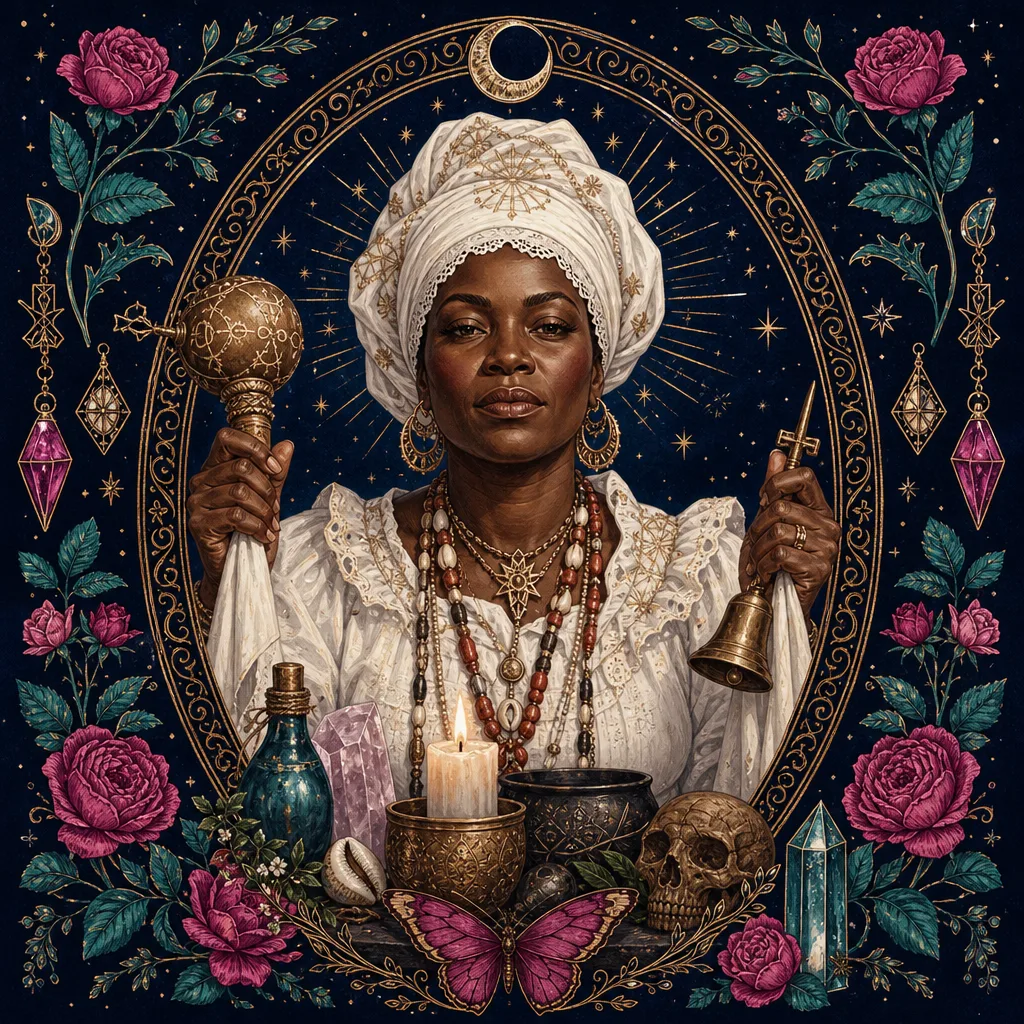
Spirit Workers
Houngan / Mambo
Also called houngan, mambo, prèt savann
A houngan (male) or mambo (female) is an initiated priest or priestess of Haitian Vodou, the living Afro-Caribbean religion of the Haitian people. The houngan and mambo serve their communities as spiritual leaders, healers, diviners, and intermediaries with the lwa -- the spiritual beings of Vodou. This is a closed, initiatory role entered only through the living Vodou lineage.
- Tradition
- Haitian Vodou; a living Afro-Caribbean religion of the Haitian people
- Standing
- Closed
A profile of the Houngan / Mambo
An initiated priest or priestess at the living centre of their community, who heals, divines, and holds the door open between the world of the living and the world of the lwa.
- Loves
- a well-tended peristyle altar, the drumming that calls the lwa to ceremony, veve drawings made with precision and love, Haitian Kreyol sung in ceremony, the sacred asson rattle.
- Hobbies and pastimes
- preparing ritual foods for specific lwa, teaching ounsi in the traditions of the hounfo, reading with cowrie shells or cards, maintaining the sacred objects of the peristyle.
- Dream familiar
- A great python, the serpent of Danbala, who coils around the white tree in stillness and carries the wisdom of deep water and ancient sky without ever needing to speak.
- Found in their element
- You would find the houngan or mambo in the peristyle on the night of a fete, moving between the altar and the community of dancers, watching everything, attending to the moment when a lwa arrives and the work of the evening truly begins.
- Signature objects
- the asson beaded rattle of asogwe initiation, veve patterns traced in cornmeal, bottles of kleren rum for libation, sequined flags representing the lwa, a machete for Ogou on his altar, ritual white clothing for kanzo ceremony.
A houngan (male priest) or mambo (female priest) is an initiated servant of the lwa and a leader of their Vodou community within Haitian Vodou — a living Afro-Caribbean religion of the Haitian people. The houngan and mambo stand at the centre of their hounfo (temple community), serving as healers, diviners, ritual leaders, and intermediaries between the living and the lwa who sustain and guide community life. This is among the most significant spiritual roles in one of the world”s most remarkable religions, and it is entered only through genuine initiation within a living Vodou lineage.
This is a closed role. Not closed in the sense of being inaccessible to all outsiders — Vodou has historically been open to those whom the lwa call, regardless of ancestry — but closed in the sense that the title and authority cannot be self-granted, purchased remotely, or claimed outside of genuine kanzo initiation within an established Haitian Vodou lineage. The difference between a houngan or mambo and someone who calls themselves one without that initiation is not a matter of cultural preference but of fundamental spiritual reality within the tradition.
The work
The houngan”s and mambo”s work is the work of priestly community service. They lead ceremonies (fetes) in which the lwa are honoured, fed, and given the opportunity to manifest through the bodies of initiated serviteurs (servants of the lwa) in possession. They diagnose and treat illness, both physical and spiritual, drawing on knowledge of the lwa”s domains and of the ritual procedures appropriate to each condition. They divine — using a variety of methods including reading with cards, shells, or fire — to guide members of their community through challenges and decisions. They manage the sacred objects and relationships that protect their community.
Healing in Vodou does not separate spiritual and physical illness in the way that Western biomedicine does. The houngan or mambo assesses the whole person and their situation: their relationships with the lwa, whether any lwa is speaking through their illness, whether an enemy”s work is involved, what the person owes or has neglected. Treatment follows from accurate diagnosis and may involve ceremony, baths, herbal preparations, offerings to specific lwa, and the resolution of whatever spiritual imbalance underlies the physical manifestation.
Managing the hounfo is a substantial practical responsibility. The houngan or mambo oversees the physical space, the community of initiates (ounsi) who assist in ceremonies, the maintenance of the altars (peristyle) dedicated to each lwa, the finances of the temple, and the care of all the sacred objects that the tradition requires. They also perform the initiations that bring new members into the community and elevate initiates to higher levels.
The lwa themselves direct much of this work. The houngan or mambo”s relationships with the specific lwa who chose them at initiation — and who have accompanied them through their spiritual development — are the foundation from which all priestly work flows. These are active, demanding, personal relationships, maintained through regular offering, ceremony, and the fulfilment of specific obligations the lwa have asked for.
History and tradition
Haitian Vodou emerged from one of history”s most devastating intersections of peoples and powers. The enslaved people brought to Saint-Domingue (present-day Haiti) from West and Central Africa came from many different cultures — Fon, Ewe, Yoruba, Kongo, Mande, and others — each with their own spiritual traditions. Under the conditions of the plantation system, these traditions were suppressed, distorted, and driven underground, while simultaneously being maintained, synthesised, and adapted by people who refused to let them die.
The result was not a museum of any single African tradition but something new: Vodou, a religion that carried forward the essential spiritual technologies and relationships of West African religion while transforming them through the specific historical experience of Haiti. The lwa themselves, in Vodou understanding, came with the people from Africa and adapted to their new situation alongside the community that served them.
The Haitian Revolution of 1791-1804, the only successful slave rebellion in history to produce an independent state, was deeply entwined with Vodou. The founding ceremony at Bois Caiman in 1791, where the revolutionary pact was made, is understood within Vodou as a moment of direct divine intervention. Haitian independence carried Vodou forward as the spiritual inheritance of a free people.
Since independence, Vodou has survived French Catholic missionary pressure, American occupation and anti-Vodou campaigns (1915-1934), Duvalier-era manipulation, and continuing mischaracterisation by outsiders ranging from colonial observers to horror filmmakers. Through all of this, it has remained a living, practising religion of the Haitian people both in Haiti and in diaspora communities worldwide.
Walking this path
The houngan and mambo roles are not walked by declaration or study alone. They are entered through kanzo initiation within a genuine Haitian Vodou lineage, conducted in the context of a real hounfo with established relationships to the lwa and to the broader Vodou community. The initiation involves specific ritual procedures — particular ceremonies, periods of seclusion, the reception of the lwa through specific ritual means — that cannot be replicated outside their proper context.
Non-Haitians who feel genuinely called by the lwa do exist within the Vodou tradition. The lwa themselves are understood as choosing their devotees without regard to ethnicity or nationality. But the calling must be discerned carefully, and genuine initiation — not a purchased certificate or a remote ceremony — requires real commitment: travel to Haiti or to a legitimate Haitian hounfo, significant time, genuine engagement with the language and community, real financial sacrifice, and the long-term maintenance of the relationships and obligations that initiation creates.
What is not available is the title without the initiation, the authority without the community, or the priesthood without the lwa”s actual reception. The Haitian Vodou community — both in Haiti and in diaspora — has the capacity and the right to evaluate claims of initiation, and fraud within this tradition is visible to those who know the tradition from inside.
If you feel drawn to Vodou and are not Haitian, the appropriate path begins with honestly encountering the tradition on its own terms: reading Haiti”s history and the history of Vodou within it, engaging with Haitian scholars and practitioners” own accounts (not outsiders” interpretations), and if the calling persists and deepens, seeking out a legitimate hounfo with a verifiable lineage. Respect begins with recognising that this religion belongs to a people, and that your relationship with it is a guest”s relationship, not an owner”s.
In myth and popular culture
The representation of Haitian Vodou in Western popular culture is a long and largely unfortunate history of distortion. Hollywood cinema from the 1930s onward seized on the sensational possibilities of zombie mythology, producing films such as White Zombie (1932) and I Walked with a Zombie (1943) that stripped Vodou of its religious content and presented it primarily as a vehicle for horror and racial anxiety. These films bear little resemblance to actual Vodou practice and were made without meaningful Haitian input. The damage to Vodou’s public image from this genre has been substantial and long-lasting, and it is worth naming clearly: the cinematic “voodoo” of Hollywood is a separate invention that uses borrowed terminology to stigmatize a genuine religion.
The scholarly corrective to this distortion began in the mid-twentieth century with the work of researchers who actually engaged with Vodou on its own terms. Alfred Metraux’s Voodoo in Haiti (1959) was among the first serious academic studies of Vodou in English, and while its perspective reflects its era, it attempted genuine documentation of practice and belief. More recently, Karen McCarthy Brown’s Mama Lola: A Vodou Priestess in Brooklyn (1991) offered an intimate and respectful portrait of a real Haitian mambo working in the diaspora community, and it remains one of the most important books on living Vodou in English. Claudine Michel and Patrick Bellegarde-Smith’s edited volume Vodou in Haitian Life and Culture (2006) provides a range of Haitian scholarly perspectives on the religion.
In literature the Haitian-American writer Edwidge Danticat has consistently engaged with Vodou’s place in Haitian culture and history in ways that honour its complexity. Her novel The Farming of Bones (1998) and her story collections treat Vodou as part of the fabric of Haitian life rather than as exotic spectacle. Zora Neale Hurston, the American anthropologist and novelist, conducted fieldwork in Haiti in the 1930s and documented what she observed in Tell My Horse (1938), a book that combines journalism, folklore documentation, and personal memoir and presents the houngan and mambo as the community figures they are, without the sensationalizing frame of the horror genre.
In music the relationship between the lwa and Haitian popular culture is continuous and living. Haitian compas and roots music frequently invoke specific lwa and encode Vodou cosmology in lyrics that Haitian audiences understand intimately. The international success of Boukman Eksperyans, a Haitian roots band whose music draws explicitly on Vodou ceremonial music and political liberation theology, brought this dimension of Haitian culture to audiences outside Haiti in the late 1980s and early 1990s, during the period of political upheaval following the fall of Jean-Claude Duvalier.
People also ask
Questions
What is Haitian Vodou?
Haitian Vodou is a living religion of the Haitian people, rooted in the spiritual traditions of West and Central African peoples -- particularly the Fon and Ewe of Dahomey (present-day Benin) -- brought to Haiti through the transatlantic slave trade and transformed through the specific historical experience of Haitian people, including the Haitian Revolution of 1791-1804. Vodou is a full religious system with its own theology, ethics, community structures, liturgy, and cosmology, not a system of magic or superstition as it is often mischaracterised in outsider accounts.
What are the lwa?
The lwa (also spelled loa) are the spiritual beings of Haitian Vodou -- not gods in the Western sense, not angels, not demons, but a category of powerful spiritual beings with their own personalities, domains, preferred colours, foods, days, and ways of relating to humans. The lwa include figures like Erzulie Freda (love, luxury, beauty), Ogou (iron, warriors, justice), Baron Samedi (death, the cemetery, the grave), Maman Brigitte (death, cemeteries), and many others. They are served by the community and serve the community in return, providing healing, guidance, and protection.
What does initiation involve in Haitian Vodou?
Initiation into the houngan or mambo role (kanzo initiation) is a serious, multi-stage process conducted within a specific Vodou lineage and hounfo (temple community). It involves extended periods of seclusion, ritual procedures, the establishment of specific relationships with the lwa, and the receiving of the asson -- a sacred rattle that is the symbol of Vodou priesthood -- in the case of asogwe (senior) initiation. The specific content of initiation is sacred to the tradition and not shared publicly. Initiation cannot be purchased at a distance, conferred online, or acquired outside a genuine Vodou lineage.
Why is houngan or mambo a closed role?
The houngan and mambo roles are closed because they are priestly roles within a living religion that belongs to a specific people with a specific history. Vodou was created and maintained by Haitian people, mostly under conditions of enslavement and colonial oppression, and it remains the spiritual inheritance of that community. The priesthood is entered through initiation within a living lineage: the spiritual relationships, the lwa who choose specific initiates, and the community that recognises the priest cannot be replicated by self-declaration, online ceremony, or purchase. Non-Haitians who pursue genuine kanzo initiation within a legitimate hounfo may receive it -- Vodou has historically been open to those whom the lwa call -- but the initiation is real, costly, conducted in Haiti with established lineage holders, and not available as a cultural accessory.
What is the difference between asogwe and sur pwen?
Sur pwen and asogwe are two levels of Vodou initiation. Sur pwen is the first level, in which the initiate receives the lwa "on the point" -- establishing the foundational relationships with the spirits of the tradition. Asogwe is the higher initiation, in which the initiate receives the asson, the sacred beaded rattle that is the tool and symbol of senior Vodou priesthood, and gains the authority to initiate others. Both levels require genuine kanzo ceremony within a living lineage.
What are the signs of a fraudulent houngan or mambo?
Online initiations, remote initiations, initiations that take only a few hours, initiations sold at low cost, initiations that do not involve travel to Haiti or a genuine Haitian lineage, and self-claimed titles without verifiable lineage are all signs of fraud. Legitimate Vodou lineage holders can be verified: they have known communities, known teachers, and reputations within the Haitian and Haitian diaspora Vodou communities. The hounfor (temple) community is the context in which priesthood makes sense, and that context cannot be faked.