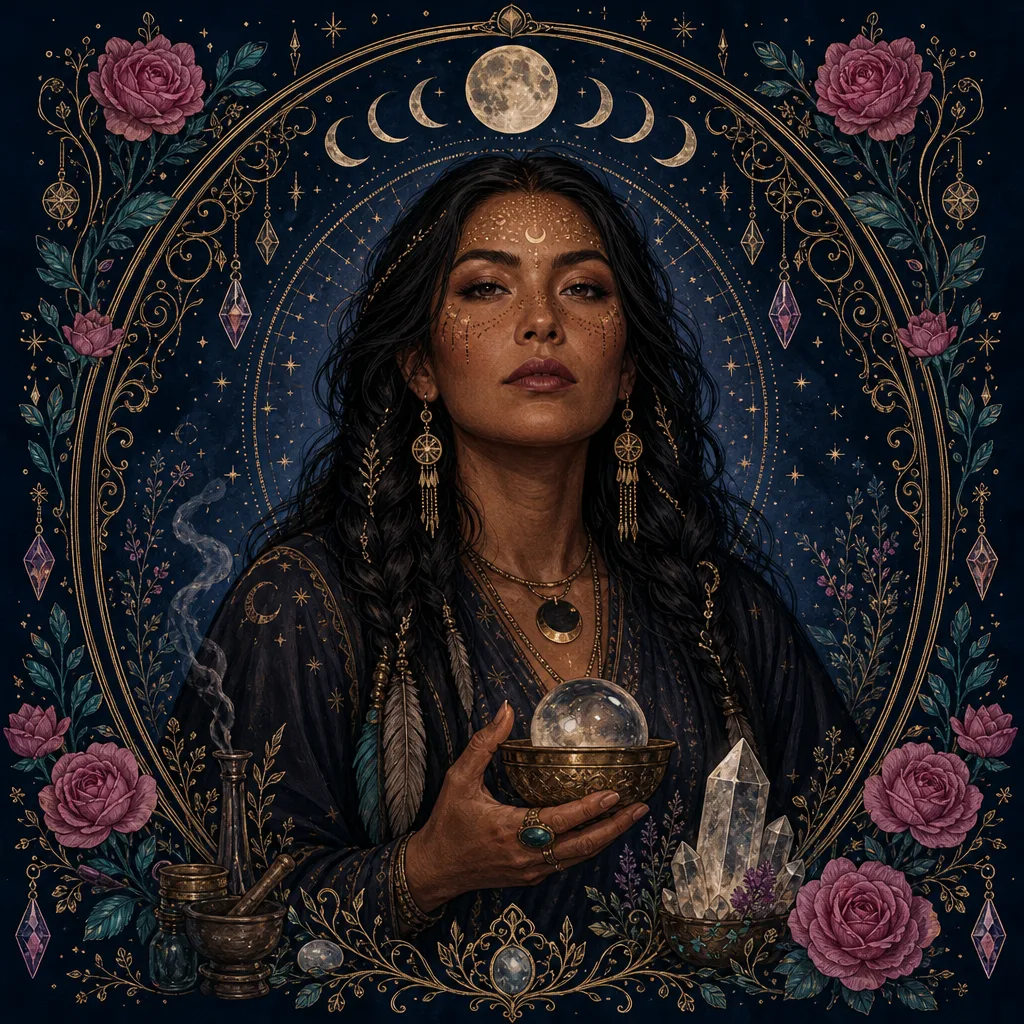
Witches & Their Paths
Lunar Witch
Also called Moon Witch, Moon Priestess
A lunar witch is a practitioner who centres their magic on the cycles of the moon, timing rituals and spellwork to lunar phases and working with the moon as a primary source of magical energy and spiritual guidance.
- Tradition
- Contemporary eclectic witchcraft, drawing on ancient lunar cult and folk moon-lore
- Standing
- Open
A profile of the Lunar Witch
A practitioner whose entire magical calendar is written in moonlight, who knows without looking up what phase the moon is in and what that means for the work tonight.
- Loves
- bowls of water set out under a full moon, the moment when the crescent first appears, moonrise over open water, silver and white stones, selenite on a windowsill.
- Hobbies and pastimes
- keeping a moon journal across full cycles, making moon water at each full moon, timing all spellwork to lunar phase, tracking the moon through the astrological signs.
- Dream familiar
- A large white hare who runs across the full moon's face without casting a shadow and always knows, precisely, what phase comes next.
- Found in their element
- You would find the lunar witch outside on a clear full moon night, shoes off in the grass if the season allows, ritual laid out simply around them, face turned upward to catch every bit of that light.
- Signature objects
- a silver bowl for moon water, a lunar phase wheel or calendar, white and silver candles, a moonstone pendant, selenite wands for cleansing, a full-moon ritual journal.
A lunar witch is a practitioner who organises their magical life around the phases of the moon, treating the lunar cycle as the primary calendar of magical work and the moon itself as the central source of energy and spiritual orientation. Every major working is timed to the relevant phase; the rhythm of new and full moon marks the practitioner”s months as definitively as any calendar; and the quality of light on any given night is an active variable in how the work is approached and what it aims to accomplish.
Like “cosmic witch,” the label “lunar witch” as a self-identifier is contemporary, spreading through online witchcraft communities in the 2010s. But moon magic itself is one of the oldest practices in the human record, attested in ancient Mesopotamia, Egypt, Greece, and Rome, and present in folk traditions worldwide. The lunar witch who works with the new moon to set intentions and the full moon to complete workings is standing in a tradition of genuinely enormous depth, even if the name is new.
The work
The monthly rhythm of the lunar cycle provides the structure for a lunar witch”s practice. The new moon is the beginning: a time to sit quietly with what is being called in, to write intentions with deliberate care, and to begin new projects, relationships, or personal changes. New moon workings are often simple, candles lit in the dark, intentions written and folded away, seeds planted in earth or in the mind.
As the moon waxes from new to full, the lunar witch builds on what was started. Workings done in the waxing phase carry an amplifying quality; they are good for growth, increase, strengthening, and developing. The waxing moon supports practical action taken in the direction of new moon intentions.
The full moon is the peak. Energy is at its highest; the moon”s light is available all night; major workings are performed with full ceremony. Many lunar witches celebrate the full moon with a formal ritual, whether elaborate or simple, that marks the culmination of what the new moon set in motion. Making moon water is common: placing bowls or bottles of water under the open sky to receive the full moon”s charge.
The waning phase from full back to new is for releasing: letting go of what no longer serves, banishing harmful influences, completing what needs to end, and moving into the quieter interior space that the dark moon represents. The dark moon, the last few nights before the new moon when the moon is invisible, is time for shadow work, deep rest, communion with the dead or the unconscious, and preparation for the cycle”s renewal.
Beyond the monthly cycle, many lunar witches track the moon”s journey through the astrological signs, working with the specific quality of the moon in Aries versus the moon in Pisces. They also note eclipses, which are treated as intensified and often disruptive moon moments requiring careful attention.
History and tradition
The moon has been a focus of religious and magical attention since before written history. The moon goddesses of the ancient world, Selene and Hecate in Greece, Diana in Rome, Isis as lunar queen in Egypt, Sin in Mesopotamia, represent a continuous tradition of relating to the moon as a powerful being whose cycles govern life on earth. The agricultural world depended on understanding lunar timing for planting and harvesting; the medical world of antiquity tied many conditions to lunar phases; the magical world organised much of its work by them.
In European folk magic, moon timing was taken for granted in a way that appears constantly in the records: plant in the waxing moon, cut timber in the waning moon, cure warts at the dark of the moon, bleed patients in the full. This pervasive folk knowledge of lunar timing is the direct predecessor of what the contemporary lunar witch practices.
The specific practice of the monthly full moon circle as a religious and magical observance was formalised within Wicca as the esbat, distinct from the sabbat seasonal festivals. Wicca”s emphasis on the Triple Goddess, whose faces map to the moon”s three visible phases, placed lunar consciousness at the theological centre of modern witchcraft in a way that shaped almost all subsequent practice.
Walking this path
Beginning the lunar witch path is as simple as getting a lunar calendar and beginning to pay attention. Note how you feel at the new moon versus the full; observe whether the phases correlate with your energy, mood, and the quality of your workings. Most people who pursue this path discover relatively quickly that the correlation is real and instructive.
Starting with the monthly rhythm of new and full moon ritual, even if that ritual is twenty minutes of candle lighting and journaling, builds the practice sustainably. From there, adding waxing and waning workings, moon water making, and lunar-phase timing for spellwork deepens the practice without overwhelming it.
The lunar witch path is one of the most accessible entry points into witchcraft because the moon is always present and the calendar is self-evident. It combines naturally with cosmic witchcraft, devotional goddess practice, cottage witchcraft, and almost every other path in this collection.
In myth and popular culture
The moon goddess in her many forms is one of the most persistent figures in world mythology. In ancient Greece, Selene drove the silver chariot of the moon across the sky and was invoked in magical papyri as a powerful ally; Artemis, goddess of the hunt and the wilderness, was associated with the crescent moon and with transitions including birth and death; and Hecate, particularly in her later triple-formed representation, became the goddess most directly linked to magic, the crossroads, and the moon’s dark phase. These three figures were sometimes treated as aspects of a single lunar divinity, a triplication that Robert Graves formalized in The White Goddess (1948) and that Wicca absorbed as the Triple Goddess of Maiden, Mother, and Crone, making this mythological framework foundational for modern witchcraft.
In Roman religion Diana occupied the role corresponding to Artemis and Hecate combined, and her cult at Nemi, documented by James George Frazer in The Golden Bough (1890), became one of the central examples in anthropological literature of the connections between sacred kingship, fertility, and lunar religion. Frazer’s interpretation has been substantially revised by later scholarship, but his work made the connection between Diana, the moon, and the forest-dwelling wise woman indelible in the popular imagination, and it directly influenced the development of Wicca through Gerald Gardner’s reading of his ideas.
In literature the moon as a force shaping magical practice appears across traditions and centuries. Apuleius’s Metamorphoses (The Golden Ass, second century CE) contains an extended invocation of Isis as queen of the moon, describing the full moon as the moment when her power is most available and most responsive to supplication: the passage is a genuine piece of ancient moon magic embedded in a comic novel. Shakespeare’s A Midsummer Night’s Dream (1600) saturates its magical action in lunar imagery, and the moon’s fickleness is both a dramatic engine and a comment on the connection between feminine power, desire, and the perpetually changing sky. More recently, the moon as a site of feminine magical power has been central to the work of authors such as Alice Hoffman, whose novel Practical Magic (1995) and its prequel The Rules of Magic (2017) treat lunar timing and moon-sensitive plant work as ordinary features of a New England witching family’s life.
In music the association between the full moon and heightened magical sensitivity has been a persistent theme in folk traditions and in the popular music that descends from them. The tradition of gathering at the full moon for ceremony persists in contemporary Wiccan and broader pagan communities worldwide, and the social media calendar of the witchcraft community is visibly organized around lunar phases, with the new and full moon generating the highest volume of shared practice and ritual documentation.
People also ask
Questions
What are the main lunar phases and how does a lunar witch use each?
The new moon is used for new beginnings, setting intentions, and planting the seeds of what the practitioner wants to grow. The waxing moon builds energy toward the full, making this the time for growth and increase. The full moon is the peak of energy, used for major workings, celebration, and culmination. The waning moon is used for release, banishing, and letting go. The dark moon, the three nights before the new moon, is a time for deep introspection and work with shadow.
Does a lunar witch worship the moon?
Some do and some do not. Many lunar witches relate to the moon as a spiritual presence or deity, often identified with goddesses such as Selene, Hecate, Artemis, or Diana. Others work with the moon as a powerful natural cycle and energy source without attaching theological meaning to it. Both approaches are valid expressions of the path.
What is moon water and how is it used?
Moon water is water placed outdoors or on a windowsill to charge under the light of the full moon overnight. Lunar witches use it for cleansing objects and spaces, anointing tools, watering magical plants, adding to ritual baths, and as an ingredient in spells. Water charged at other lunar phases carries those phases' particular qualities.
Is the lunar witch label ancient or modern?
The practice of timing magic to lunar phases is ancient and cross-cultural, but the specific self-identifier "lunar witch" is a contemporary label that became common on social media and in online witchcraft communities from the 2010s onward. The underlying practice of moon magic is one of the oldest in the human record.
Do lunar witches also work with astrology?
Many do, particularly with the sign the moon occupies as it moves through the zodiac roughly every two and a half days. Tracking both the lunar phase and the moon's sign adds another layer of timing precision: a full moon in Scorpio has a different quality than a full moon in Taurus. Cosmic witchcraft expands this to include all planetary bodies; lunar witchcraft focuses primarily on the moon.