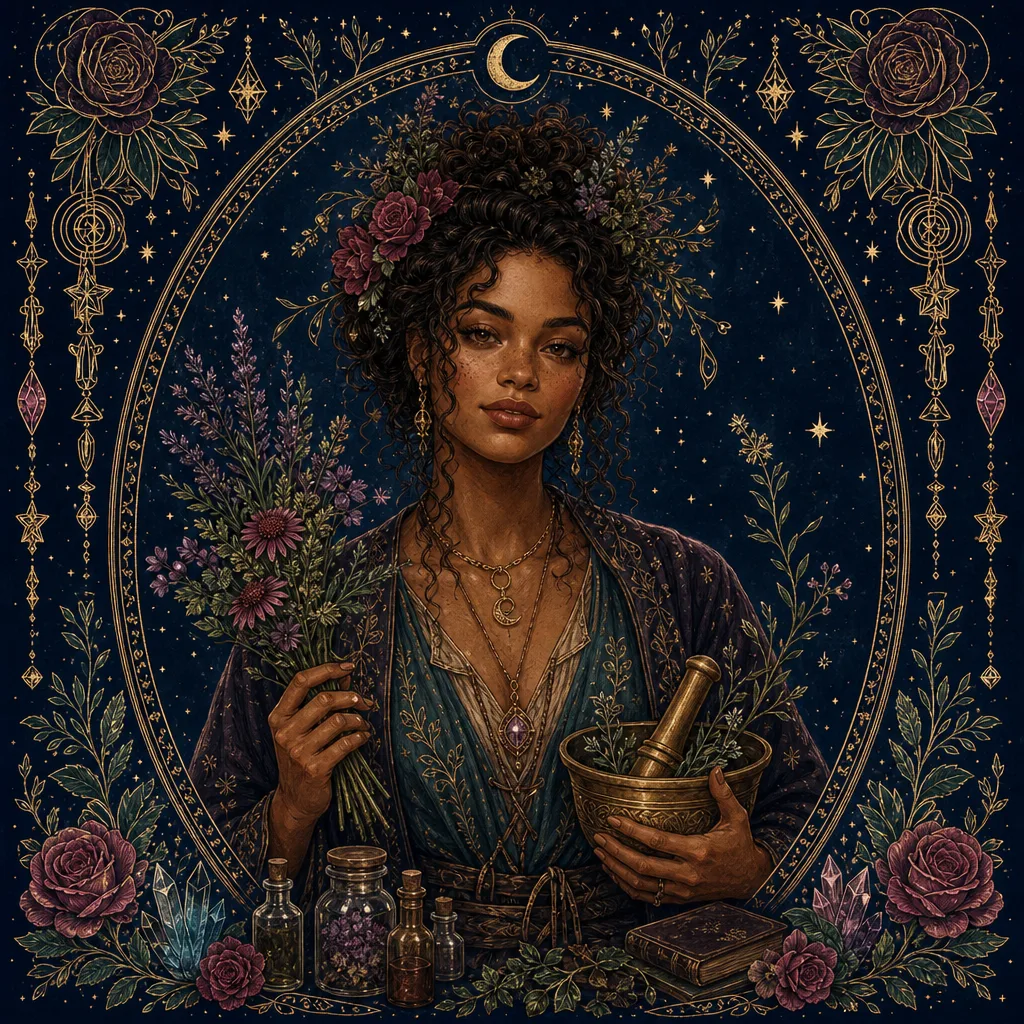
Healers & Wise Folk
Magickal Herbalist
Also called Herb Witch, Plant Magician, Green Witch
A magickal herbalist is a practitioner who works with plants not only for their physical medicinal properties but also for their spiritual qualities, correspondences, and inherent power. Plants are understood as living beings with their own wisdom and magical character, and the magickal herbalist cultivates direct relationship with them as allies, medicines, and ritual materials.
- Tradition
- Present in virtually all magical traditions worldwide; particularly associated with European cunning tradition, folk herbalism, and contemporary green witchcraft
- Standing
- Open
A profile of the Magickal Herbalist
A patient keeper of green allies who knows that plants are not passive ingredients but living beings with opinions, and that the best herb medicine begins with genuine relationship.
- Loves
- the first rosemary growth after winter, Culpeper's English Physician read next to a garden, a drying rack hung with mugwort and yarrow, the moment a tincture is ready to strain, wild-harvesting in the right season.
- Hobbies and pastimes
- wildcrafting excursions with field guides, making planetary-hour timed harvests, preparing spagyric tinctures, annotating herbals from personal experience, growing medicinal plants from seed.
- Dream familiar
- A green-eyed hare who moves through the hedgerow and knows the name and use of every plant it passes, and will stop and wait when the herbalist falls behind.
- Found in their element
- You would find the magickal herbalist in the garden at dawn during a waxing moon, basket in hand, talking quietly to the plants before cutting, and looking more awake than anyone has a right to be at that hour.
- Signature objects
- a worn copy of Culpeper's Complete Herbal, amber glass tincture bottles, a harvesting knife with a bone handle, dried herb bundles sorted by planet, a mortar of carved marble, a lunar phase planting calendar.
A magickal herbalist is a practitioner who works with plants as allies, medicines, and ritual materials, engaging with their physical properties alongside their spiritual qualities and magical correspondences as dimensions of a single integrated practice. Plants are not merely pharmaceutical resources in this understanding but living beings with their own character, wisdom, and power, and the magickal herbalist cultivates real relationship with them, learning their natures through direct observation and use, understanding their traditional folk and esoteric associations, and approaching them with the respect and reciprocity appropriate to a genuine relationship.
This approach to plants is ancient and nearly universal: the folk healers of Europe, the curanderas of the Americas, the herbalists of traditional Chinese and Ayurvedic medicine, and the shamanic plant-workers of countless traditions all share the understanding that plants offer something more than chemistry, and that the most effective work with plants requires attention to that something more. What contemporary magickal herbalism does is make this orientation explicit and central, rather than treating it as a superstitious overlay on practical plant knowledge.
The work
The magickal herbalist”s practice begins with learning the plants themselves. This means spending time with them in their growing conditions, observing how they move through the seasons, noticing their relationship to insects and birds and weather, paying attention to the qualities they present visually and in scent and touch before ever learning their botanical name or their traditional uses. This direct relationship is the foundation on which the rest of the practice rests, and it cannot be replaced by book learning, however thorough.
The traditional botanical knowledge of each plant, its folk names and the stories attached to them, its planetary correspondence, its elemental nature, its historical use in medicine, magic, and ritual, fills in the cultural and esoteric layer on top of direct experience. The great herbals, from Culpeper”s seventeenth-century English Physician Enlarged through Grieves”s Modern Herbal to the work of contemporary plant writers such as Matthew Wood and Rosemary Gladstar, provide this context for European and North American practice. The magickal herbalist reads these alongside, not instead of, the direct relationship with the plants.
Preparation is a practice in itself. The timing of harvest matters: lunar phase, planetary hour, seasonal moment, and time of day each affect what a plant is understood to offer and how to work with it most effectively. Gathering is done with attention and thanks, with awareness of the plant”s abundance and the practitioner”s genuine need, and without waste. Preparation, whether drying, infusing in oil or alcohol, decocting, or working fresh plant material, is accompanied by focused intention and appropriate words. The resulting preparations carry both the plant”s physical properties and the quality of the attention given to their making.
Ritual use of plants includes their employment as incenses, in sachets and bundles, as additions to ritual baths, as components of poppets and spells, and as offerings to deities and ancestors. The selection of the right plant for each ritual purpose draws on the correspondence systems of the tradition, understood not as arbitrary assignments but as accumulated wisdom about the plant”s actual qualities as experienced by practitioners over generations.
History and tradition
The integration of herbal knowledge and magical practice is documented from the earliest written sources. Egyptian magical papyri, Roman natural magic, the Anglo-Saxon leechbooks, and the herbal literature of medieval Europe all treat plants as possessing both physical and spiritual properties that are relevant to their use. The doctrine of signatures, developed in the Renaissance, proposed that a plant”s visible form gives clues to its use and nature, a doctrine continuous with the older understanding of plants as possessed of inherent meaning and relationship with the rest of creation.
The cunning women and wise men of early modern Europe were typically herbalists as well as charm workers and diviners, and the herbals of the period reflect this integration: Nicholas Culpeper”s enormously popular seventeenth-century herbal assigned every plant a planetary ruler and drew explicit connections between a plant”s astrological character and its medicinal properties, treating the two as inseparable aspects of the same knowledge.
The twentieth century saw a broad folk herbalism revival alongside the development of modern green witchcraft as an explicit path. Scott Cunningham”s Magical Herbalism (1982) and Encyclopedia of Magical Herbs (1985) made a comprehensive system of plant correspondences accessible to a generation of practitioners and remain widely referenced. Rosemary Gladstar”s clinical herbalism work and the broader integrative herbalism movement have developed alongside the magical tradition, with many practitioners working comfortably in both.
Walking this path
Most magickal herbalists begin with a few plants that feel compelling or familiar and deepen their relationship with those before widening their range. The temptation to learn hundreds of plants superficially before any real relationship has developed is a common early error; ten plants known deeply serve the practitioner far better than a hundred known only from their entries in a correspondence table.
Growing plants, or regularly spending time where they grow wild, accelerates the development of real knowledge more than anything else. A season of growing rose, rosemary, and lavender in a window box teaches more than a year of reading about them. Where growing is not possible, wildcrafting excursions and sustained observation of plants in whatever landscape is accessible provide similar grounding.
The magickal herbalist role sits naturally beside the folk healer, the wise woman or wise man, and the green witch. Many practitioners hold all these identities simultaneously and experience their practice as a unified whole rather than as several separate roles combined.
In myth and popular culture
The figure of the herb-worker whose botanical knowledge extends into the spiritual realm appears in mythology from the earliest written sources. Medea, in Greek myth, is the most fully realized ancient example: the granddaughter of Helios and a priestess of Hecate, she commands the plants of the earth with a directness and authority that later writers including Apollonius of Rhodes (Argonautica, third century BCE) and Ovid (Metamorphoses, first century CE) describe in considerable pharmacological detail. Her herb-gathering at night, by moonlight and with proper invocation, her knowledge of which plants have transformative power and how to compound them, and her role as the dangerous outsider whose botanical knowledge exceeds that of the communities she passes through, establish a template that the figure of the witch-herbalist has followed in the literary imagination ever since.
Hecate, Medea’s patron goddess, was herself associated with plant magic and particularly with the dangerous plants of the nightshade family, including aconite and belladonna, whose psychoactive properties were known in antiquity. The plants grew, in folk belief, from the drool of Cerberus as Heracles dragged the hound from the underworld, and Hecate’s gardens were said to cultivate them. This mythological association between the goddess of the crossroads and the pharmacologically powerful plants that grew where she presided gave the herb-witch her dangerous reputation in classical culture.
In early modern Europe the figure of the cunning woman with her herbal knowledge was simultaneously respected and feared, and this ambivalence surfaces in the literature of the period. Edmund Spenser’s The Faerie Queene (1590) includes a learned herb-woman, and the English herbalists of the period, including John Gerard (Herball, 1597) and Nicholas Culpeper (The English Physician Enlarged, 1653), worked in a cultural context where the boundary between medicine, magic, and folk practice was permeable and contested. Culpeper’s insistence on planetary correspondences as the explanatory framework for plant medicine made his herbal a magical document as much as a medical one, and it remains in print today precisely because that integration resonates with practitioners who refuse to separate the two.
In contemporary fiction the magickal herbalist appears most vividly in works of domestic fantasy and magical realism. Alice Hoffman’s Practical Magic (1995) centres on sisters whose inherited witchcraft is expressed partly through herbal preparation and whose garden of “dangerous plants” echoes the ancient connection between herb knowledge and transgressive power. Robin Wall Kimmerer’s Braiding Sweetgrass (2013), while not a work of fiction, has had profound influence on contemporary magical herbalist practice: its Indigenous botanical philosophy of plant personhood, reciprocal relationship, and gratitude as the foundation of gathering articulates in scientific and poetic terms what traditional herb-working cultures understood intuitively and what contemporary magickal herbalists attempt to practice.
People also ask
Questions
What makes herbalism "magickal" rather than just herbal medicine?
Magickal herbalism treats plants as living beings with spiritual qualities, consciousness, and power that extend beyond their chemical constituents. The magickal herbalist attends to a plant's planetary correspondence, its elemental nature, its traditional folk associations, and its own communicated qualities as accessed through direct observation and relationship, not just its pharmacological action. The way a plant is approached, gathered, prepared, and offered matters as much as the plant itself. A tisane of chamomile prepared with attention, gratitude, and intention is understood to carry different qualities than the same herb prepared mechanically.
What are plant correspondences and how are they used?
Plant correspondences are the traditional associations between plants and other magical categories: planets, elements, deities, colours, intentions, and qualities. Rose is associated with Venus, love, and water; nettle with Mars, protection, and fire; lavender with Mercury, clarity, and air. These correspondences provide a language for understanding what a plant offers magically and for selecting the right plant for a given working. They were codified in herbals from antiquity onward and developed extensively in the Renaissance under the doctrine of signatures, which held that a plant's appearance gave visible clues to its uses and nature.
How does a magickal herbalist harvest and prepare plants?
Harvesting is typically done at a time considered appropriate for the plant's purpose: by planetary hour, lunar phase, season, or time of day. The plant is addressed before cutting, often thanked and asked permission in the tradition's specific form. The harvesting is done cleanly and without waste. Preparation involves working with focused intention, often speaking words over the preparation, aligning the action with the plant's qualities. Drying, infusing, decocting, or extracting are all done with attention to how the specific preparation method affects and preserves the plant's magical as well as physical properties.
Is the magickal herbalist the same as a green witch?
The terms overlap substantially. Green witch is a contemporary label that emphasizes the practitioner's close relationship with plants, nature, and the land, and it often implies the specific kind of nature-centred, plant-focused magical practice that magickal herbalism describes. The magickal herbalist may or may not identify as a witch; they might describe themselves as an herb witch, a plant witch, a folk herbalist, or simply as someone who works with plant medicine in a spiritual context. The practices described by all these terms are largely continuous.
Does a magickal herbalist need to grow their own plants?
Growing and wildcrafting give the practitioner the deepest relationship with the plants they work with, because direct observation through the full growth cycle and direct engagement in the landscape reveal things about a plant that cannot be learned from a dried product. However, not every practitioner has access to land or a growing climate that supports the plants they need, and many excellent magickal herbalists work primarily with ethically sourced dried or tinctured plants. The key is that the relationship with the plant, however the plant is encountered, be genuine and attentive.