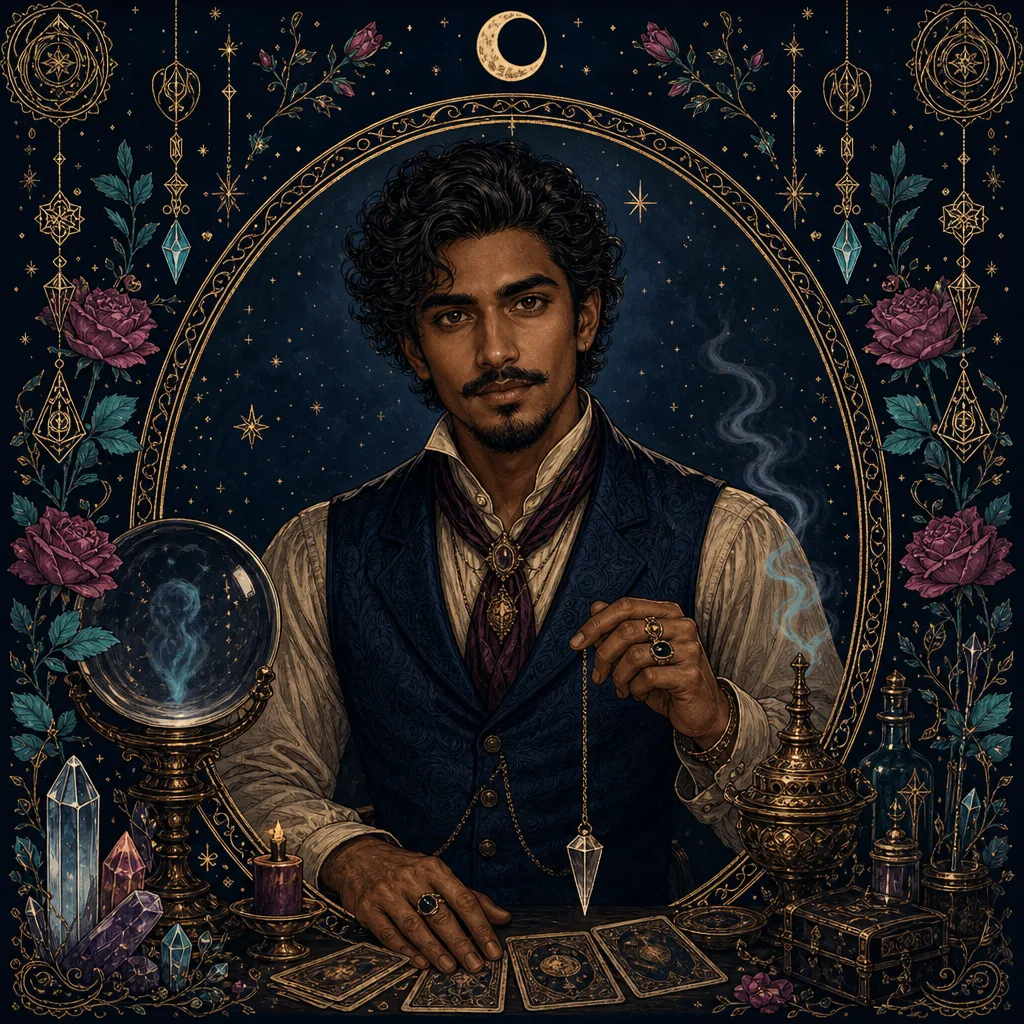
Diviners & Seers
Medium
Also called spirit communicator, sensitive
A medium is a practitioner who perceives and communicates with spirits of the dead, or other non-physical beings, and relays that communication to the living. The role involves specific perceptual abilities, developed through training and practice, that allow the medium to receive impressions, messages, or direct communication from discarnate intelligences.
- Tradition
- Modern Spiritualism (19th-century Anglo-American); parallel traditions in most world cultures
- Standing
- Open
A profile of the Medium
The medium stands at the threshold between the living and the dead, held there by love as much as by skill.
- Loves
- quiet in a busy room, the first moment of contact in a reading, old photographs brought to a session, letters from those no longer living, the smell of chrysanthemums.
- Hobbies and pastimes
- sitting in development circles, journaling impressions on waking, botanical watercolour painting, long walks in old cemeteries.
- Dream familiar
- A grey heron, patient and watchful at the edge of still water, at home between the worlds of earth and sky.
- Found in their element
- You will find the medium in the back room of a Spiritualist church on a Wednesday evening, head bowed in a development circle with seven others sitting in the candlelight.
- Signature objects
- a card from a Spiritualist church, a small photograph of a loved one in spirit, a cloth-covered notebook, a single white candle, a piece of labradorite.
A medium is a practitioner who serves as an intermediary between living people and discarnate spirits, most often the spirits of the deceased. The word “medium” in this sense entered English usage through the Spiritualist movement of the 19th century, and it described someone whose consciousness could function as a conduit through which spirits could communicate. The role is older than the name, however: cultures across the world have honoured people who speak with the dead and relay their messages, and spirit communication appears in the oldest written records of human religious life.
What defines the medium’s role, as distinct from other spirit-workers or intuitives, is the specific focus on communication with discarnate beings and the translation of that communication into language the living can receive and use. Evidence of identity, recognisable details known to the deceased and to those they loved, is considered one of the marks of authentic mediumship in most traditions. A reading that produces such evidence, names, memories, personality traits, private information, is held to demonstrate that contact is genuine rather than merely comforting.
The work
The working medium typically opens a session through some form of prayer, meditation, or ritual that signals their intention to receive spirit communication and establishes the quality of connection they seek. Many mediums work from a chair, seated and still, though the practice varies. Some begin with general impressions of who is present; others work more specifically, asking the client to hold the thought of a particular person.
Mental mediumship, the most common contemporary form, operates through the medium’s inner senses. A medium may see a mental image of the person in spirit, perceive a name or phrase audibly in their inner hearing, feel an emotion or a physical sensation associated with the deceased person, or simply receive certain information as direct knowing. Skilled mediums learn to distinguish between their own thoughts and the information they are receiving, a discernment that develops over time and with much practice.
Evidence is prioritised. A responsible reading offers specific, verifiable details rather than generalities. After establishing evidence of identity, the medium typically relays whatever the spirit wishes to communicate, which is most often reassurance, love, resolution of unfinished emotional business, or specific guidance relevant to the recipient’s life.
History and tradition
Ancestor communication and spirit mediumship appear in the records of virtually every culture. Egyptian texts address the dead directly. Hebrew scripture condemns the woman of Endor for her ability to raise spirits, which is itself evidence that the practice existed. Greek oracles, such as those at Delphi, involved altered states in which a divine voice spoke through a human intermediary.
The Spiritualist movement, which emerged in upstate New York in 1848 following the Fox sisters’ reported communications with a spirit in their home, gave the modern West a structured framework for understanding and developing mediumship. Spiritualism spread rapidly through the United States and Britain, attracting prominent scientists, politicians, and writers. By the late 19th century, Spiritualist churches and home circles were the primary context in which mediumistic ability was cultivated. The Society for Psychical Research, founded in 1882, investigated mediums with varying conclusions and produced some of the most thorough records of the phenomena.
The Spiritualist tradition remains active today, particularly in Britain, Brazil, and the United States, with organised churches, training programmes, and an ethics of practice developed over more than 150 years. Contemporary mediums also operate outside institutional Spiritualism, working in spiritual communities, independently, or alongside other healing and intuitive practices.
Walking this path
Development circles, small groups that meet regularly to sit in meditation with the shared intention of developing spirit communication, are the traditional training ground for mediums and remain the most recommended starting point. The circle provides a supportive group energy, mentorship from more experienced sitters, and the regular practice that mediumistic development requires. Many Spiritualist churches offer development circles open to newcomers.
Solo practice typically includes daily meditation, journaling of impressions, and deliberate exercises in distinguishing inner senses. Some mediums work with a specific teacher or mentor, which accelerates development considerably. Learning to set clear energetic boundaries around when you are open for spirit communication, and when you are not, is a skill most mediums name as essential to long-term wellbeing.
Mediumship sits naturally alongside other sensitive and intuitive practices, and many mediums are also clairvoyants, readers, or healers. The path asks for emotional maturity, grounded stability, and genuine compassion for both the living and the dead.
In myth and popular culture
The figure of the medium is among the oldest in human storytelling. The Witch of Endor in the First Book of Samuel calls up the shade of Samuel for King Saul, and the account is remarkable for its matter-of-fact tone: she sees the spirit rise, describes him, and relays his words. Homer’s Odyssey gives us Odysseus travelling to the world’s edge to consult the dead, pouring blood into a trench to draw the shades near enough to speak. These are not mediums in the modern Spiritualist sense, but they embody the same essential act: a living person opening a channel of communication with the dead.
The 19th-century Spiritualist movement produced the medium as a cultural figure in the modern West. Figures such as Daniel Dunglas Home, who conducted seances for Napoleon III and was never definitively exposed as a fraud despite sustained scrutiny, and Florence Cook, who claimed to materialise the spirit Katie King in full form, fascinated the Victorian public and the scientific establishment alike. The Society for Psychical Research investigated many such claims and produced enormously detailed records that remain historically valuable regardless of one’s conclusions about their subject matter. Leonora Piper was investigated extensively by William James, who famously called her his “white crow,” the one case sufficient to overturn the proposition that no authentic mediums existed.
In fiction, the medium has been treated with both sympathy and scepticism. Henry James’s “The Bostonians” (1886) features a young woman whose apparent gift becomes an object of social contest. Noel Coward’s comedy “Blithe Spirit” (1941) gives us Madame Arcati, a cheerfully eccentric medium who inadvertently raises a man’s first wife during a parlour seance, with chaotic results; the play has never left the repertoire. More recent fiction includes Sarah Waters’s novel “Affinity” (1999), set in Victorian London and exploring the ambiguity of mediumship with considerable psychological depth, and the television series “The Dead Zone” (2002 to 2007) and “Medium” (2005 to 2011), the latter based loosely on the claimed experiences of Allison DuBois and explicitly naming the role in its title.
Films have returned repeatedly to the medium figure. Robert Wise’s “The Haunting” (1963) features a character sensitive to the house’s presence without being a medium in any formal sense, while “The Sixth Sense” (1999, dir. M. Night Shyamalan) relocated the capacity to perceive the dead onto a child in a way that resonated widely. The stage and screen both tend to treat the medium as either a figure of ridicule, the charlatan at the Victorian table, or as a figure of genuine pathos, caught between worlds. The actual practice of mediumship, as it exists in Spiritualist churches and contemporary training contexts, is rarely represented accurately, which makes the gap between popular image and working tradition one of the more interesting features of the role.
People also ask
Questions
What is the difference between a psychic and a medium?
A psychic perceives information about living people, past or present circumstances, or probable futures through extrasensory means. A medium specifically perceives and communicates with discarnate spirits. All mediums are considered psychic, but not all psychics work as mediums.
What are the different types of mediumship?
Mental mediumship involves the medium receiving impressions, images, words, or feelings from spirits while remaining conscious and in control. Physical mediumship involves physical phenomena such as sounds, movement of objects, or materialisation, and is much rarer. Trance mediumship involves the medium entering an altered state in which a spirit may communicate directly through them.
How does a medium receive spirit communication?
Most mental mediums describe receiving impressions through some combination of clairvoyance (seeing), clairaudience (hearing), clairsentience (feeling), and claircognizance (direct knowing). A medium may see an image of a person, hear a name or phrase, feel an emotion, or simply know a fact without sensing how they know it.
Is mediumship dangerous?
Responsible mediumship practice includes regular grounding and protection work, and most mediums develop clear boundaries around when and how they open to spirit contact. The tradition of Spiritualism placed considerable emphasis on developing these skills safely, and contemporary mediums continue to emphasise the importance of a stable, well-grounded foundation.
Can mediumship be developed, or is it an innate gift?
The Spiritualist tradition holds that mediumistic ability is present to varying degrees in most people and can be developed through structured practice in a development circle. Many contemporary mediums developed their abilities through years of circle work and did not begin with dramatic spontaneous experiences.