Spirit Workers
Necromancer
Also called death-mage, nigromancer
A necromancer is a magickal practitioner who works with the spirits of the dead, using that relationship to access knowledge, influence events, and navigate the space between the living and the dead. The role is ancient and appears across many world cultures, though the specific term has its roots in classical Greek and Latin tradition.
- Tradition
- Cross-cultural; classical Greco-Roman, medieval European, and contemporary occult
- Standing
- Open
A profile of the Necromancer
The necromancer has made peace with death before most people will admit it is coming, and that peace is the source of all their power.
- Loves
- the smell of graveyard earth after rain, ancestor photographs arranged on an altar, midnight silence in a churchyard, old obituaries and death notices, dark resinous incense.
- Hobbies and pastimes
- gravestone rubbing and cemetery walks, genealogical research, reading historical accounts of the dead, maintaining an ancestor altar with offerings, studying mortuary traditions across cultures.
- Dream familiar
- A black crow with one knowing eye, perched on the lintel of an old gate, equally at home on either side.
- Found in their element
- Find the necromancer at a crossroads cemetery just after midnight, leaving bread and black coffee on a grave that nobody else visits.
- Signature objects
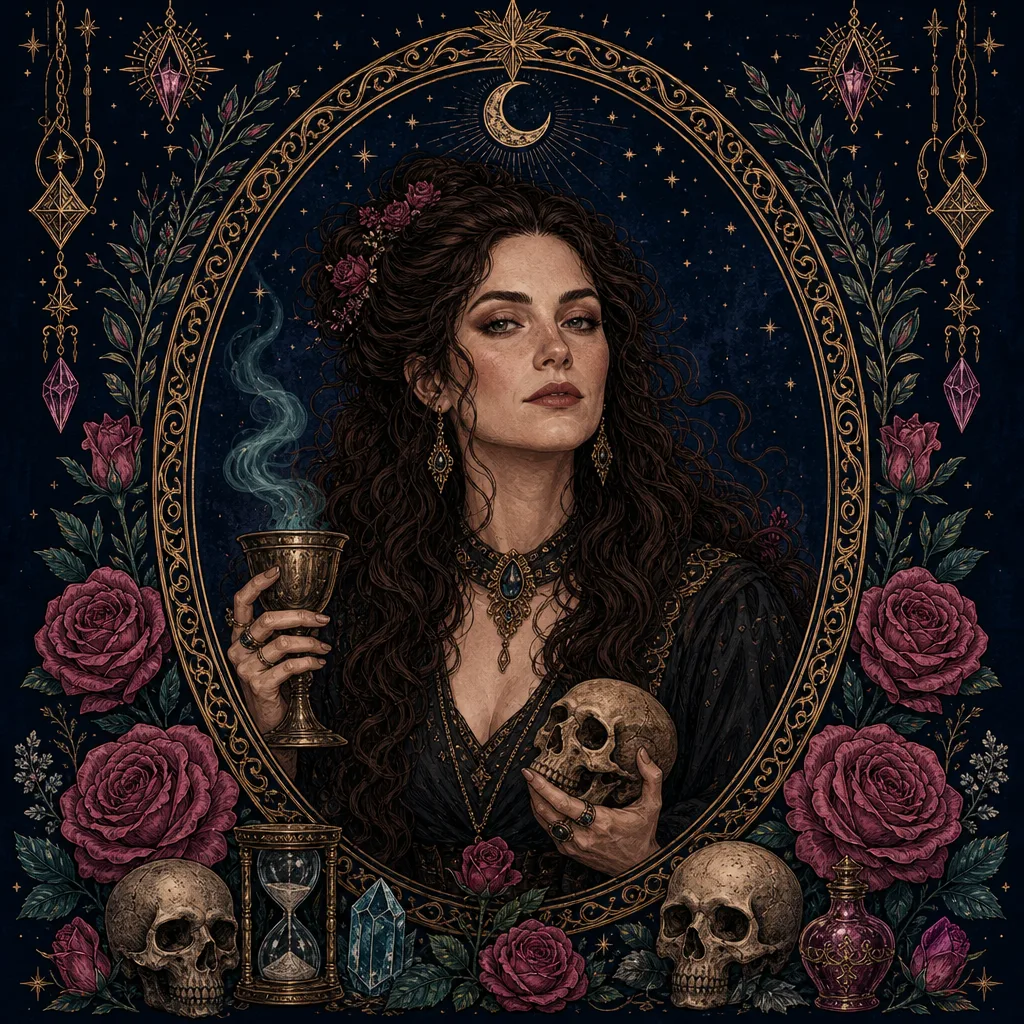
- a skull or carved bone focal point, a bottle of whiskey for offerings, graveyard dirt in a sealed jar, black and white candles, a scrying mirror framed in dark wood.
A necromancer is a magickal practitioner who works with the spirits of the dead as the central or a significant part of their practice. The relationship between the necromancer and the dead is not one of domination — not the Hollywood image of a sorcerer commanding skeletal armies — but of sustained, respectful engagement with beings who have passed beyond the threshold the living have not yet crossed, and who carry knowledge and perspectives that the living cannot access any other way.
The word “necromancy” derives from Greek roots meaning “divination by the dead,” and the original practice was precisely that: going to the dead to learn what the living could not know. The scope of the term has expanded over millennia to encompass all serious magical relationship with the dead, but the core remains: the necromancer is the person who has developed the capacity and the relationship to work across the boundary between the living and the dead.
The work
The necromancer”s primary skill is communication: developing the perceptual capacity, ritual structures, and relational protocols that allow meaningful exchange with the spirits of the dead. This is not a simple or automatic process. The dead communicate in ways that differ from the living, and learning to receive their communication clearly — distinguishing genuine spirit contact from imagination, wish-fulfillment, or confusion — requires sustained practice and honest self-assessment.
Divination through the dead remains central to the practice. The dead know things the living do not: they have access to perspectives from outside time”s flow as the living experience it, they may have information about specific situations or people, and they carry the accumulated knowledge of their lifetimes. Consulting the dead for counsel, warning, or guidance is among the oldest practices in human spiritual life.
Offerings are the currency of necromantic relationship. The dead are typically fed with food and drink that have specific traditional associations — alcohol (particularly whiskey, rum, or wine), tobacco, black coffee, bread, eggs, and other culturally specific foods depending on the tradition. Graveyard dirt and human remains (bones, hair) may be used as focal points in some traditions. Incense with deep, resinous, or earthy character — myrrh, cypress, copal, wormwood — creates the appropriate liminal atmosphere.
Ritual space-marking is important. The necromancer typically works at or after midnight, at crossroads, at gravesites, or in a dedicated space that has been prepared to signal the boundary between living and dead. The work itself involves invitation, communication, thanksgiving, and careful closure — the same basic structure as any guest-host relationship, which is exactly how many traditions frame it.
The necromancer may also work with the restless dead: spirits who have not passed fully into whatever lies beyond, who are confused, stuck, or carrying unresolved energy that affects the living. This work is more demanding and requires the capacity to both communicate with distressed spirits and hold enough stability to help them move.
History and tradition
Necromancy is among the oldest magical practices documented in world history. The Book of the Dead in ancient Egypt provides procedures for navigating the afterlife. The Odyssey”s katabasis scene, in which Odysseus consults the dead at the world”s edge, reflects a genuinely ancient Greek practice. The Witch of Endor in the Hebrew Bible calls up the shade of Samuel. The Roman Necromantia involved specific rituals for consulting the dead.
Medieval European necromancy, preserved in texts like the Munich Manual of Demonic Magic, combined Christian angelology and demonology with older practices of dead-spirit consultation, often within grimoire frameworks that treated the dead as one category among the spirits a magician might invoke. The tradition continued through the early modern period and into the nineteenth century”s Spiritualist movement, which democratised contact with the dead and brought it into parlours and séance rooms.
Contemporary necromancy draws on all of these streams as well as on African, African-American, indigenous American, and Asian traditions of working with the dead, each of which has its own specific framework for understanding and engaging with the spirits of the deceased.
Walking this path
The necromancer”s path is open to anyone with the genuine disposition for it, which is not universal. Working with the dead requires a stable, grounded relationship with death itself — your own eventual death, the deaths of people you have loved, and the reality of mortality as the fundamental condition of human life. Practitioners who enter this work from a place of fear, fantasy, or avoidance rather than honest engagement with death”s reality tend to produce poor and sometimes destabilising results.
Building a practice typically begins with the ancestors: the known dead of your own blood and chosen lineage. This is both more accessible and more ethically clear than working with unknown spirits, and the relationship you build with your own dead provides a foundation and a degree of protection for more expansive work. Regular ancestor veneration — offering food, water, light, and communication to the dead of your lineage — is the basic discipline from which necromantic capacity grows.
The necromancer role sits comfortably alongside many others. Ancestor workers, psychopomps, hedgewitches, spirit workers, and those working within African-derived religious traditions all have developed, specific relationships with the dead. The necromancer”s particular orientation is toward the dead as the primary spiritual interlocutor, but the work overlaps with all these paths naturally.
In myth and popular culture
The necromancer”s mythological ancestry is old and widespread. The most celebrated classical example is the Witch of Endor in the First Book of Samuel, who raises the spirit of Samuel at Saul”s request, a scene that troubled Christian interpreters for centuries precisely because it worked: the ghost of Samuel appeared and spoke with genuine prophetic authority. Homer”s Odyssey includes a necromantic episode in Book XI in which Odysseus follows Circe”s instructions to dig a trench, pour libations, and sacrifice animals to draw the shades of the dead near enough to speak; his conversation with the prophet Tiresias, the warrior Achilles, and his own mother Anticleia reads as a genuine account of what such a consultation was understood to involve. Virgil”s Aeneid (Book VI) gives Aeneas a guided descent into the underworld in which he speaks with the dead, including his father Anchises, in a passage that influenced western ideas about the afterlife for two millennia.
Medieval European literature produced the necromancer as a figure of learned and usually sinister power. The anonymous “Munich Manual of Demonic Magic” (15th century) preserves genuine necromantic ritual instructions within a grimoire framework, demonstrating that the practice was real rather than merely literary. Christopher Marlowe”s “Doctor Faustus” (c. 1592) gives the necromantic magician his archetypal dramatic form: immense learning, a pact with dark powers, spectacular results, and catastrophic cost. Shakespeare”s “The Tempest” (1611) and “Macbeth” (1606) both include spirit-raising; the Weird Sisters” conjuration in Macbeth, producing apparitions that speak with genuine prophetic accuracy, is necromancy in the strict sense.
Modern fantasy literature has made the necromancer one of its defining character types, though almost always at considerable distance from actual practice. Tolkien”s Necromancer in “The Hobbit” (1937), later identified as Sauron in “The Lord of the Rings,” uses the name to signal a particular quality of dark spiritual power rather than dead-spirit consultation. Garth Nix”s “Sabriel” (1995) is more interesting: its protagonist is a necromancer in the old sense, one who enters the realm of the dead to return spirits to their proper place, and the books treat the work as a demanding vocation with its own ethics and discipline. Video games including the “Diablo” series and “Dark Souls” have made the necromancer a popular player character class, though the gameplay mechanics bear no relationship to actual practice. The gap between the pop-cultural necromancer, typically raising skeletal armies in service of conquest, and the actual practice of working with the dead through offerings, communication, and respectful relationship, is one of the wider distances in contemporary occult culture.
People also ask
Questions
What does necromancy actually mean?
The word comes from the Greek "nekros" (corpse or dead person) and "manteia" (divination). In its classical original meaning, necromancy referred specifically to divination through the dead -- accessing knowledge of the future or hidden things by consulting the spirits of the deceased. Over time the term broadened to include all magical work involving the dead, not just divination, and in later medieval usage "nigromancy" often became a general term for black magic, losing its specific dead-spirit meaning.
Is necromancy harmful or dangerous?
Like most powerful magickal practice, necromancy carries genuine demands and risks, but these are primarily of a spiritual and psychological nature rather than the dramatic supernatural dangers of popular imagination. Working with the dead requires the practitioner to develop a clear and grounded relationship with death itself, to maintain appropriate boundaries with spirits, and to manage the energetic weight of work in the liminal space between living and dead. Practitioners who work without adequate preparation or discernment can find the work destabilising.
How does necromancy relate to ancestor work?
Ancestor work is a specific and often more accessible form of necromantic practice focused on one's own blood and chosen lineage. Necromancy in the broader sense encompasses the dead generally, not just one's own ancestors, and may include working with unrelated spirits, historical figures, or the restless dead who have not moved on. Many practitioners begin with ancestor work and develop their relationship with the dead more broadly from there.
What tools do necromancers use?
The tools of necromantic practice vary by tradition and practitioner but commonly include offerings of food, drink, and incense appropriate to the dead (often including alcohol, bones, graveyard dirt, and dark-scented herbs like cypress, myrrh, and wormwood), a ritual space that marks the boundary between living and dead, candles (particularly black and white), and a means of communication such as a pendulum, a spirit board, scrying mirror, or direct mediumistic perception. Some traditions use the skull or bones of specific individuals as focal points.
How is necromancy viewed in contemporary occultism?
Contemporary occultism treats necromancy as a legitimate and serious practice within the broader field of spirit work. It has been addressed by grimoire magicians drawing on historical texts like the Munich Manual, by folk practitioners who work with the dead in Hoodoo and related traditions, by Solomonic magicians, and by contemporary witches who include death work and ancestor veneration in their practice. The sensationalism that surrounds the word in popular culture is largely absent from serious practitioners' approaches.