Folk Magick Practitioners
Pellar
Also called pellar-witch, conjurer
A pellar is a traditional Cornish cunning person who specialised in counter-magic, lifting curses, and protection against witchcraft. The role is one of the most distinctively named positions in British folk magic, tied to the landscape and community life of Cornwall.
- Tradition
- Cornish folk magic and British cunning-craft tradition
- Standing
- Open
A profile of the Pellar
The pellar stands between the village and everything that wishes it harm, which is an old and honourable place to stand.
- Loves
- the Cornish coast on a grey morning, old stone boundaries and field margins, the smell of hot iron, handwritten charm books, the sound of the sea at a crossroads near the shore.
- Hobbies and pastimes
- collecting Cornish folklore and folk practice records, making witch-bottles and protective sachets, walking boundaries and liminal places, studying the history of Cornish cunning craft.
- Dream familiar
- A Cornish chough, red-billed and black-winged, bold enough to go anywhere and clever enough to come home.
- Found in their element
- The pellar is on the coastal path at the edge of a Cornish village at dusk, checking the charm hung at the field gate before the sun goes down.
- Signature objects
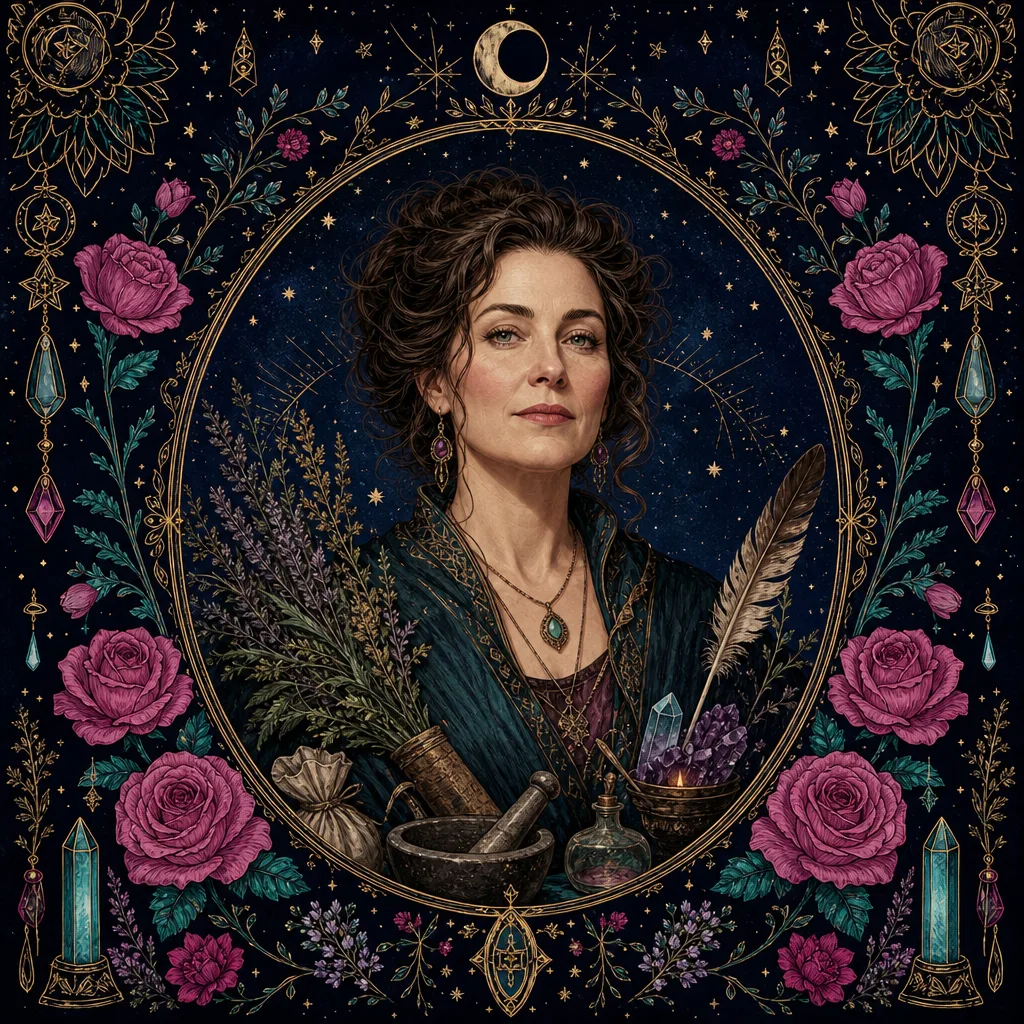
- a witch-bottle sealed with wax, a hand-copied book of charms, a crystal ball or dark mirror for scrying, iron nails for threshold protection, dried herbs gathered at the right time.
A pellar is a Cornish cunning person whose primary function was counter-magic: lifting curses, diagnosing bewitchment, removing ill-wishes, and providing protective charms for people, animals, and property. The pellar occupied a role of genuine local authority in Cornish communities, consulted in the same way a physician or magistrate might be, but for troubles that medicine and law could not address.
The word itself likely derives from “repeller,” one who repels harmful forces, and this etymology captures the pellar’s defining characteristic. Where the feared witch was understood to send harm outward into the world, the pellar stood as the force that pushed it back. Community recognition, rather than any initiation or formal credential, established a person in this role.
The work
The pellar’s practice was built around protection and reversal. When illness struck without obvious cause, when livestock sickened, when a boat’s luck turned sour, when butter would not churn or crops failed in ways that defied normal explanation, the pellar was the person a Cornish family would seek out. The consultation itself had the quality of a diagnosis: the pellar would identify the nature of the problem and prescribe the appropriate remedy.
Counter-magic techniques in the Cornish tradition included the witch-bottle — a vessel filled with the client’s urine, hair, and sharp objects, then heated or buried to deflect harm back to its source. Charms written on paper or scratched onto lead were produced for clients to carry or conceal at thresholds. Herbs, stones, and other natural materials with protective associations were assembled into sachets or hung in specific locations.
Divination was integral to the pellar’s work. Before any remedy could be applied, the nature and origin of the problem needed to be determined. Scrying, dowsing, and the reading of various signs helped the pellar form their diagnosis. Some historical pellars also claimed the ability to see witches and spirit beings directly, a visionary capacity that set them apart from ordinary practitioners.
The pellar’s tools might include a crystal or mirror for scrying, a personal magical book of charms and procedures, knotted cords for binding and loosing, iron implements for protection, and a variety of plants and minerals gathered at auspicious times. Many pellars worked outdoors and at liminal places — boundaries, crossroads, shorelines — in ways that reflected Cornwall’s own landscape of edges and in-betweens.
History and tradition
Cornwall has a particularly rich and well-documented cunning-craft tradition, shaped by its distinct culture, Brythonic Celtic heritage, and geography as a peninsula community whose people depended heavily on fishing and farming — both vulnerable to sudden misfortune. The pellar appears in Cornish records and oral tradition from at least the seventeenth century forward.
Scholarship on the Cornish tradition has grown substantially in recent decades. Gemma Gary’s “The Black Toad” and her broader body of work on Cornish witchcraft and cunning craft draws directly on historical and folkloric documentation. Robert Hunt’s nineteenth-century collection of Cornish folklore preserves accounts of pellars and the people who consulted them. Emma Wilby’s “Cunning Folk and Familiar Spirits” addresses the broader British tradition of which the pellar is a part.
The pellar tradition shares structural features with cunning folk across Britain — the counter-magic emphasis, the diagnostic divination, the provision of material charms — while carrying distinctly Cornish character in its folklore, landscape associations, and named practitioners. The last working pellars in the traditional sense are thought to have practised in the late nineteenth or early twentieth century.
Walking this path
The pellar path is open to those who feel drawn to it. No initiatory lineage gating the practice survives, and contemporary practitioners in Cornwall and elsewhere work from historical documentation, oral tradition, and their own developed relationship with the land and the unseen.
Walking this path well calls for genuine engagement with the Cornish tradition on its own terms. Reading the primary and scholarly sources, learning something of Cornish history and culture, and approaching the folklore with respect rather than as raw material for repurposing will ground your practice in something real. The pellar was shaped by Cornwall — its coast, its mines, its particular blend of Celtic, Christian, and older pre-Christian currents — and that shaping matters.
The pellar role sits comfortably alongside other folk-magic and witchcraft paths. Many contemporary practitioners who work in British traditional witchcraft, hedgecraft, or the broader cunning-folk tradition find the pellar framework a useful and specific name for one aspect of their work, particularly the protective and counter-magic dimension. The role does not demand exclusivity; most magickal practitioners hold several roles at once.
In myth and popular culture
The pellar belongs to a broader class of folk-magic practitioners, the cunning folk of Britain, whose counterparts appear across northern and western Europe under various names: the klok gumma of Sweden, the wijs vrouwtje of the Netherlands, the devin and devineresse of France. This class of practitioner was a structural feature of European village life from at least the medieval period to the early 20th century, consulted for the same range of problems the pellar addressed: bewitchment, lost livestock, stolen property, illness without obvious cause. Scholars including Keith Thomas, whose “Religion and the Decline of Magic” (1971) remains the authoritative account of English folk belief and practice, and Emma Wilby, whose “Cunning Folk and Familiar Spirits” (2005) examines the spirit-working dimension of the tradition, have documented the cunning folk in considerable historical detail.
The pellar’s Cornish context gives the role a specific regional character that distinguishes it from the broader cunning-folk category. Cornwall’s Celtic Brythonic heritage, its history as a mining and fishing community, and its status as a peninsula culture with its own linguistic identity until the 18th century produced a folk-magic tradition with distinctly local features. The best-documented Cornish practitioners appear in 19th-century records: James Thomas of Helston, known as Tammy Blee, and the Tregear family of Callington are among those whose activities are preserved in court records, newspaper accounts, and oral tradition. Robert Hunt’s “Popular Romances of the West of England” (1865) preserves substantial folklore about pellars and the communities that consulted them, written at a moment when the tradition was living memory rather than distant history.
In fiction, the cunning-folk tradition has attracted considerable literary attention since the late 20th century, as scholars’ documentation of the historical record made the material available to writers working outside specialist circles. Alan Garner’s novel “The Owl Service” (1967) draws on Welsh mythological material and the figure of the cunning person without naming the role explicitly. The historical novelist Bernard Cornwell has featured Merlin as a cunning man in his Warlord Chronicles trilogy (1995 to 1997), a treatment that, while set in post-Roman Britain, captures something of the pragmatic, community-embedded quality of the actual tradition. More directly relevant is Gemma Gary’s body of work, which straddles scholarship and practice and has done more than any other contemporary source to make the pellar tradition accessible to practitioners and readers who lack access to specialist archives.
People also ask
Questions
What does the word "pellar" mean?
The most widely accepted explanation is that "pellar" derives from "repeller" -- one who repels evil, witchcraft, and malevolent forces. Some scholars have also connected it to the Cornish language, though the etymology remains debated. What is consistent across the historical record is that the pellar was understood as someone who drove harm away rather than sending it.
How was a pellar different from a witch?
In Cornish folk understanding, the pellar was the antidote to the witch. A witch (in the negative popular sense) caused harm; the pellar undid it. Many people who suspected bewitchment would travel considerable distances to consult a pellar, pay for a diagnosis, and receive a charm or remedy. The pellar's identity was built around protection and healing rather than cursing.
Who was the most famous historical pellar?
James Thomas of Helston, known as Tammy Blee, and later the Tregear family are among the best-documented Cornish pellars. James Murrell of Suffolk is sometimes included in the broader cunning-folk tradition, though he is technically from a different county. The most famous Cornish pellar is probably the figure known from oral tradition and later documentation as the last of the working pellars in the nineteenth century.
Did pellars use familiar spirits?
Historical accounts and Emma Wilby's research into cunning folk and familiar spirits suggest that some pellars did describe working with spirit helpers, sometimes inherited alongside their practice. These were not demonic in the popular witch-trial sense but were understood as helpful presences, sometimes described as fairy-derived or ancestral. The relationship was cooperative rather than coercive.
Can modern practitioners work as pellars?
Yes. The pellar tradition is open, and a number of contemporary Cornish and broader British practitioners work within this framework, often drawing on historical documentation, Cornish folklore, and the broader cunning-craft tradition. Modern authors including Gemma Gary have written practical and scholarly works grounding this practice in its Cornish context.