Spirit Workers
Psychopomp
Also called soul guide, death guide, soul conductor
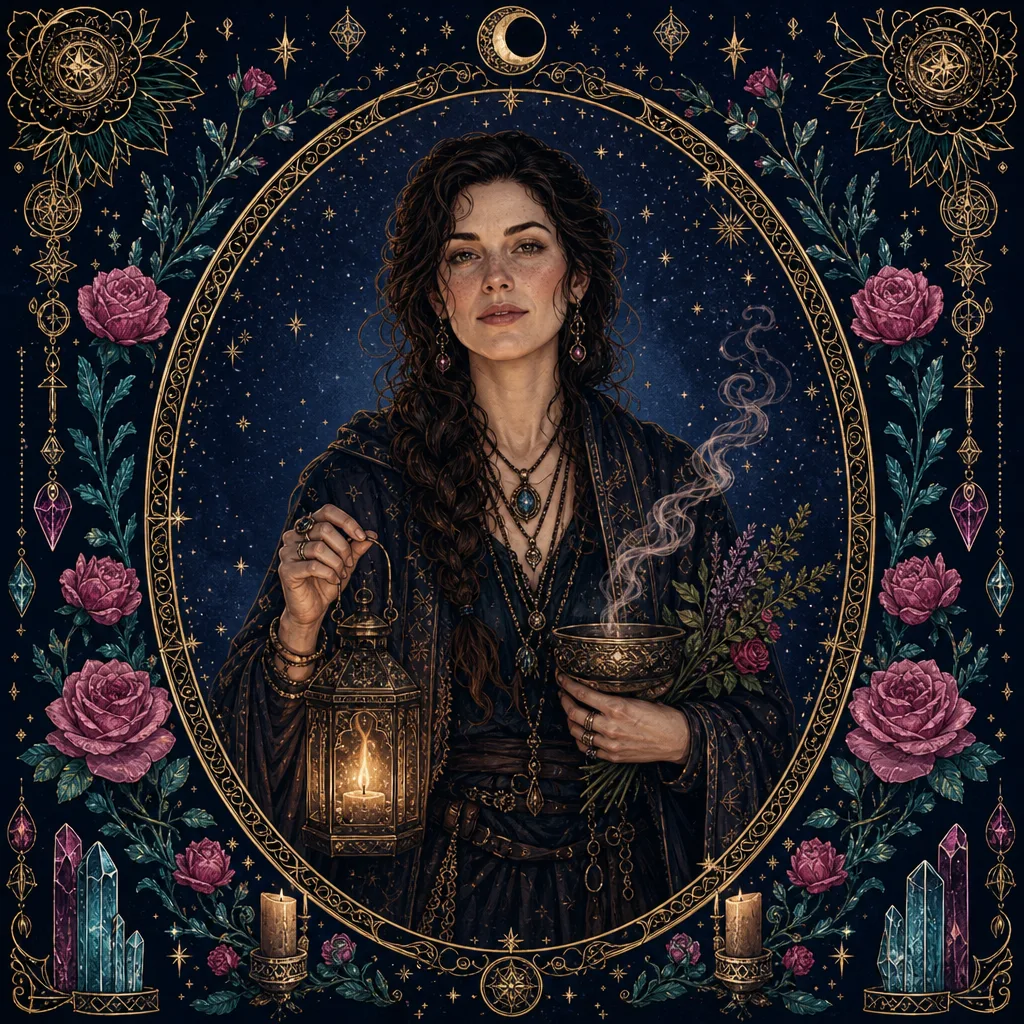
A psychopomp is a spiritual practitioner who assists the dying and the recently dead in transitioning from life to whatever lies beyond, guiding souls across the threshold between the living and the dead. The role is ancient, appearing across world cultures in both human practitioners and deity-forms, and is practised by contemporary spirit workers, shamanic practitioners, and hospice-adjacent spiritual caregivers.
- Tradition
- Cross-cultural; found in Greek, Celtic, Norse, shamanic, and many other traditions
- Standing
- Open
A profile of the Psychopomp
A calm and compassionate guide who stands at the threshold between life and death, helping the newly dead find their way forward with patience and without fear.
- Loves
- quiet rooms and candlelight, the sound of running water, threshold places where land meets water or road meets forest, ancient maps of the underworld.
- Hobbies and pastimes
- ancestor veneration and altar keeping, studying death customs across cultures, sacred chant and toning practice, dreamwork.
- Dream familiar
- A raven who knows every road between the worlds and never loses its bearings.
- Found in their element
- At the bedside of the dying, or alone at a crossroads at dusk, offering passage to whoever has not yet found the way.
- Signature objects
- a candle lit for the recently dead, a drum for trance journeying, offerings of food and drink for the departed, a psychopomp deity image on the altar, a cloak worn only for death work.
A psychopomp is a spiritual practitioner who guides souls across the threshold of death — assisting the dying in their transition, helping the newly dead orient and move on, and working with spirits who have become stuck between worlds. The psychopomp stands at the boundary between the living and the dead not as a passive observer but as an active, compassionate guide whose skill and presence make the crossing easier.
The word comes from Greek and means “soul conductor,” and the figure it names is one of the oldest in human spiritual life. Death gods and messenger figures in cultures around the world serve as divine psychopomps, and the human practitioner who takes up this work does so as the earthly expression of a role that has always been understood as necessary at the threshold of life”s ending.
The work
The psychopomp”s work spans several contexts and stages of the dying process. Some practitioners work primarily with the dying: holding space at deathbeds, offering prayer, chant, or sacred sound to ease the passage, creating a spiritually clean and supportive environment, and maintaining their own perceptual awareness to follow the soul”s departure. This work is both practical and deeply intimate, requiring the practitioner to be genuinely comfortable with death”s physical reality while maintaining their spiritual function.
Work with the newly dead addresses the disorientation that can follow traumatic, sudden, or unexpected death, and the attachment that sometimes keeps a soul near the familiar rather than moving toward what comes next. The psychopomp communicates with the recently departed spirit — often through mediumistic perception, prayer, or ritual address — acknowledging the death, helping the spirit understand its situation, and facilitating its movement toward appropriate guides or the appropriate destination within the practitioner”s cosmological framework.
Clearing locations of accumulated or stuck spirits is another dimension of the role. Places where many people have died, or where a traumatic death occurred, may hold one or more spirits who have not fully transitioned. The psychopomp assesses these situations, communicates with the spirits present, addresses whatever is keeping them, and facilitates their movement. This work overlaps with space-clearing and house-blessing practice.
The tools of psychopomp practice vary by tradition. Song and sacred sound are widely used — singing a soul out is documented across Celtic, shamanic, and various folk traditions. Prayer and invocation, particularly to death deities or guardian ancestors who meet the soul, form a backbone of most practitioners” work. Some practitioners work in trance states that allow them to perceive and accompany the soul”s journey more directly. Others work through mediumistic communication, receiving the soul”s communication and responding to it.
History and tradition
The psychopomp is among the most ancient of spiritual roles. In shamanic traditions across Siberia, Central Asia, and the Americas, the shaman”s function explicitly included accompanying the souls of the dead to their proper destination, and shamanic soul-retrieval for the living is the complement of this death-guiding work. Celtic traditions document the role of specific practitioners in singing the dead and maintaining the threshold between worlds. The Norse tradition”s Valkyries serve a psychopomp function in escorting slain warriors to Valhalla.
The Greek concept of the psychopomp, carried by Hermes, Hecate, and Charon among others, gave contemporary practitioners the word that has become most widely used across traditions. This Greek terminology was taken up in Jungian psychology — where the psychopomp appears as an inner guide figure — and from there entered the broader spiritual vocabulary.
Contemporary psychopomp practice draws on these many sources and has been developed particularly within neo-shamanic, Northern Tradition, and contemporary witchcraft communities. Practitioners including Orion Foxwood, who works within an Appalachian and folk-magic context, and various teachers in the Foundation for Shamanic Studies tradition have articulated methods for this work in contemporary language.
Walking this path
Psychopomp work is open to practitioners who have genuine capacity for it, which requires honest self-assessment rather than aspiration alone. The requirements are substantial: a stable, grounded relationship with death that is not contaminated by fear, fantasy, or avoidance; developed perceptual capacity for working with the dead; and the emotional and energetic resilience to work regularly in the space between living and dead without destabilisation.
Most practitioners who develop psychopomp work do so gradually, beginning with ancestor veneration and necromantic practice and moving toward more active soul-guiding work as their capacity and established spirit relationships allow. Working under the guidance of a death deity — developing a genuine devotional and working relationship with Hermes, Hecate, Anubis, or another relevant figure — provides both protection and mentorship in a domain that is not safe for the unprepared.
The psychopomp role overlaps significantly with necromancy, ancestor work, and spirit work in general, and most practitioners who do this work hold several of these roles simultaneously. The psychopomp”s specific characteristic is the soul-guiding orientation: being present at the threshold not simply to communicate or learn from the dead but to actively assist their passage. That particular calling, and the work it asks, is what defines the role.
In myth and popular culture
The divine psychopomp is one of mythology’s most consistent and widespread figures. Hermes, in Greek tradition, carried souls to the underworld as one of his many functions, his winged sandals suited equally to messages between gods and escort of the dead. Anubis, in Egyptian tradition, conducted souls to judgment and weighed the heart against the feather of Ma’at, combining the psychopomp function with that of guardian of the weighing. The Norse Valkyries chose the slain on the battlefield and conducted the worthy to Valhalla, a selective and martial version of the escorting role. In West African and Afro-Caribbean traditions, the Gede and Baron Samedi in Haitian Vodou serve as lords of the dead who also maintain the passage between worlds. What unites these figures across enormous cultural distance is the understanding that death is a transition requiring guidance, not merely an ending.
In literature and film, the psychopomp has generated some of fiction’s most enduring characters. Death appears as a named, personal guide-figure in Terry Pratchett’s Discworld novels, where the character is humane, curious, and philosophically generous, representing a benevolent reading of the escorting function stripped of terror. Neil Gaiman’s treatment of Death in “The Sandman” comic series draws on the same tradition, depicting a psychopomp figure who is warm and companionable with the dying. Charon, the ferryman of Greek myth, appears in Dante’s “Inferno” and has remained a literary reference point for centuries. In Ingmar Bergman’s 1957 film “The Seventh Seal,” Death is a player in a chess game with a dying knight, a figure of patience and inevitability rather than pure malice.
In the context of shamanism, the soul-guiding function appears in academic literature alongside the soul-retrieval function, as two sides of the shaman’s relationship with the spirit world. Mircea Eliade’s “Shamanism: Archaic Techniques of Ecstasy” (1951) describes psychopomp work as one of the shaman’s core responsibilities across Siberian and Central Asian traditions, and this framing influenced the neo-shamanic revival of the late twentieth century through figures like Michael Harner, whose Foundation for Shamanic Studies has trained many contemporary practitioners in practices that include work with the dying and the newly dead.
People also ask
Questions
What does psychopomp mean?
The word comes from the Greek "psyche" (soul) and "pompos" (guide or conductor), giving "soul guide" or "conductor of souls." In Greek mythology, Hermes served as psychopomp, guiding the newly dead to the underworld. The term has been taken up in contemporary spiritual practice to name the human (rather than divine) practitioner who performs analogous work: helping souls cross the threshold at death.
What does a human psychopomp actually do?
The human psychopomp assists with soul transition in several ways. At deathbeds, they may provide spiritual support for the dying, creating a calm and sacred environment, praying or chanting to ease passage, and perceiving the progress of the soul's departure. After death, they may work with the spirit of the newly dead who has not fully crossed, helping orient the confused or frightened dead and guide them toward the light or whatever their tradition understands as the appropriate destination. They may also work with stuck or restless spirits in locations where the dead have accumulated without transitioning.
Is psychopomp work related to hospice or palliative care?
Some psychopomp practitioners work explicitly in hospice and end-of-life care contexts, offering spiritual presence and soul-guiding work alongside or within a secular or non-denominational framework. Others work entirely within magickal and spiritual practice contexts. The two dimensions can coexist naturally, and a number of practitioners trained in both areas serve as a bridge between conventional end-of-life care and explicitly spiritual assistance.
How does a psychopomp deal with stuck or restless spirits?
Work with restless spirits requires first perceiving and communicating with the spirit to understand why it has not transitioned -- confusion about the fact of death, attachment to a person or place, unresolved grief or guilt, or circumstances of traumatic dying that left the soul disoriented. The psychopomp then works to address whatever is keeping the spirit from moving: providing information, facilitating a communication the spirit needs to complete, calling in specific guides or ancestral spirits to meet and escort the soul, or creating a ritual structure that opens a clear path forward.
Which deities or beings serve as psychopomps in different traditions?
Hermes and Hecate in Greek tradition, Anubis in Egyptian tradition, the Valkyries in Norse tradition, Baron Samedi and the Gede in Haitian Vodou, Azrael in Islamic tradition, the Morrigan in Irish tradition, and Yama in Hindu and Buddhist traditions are among the best-known divine psychopomps. Working with one or more of these beings is common among human psychopomp practitioners, who often understand themselves as acting under the guidance or patronage of a specific death deity.