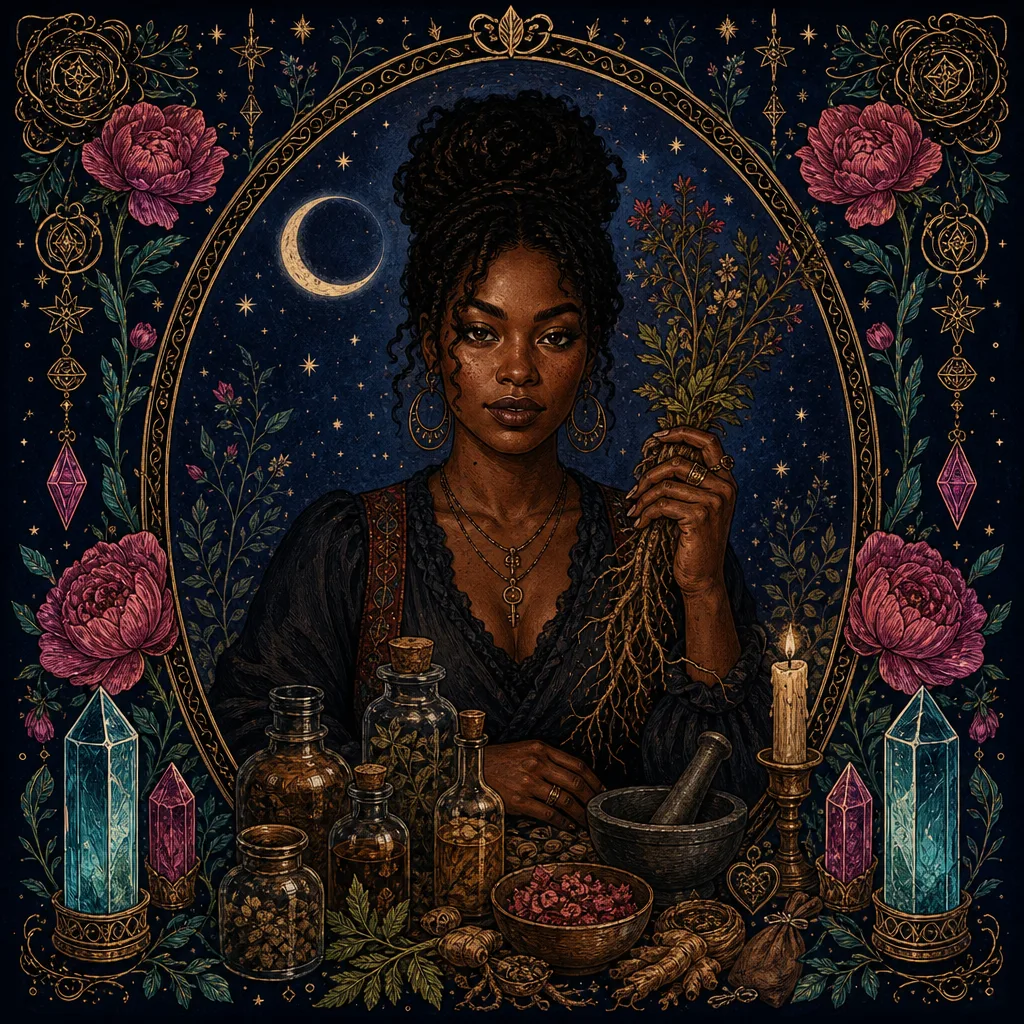
Folk Magick Practitioners
Rootworker
Also called root doctor, two-headed doctor, worker
A rootworker is a practitioner of Hoodoo, the African American folk magic tradition rooted in the experience and spiritual inheritance of enslaved Africans and their descendants in the American South. Rootwork uses roots, herbs, spiritual supplies, prayer, and ritual to address love, protection, money, health, justice, and the reversal of harm.
- Tradition
- Hoodoo; African American Southern folk magic
- Standing
- Culturally rooted
A profile of the Rootworker
A skilled and pragmatic healer who draws on centuries of accumulated African American wisdom to solve real problems with roots, prayer, and a thorough knowledge of what works.
- Loves
- High John the Conqueror root, the smell of condition oils and beeswax, well-worn Psalm books, the crossroads at midnight, graveyard dirt gathered with proper permission.
- Hobbies and pastimes
- blending condition oils and spiritual washes, growing and drying medicinal herbs, studying African American folk history, assembling mojo bags with care and intention.
- Dream familiar
- A black cat who finds its way home from anywhere and knows which doors to leave alone.
- Found in their element
- In a back-room workspace lined with jars of roots and bottles of oil, working by lamplight for whoever needs what only she can provide.
- Signature objects
- a flannel mojo bag fed with whiskey, lodestones for drawing work, dressed candles in condition colours, a jar of graveyard dirt, a well-used mortar and pestle, a bottle of Florida Water.
A rootworker is a practitioner of Hoodoo, the African American folk magic tradition that developed among enslaved Africans and their descendants in the American South. Rootwork addresses the full range of human need — love and attraction, protection and justice, money and luck, healing and the reversal of harm — through the skilled use of roots, herbs, curios, prayer, and spiritual work rooted in African, European, and Native American knowledge traditions synthesised under conditions of slavery and transformed by generations of African American creativity and survival.
Hoodoo is not a religion and not Voodoo. It is a practical magical tradition — a technology of spiritual and material problem-solving — that can be practised alongside Christianity, which has been its most common companion in the American South, or alongside other religious frameworks. The rootworker serves a community need, providing remedies and recourse in situations where ordinary means have failed or are inaccessible.
The work
The rootworker”s practice is built around condition work: identifying what a client needs — more money, a wayward lover”s return, protection from an enemy”s malice, relief from crossed conditions that have blocked every area of life — and assembling the specific roots, herbs, curios, and ritual procedures most appropriate to that condition.
Material knowledge is central. Hoodoo has a detailed pharmacopoeia of roots and herbs, each with specific traditional applications. High John the Conqueror root is associated with strength, victory, and overcoming obstacles. Devil”s shoestring trips up enemies. Angelica root provides protection and draws blessings. Lucky Hand root and lodestones attract money and love respectively. These materials are selected, prepared, and deployed with precision: the wrong root for the condition wastes effort and resources, and the right one, worked correctly, produces results.
Mojo bags are among the most characteristic products of rootwork. The practitioner assembles a selection of appropriate roots, curios, and other materials, wraps or bags them, activates the assembly with prayer and appropriate liquid dressings, and provides it to the client to carry or place. The bag is then maintained — “fed” with whiskey, cologne, or other substances — to keep it active.
Candle work, floor washes, spiritual baths, dressing of objects with condition oils, the laying of tricks (physical objects placed in specific locations to affect specific people), and the working of graveyard dirt and cemetery traditions are all part of the rootworker”s range. Prayer drawn from the Psalms and from specific spiritual currents within African American Christianity is woven through the work, not separate from it.
History and tradition
Hoodoo emerged from one of the most devastating and creative crucibles in American history. Enslaved Africans, forcibly removed from diverse West and Central African cultures with their own rich magical and spiritual traditions, were brought into a context that destroyed nearly every external institution while failing to destroy the internal knowledge they carried. Hoodoo represents the synthesis of African spiritual technology with European folk magic (absorbed through contact with white and especially German American communities in the South), Native American plant knowledge (acquired through relationships on both sides of the colonial encounter), and the specific spiritual framework of African American Christianity.
This synthesis was not academic or leisurely — it happened under conditions of extreme violence, surveillance, and need. Hoodoo served real and urgent purposes: protecting enslaved people from harm, facilitating escape, resisting the power of enslavers, healing bodies that medicine denied, and maintaining human dignity and spiritual agency in a system designed to strip all three.
The tradition continued after emancipation and through the Great Migration, spreading to Northern cities while retaining Southern roots. The twentieth century saw the commercialisation of Hoodoo spiritual supplies through mail-order companies and physical shops (drugstores, spiritual supply shops), which both documented and shaped the tradition. The academic and documentary record includes Hyatt”s monumental field collection, the work of Zora Neale Hurston (who trained as a rootworker under the African American practitioner Samuel Thompson), and subsequent scholarship.
Walking this path
Hoodoo is a cultural tradition with deep roots in African American history and community. It is not guarded by initiatory structures in the way that Vodou priesthood is, and historically it has crossed racial lines in the American South — but crossing a racial line historically does not make any engagement automatically appropriate or respectful.
If you are outside the African American community and feel drawn to Hoodoo, the most important thing is to approach the tradition with honesty about its origins and the history that shaped it. Hoodoo is not a generic folk magic available for free appropriation. It is the product of a specific community”s resilience and spiritual genius under catastrophic conditions, and that community is living and present.
The best path forward involves learning from African American sources: reading Zora Neale Hurston”s “Mules and Men,” Catherine Yronwode”s scholarship and documentation, the academic work of Katrina Hazzard-Donald and Yvonne Chireau. Supporting African American-owned Hoodoo businesses rather than their imitators is a concrete form of respect. Listening to African American rootworkers” own framing of their tradition — rather than the simplified and often distorted versions that circulate in outsider popular culture — matters.
For African American practitioners, Hoodoo is an inheritance: a body of spiritual knowledge developed by your ancestors as an act of survival and dignity, available to you as both a practical tool and a living connection to that history.
In myth and popular culture
The rootworker and the broader figure of the Hoodoo conjure doctor appear throughout African American literature and folk narrative as figures of real social power. In the folk tales collected by Zora Neale Hurston, who trained in Hoodoo herself under several initiating doctors, conjure workers are agents of justice and protection for communities with little access to legal recourse. Hurston’s “Mules and Men” (1935) includes extended first-person accounts of her training, making it both an ethnographic document and a literary record of what it felt like to learn the work from the inside.
Charles Waddell Chesnutt’s conjure stories, collected in “The Conjure Woman” (1899), are the earliest substantial literary treatment of Hoodoo in American fiction. Chesnutt’s conjure woman Aunt Peggy is a practitioner of considerable power whose work, set during slavery, addresses the material and spiritual crises of enslaved people in ways that legal and social systems utterly fail to provide. Chesnutt understood the tradition from within African American community life and treated it with a complexity unusual for the period, depicting conjure as a technology of survival with both genuine power and genuine limits.
In popular music, Hoodoo and rootwork appear throughout the blues tradition. Robert Johnson’s recordings reference crossroads deals and conjure practice, and Muddy Waters, Howlin’ Wolf, and many others drew on rootwork imagery as both genuine belief and as coded language for experiences and powers that mainstream culture preferred to ignore. The Staple Singers, though primarily gospel artists, drew on the same deep cultural substrate where African American Christianity and folk spiritual practice are inseparable. In contemporary music, Beyonce’s “Lemonade” (2016) has been read by many scholars and commentators as drawing on Hoodoo iconography, particularly in its imagery associated with Oshun and with Southern Black spiritual tradition, though the work’s relationship to that tradition is deliberately layered and allusive rather than programmatic.
People also ask
Questions
What is Hoodoo, and how is it different from Voodoo?
Hoodoo is an African American folk magic tradition, not a religion, that developed among enslaved Africans and their descendants in the American South. It draws on African spiritual knowledge, European folk magic, and Native American plant lore, all synthesised under conditions of enslavement and adapted to the specific needs and circumstances of Black life in the South. Voodoo (Vodou) is a distinct Afro-Caribbean religion, primarily associated with Haiti and Louisiana Creole culture, with its own priesthood, theology, and liturgy. The two traditions are related but separate, and conflating them is a longstanding source of confusion and harm.
Is Hoodoo a closed tradition?
Hoodoo occupies a complex position. It is a cultural tradition with living roots in African American community and history, and it deserves respect as such. It is not initiatory or priesthood-gated in the way that Vodou is, and it has historically been practised across racial lines in the American South, with documented exchange between Black, white, and Native American practitioners. However, engaging with Hoodoo calls for genuine respect for its African American origins, honest acknowledgment of that history, and avoidance of the extractive and disrespectful approaches that have characterised much outsider engagement with the tradition.
What materials does a rootworker use?
Rootwork draws on a rich material culture: roots, herbs, and botanicals (including High John the Conqueror root, angelica, devil's shoestring, and many others), animal-derived curios (such as lodestones, bones, and feathers), mineral materials (sulphur, salt, graveyard dirt), candles dressed with condition oils, mojo bags assembled for specific purposes, and a range of commercial spiritual supplies developed within the Hoodoo tradition itself. Each material carries specific traditional associations and is selected to support the worker's intention.
What is a mojo bag?
A mojo bag (also called a gris-gris bag, hand, or toby) is a small cloth bag assembled from a selection of roots, curios, and other materials chosen to support a specific intention -- attracting love, drawing money, gaining protection, or another goal. The mojo bag is then activated (or "fed") and carried on the body or placed in a specific location. It is one of the most characteristic and widely known products of rootwork.
Who are the key scholars of Hoodoo?
Catherine Yronwode of the Lucky Mojo Curio Company has produced the most comprehensive modern documentation of Hoodoo in her "Hoodoo Herb and Root Magic" and related works. Harry Middleton Hyatt's five-volume "Hoodoo, Conjuration, Witchcraft, Rootwork" (1970-1978), based on extensive field interviews, is the largest primary source collection. Scholars including Yvonne Chireau, Katrina Hazzard-Donald, and Jeffrey Anderson have addressed Hoodoo from academic perspectives grounded in African American history and religion.
How should someone outside the African American community engage with Hoodoo?
The most important starting point is learning the history honestly: Hoodoo emerged from the trauma, resilience, and creativity of enslaved people, and that context is not separable from the practice. Engaging with African American scholarship and practitioners' own accounts rather than appropriated popular versions is essential. Supporting African American-owned Hoodoo businesses, learning from African American teachers, and approaching the tradition with gratitude rather than entitlement are basic forms of respect.