Diviners & Seers
Runecaster
Also called rune reader, vitki, runester
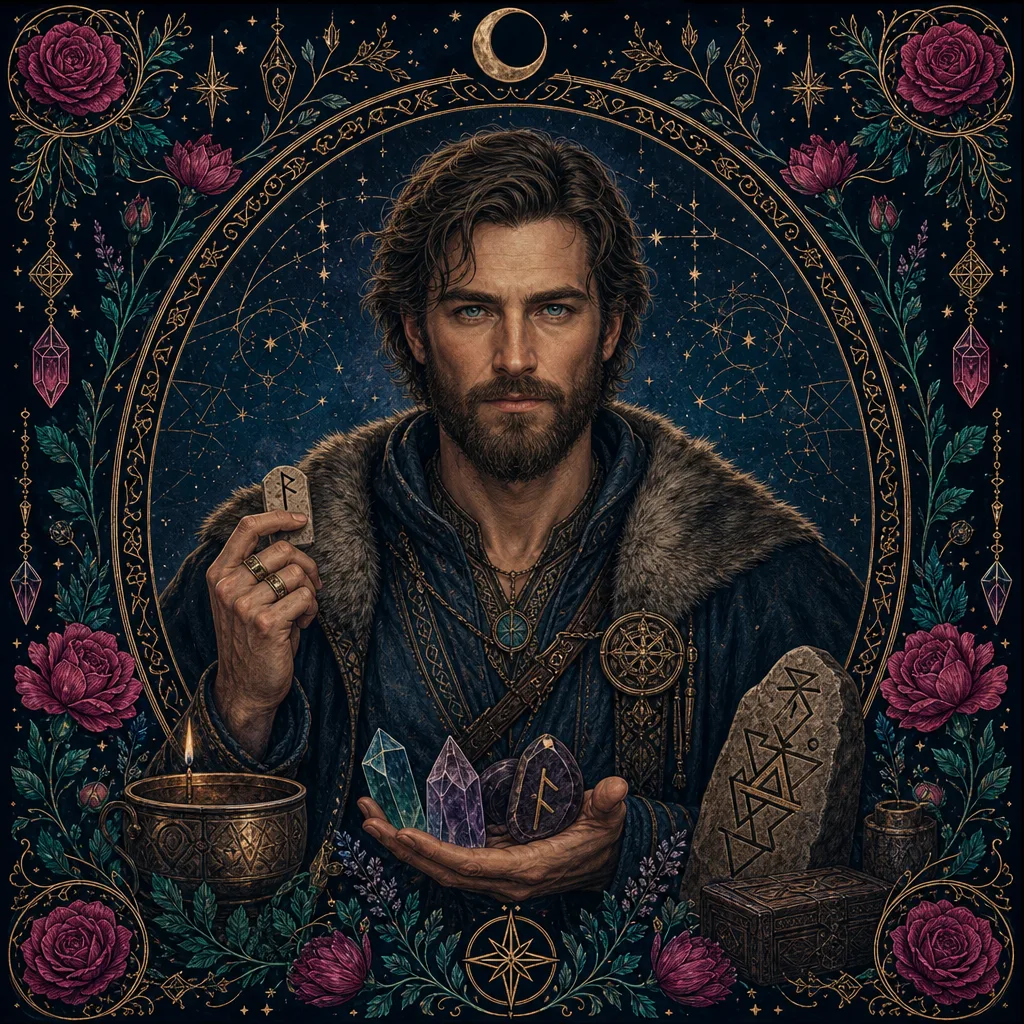
A runecaster is a practitioner who works with the runes, the ancient Germanic alphabet whose characters carry symbolic and spiritual significance, for divination, magic, and wisdom. Drawing or casting runes, the runecaster reads each character as a force or principle whose presence in a reading illuminates a situation and the energies moving through it.
- Tradition
- Norse and Germanic; the Elder Futhark runes developed in the early centuries CE; modern runic practice synthesises historical scholarship with esoteric revival
- Standing
- Open
A profile of the Runecaster
A thoughtful scholar-practitioner who has earned their relationship with the runes through sustained study, personal sacrifice, and the willingness to sit with what the runes actually say rather than what one hoped to hear.
- Loves
- hand-carved wooden rune sets, the Havamal read in Old Norse, winter nights with a fire and a journal, archaeological runestone sites in Scandinavia, the smell of wood shavings from fresh carving.
- Hobbies and pastimes
- carving and consecrating personal rune sets, translating Old Norse poetry, attending Heathen blots and runic study circles, journaling one rune at a time for weeks on end.
- Dream familiar
- One of Odin's two ravens, Huginn or Muninn, who has already seen the pattern the runes are showing.
- Found in their element
- Alone at a wooden table before dawn, casting cloth spread, runes in hand, and the journal open beside them.
- Signature objects
- a handmade set of elder wood runes, a casting cloth of undyed linen, a well-annotated copy of the Poetic Edda, a carving knife reserved for runic work, a dedicated runework journal.
A runecaster is a practitioner who works with the runes as a divinatory and magical system, reading the symbolic meaning of each character to illuminate situations, reveal underlying forces, and guide decisions. The runes are the ancient Germanic alphabet, each letter of which carries a name and a body of associated meaning, imagery, and mythological resonance that transforms them from phonetic symbols into a complex divinatory language. The runecaster draws on this language to interpret the patterns that emerge when runes are cast or drawn, understanding those patterns as a reflection of the forces at work in a situation.
The practice is grounded in a Norse and Germanic cosmological framework in which the runes are not merely human symbols but cosmic principles, forces that exist independently of their written forms and that the practitioner learns to perceive and work with. Drawing a rune is not simply consulting a reference chart; it is making contact with an energy that has its own character and implications, and the skilled runecaster reads with both the traditional meanings and a developed sensitivity to how that energy is present in the specific moment of the reading.
The work
A runecaster’s tools are their rune set, typically 24 or 25 pieces of wood, stone, or other material, each marked with one rune character, and often a casting cloth, a square or circle of fabric marked or unmarked, onto which the runes are thrown or placed. Many practitioners make their own rune sets, feeling that the act of carving and consecrating each piece builds a relationship with the runes that enhances the sensitivity of subsequent readings.
For a casting divination, the practitioner typically holds the bag of runes or the rune pieces in their hands, focuses on the question or the querent, and either draws runes blindly one by one or casts a handful onto the cloth and reads those that land face up. Each rune that appears is interpreted in its own right and in relation to the others. Some practitioners use spreads, assigning positional meanings before drawing, similar to tarot spreads; others prefer a freer, more holistic reading of whatever presents itself.
Interpretation draws on the names and traditional meanings of each rune, gathered from the historical rune poems of Anglo-Saxon, Norse, and Icelandic tradition, and from developed personal familiarity with each rune’s character. Many runecasters meditate on each rune individually, spending days or weeks with a single character, journaling what arises, and allowing the rune to teach its qualities through experience as well as study.
The magical dimension of runic practice includes carving or drawing runes onto objects, the body, or paper with specific intentions; binding runes into bindrunes (combined glyphs); and chanting runic names as a meditative or invocatory practice.
History and tradition
The Elder Futhark, the oldest complete runic alphabet with 24 characters, appears in inscriptions across the Germanic and Scandinavian world from roughly the 2nd to 8th centuries CE. The alphabet takes its name from the phonetic values of its first six characters: f, u, th, a, r, k. Inscriptions using runes for magical purposes, including for protection, healing, and cursing, are documented in the archaeological record from very early in the tradition’s history.
Odin’s discovery of the runes is narrated in the Old Norse poem Havamal, one of the poems of the Poetic Edda. The account is precise: Odin hangs on Yggdrasil, the world-ash, wounded by his own spear, without food or drink, for nine days and nights, and at the ordeal’s end takes up the runes that appear to him below. The poem then lists the magical uses of the runes. This mythological frame positions runic knowledge as earned through sacrifice and self-giving, not merely learned.
Runic use declined with Christianisation across Scandinavia and the Germanic world, though it survived in some regional contexts into early modernity. The 19th century saw a scholarly revival of runic study alongside Romantic nationalism. The 20th century esoteric revival, particularly through the work of the German occultist Guido von List and later the American scholar-practitioner Edred Thorsson (Stephen Flowers), developed systematic magical and divinatory applications of the runes. This modern tradition is distinct from the historical use and should be understood as a contemporary esoteric tradition informed by but not identical to its sources.
Walking this path
Most runecasters begin with the Elder Futhark and one of its established teaching texts. Edred Thorsson’s work, despite its ideological complexities, provides depth; Diana Paxson’s writing on rune work is widely considered accessible and well-grounded; and Ann Groa Sheffield’s historical scholarship provides a useful counterweight to purely esoteric interpretations. Reading the primary sources, the Havamal, the rune poems in translation, and selected saga material, roots your practice in the tradition’s own voice.
Daily work with one rune at a time, carried as a touchstone for a full week and journaled about, builds a working relationship with the system that no amount of abstract memorisation can replace. Many practitioners also connect their runic practice with a devotional relationship to one or more Norse deities, particularly Odin, who is the tradition’s mythological patron, finding that this living relational context deepens both their understanding and their sensitivity.
The runic community, particularly in Heathen and Asatru circles, offers mentorship, community, and ongoing discussion of both practice and scholarship. Attending blots and runic study circles, if accessible, provides a social and ritual context that enriches individual practice.
In myth and popular culture
Odin’s acquisition of the runes, narrated in the Havamal and echoed throughout the Poetic Edda, is one of the most compelling origin myths for any divinatory system. The image of the god hanging wounded on the world-tree for nine days and nights, looking down to perceive the runes at the ordeal’s end, establishes self-sacrifice and suffering as the necessary price of true knowledge. This framing distinguishes runic wisdom from mere technique and gives the system a moral and existential weight that purely mechanical divination lacks. The myth influenced the broader Norse literary tradition, and its imagery has remained potent across centuries of Scandinavian cultural life.
In the nineteenth century, Romantic nationalism in Germany and Scandinavia produced a revival of interest in runic symbolism that was aesthetically rich and historically unreliable in roughly equal measure. Richard Wagner’s Ring cycle, first performed in full in 1876, drew heavily on Norse and Germanic myth and helped cement the runes’ place in European cultural imagination, though the operas do not address runic practice directly. The same nationalist revival also produced the poisoned association between runic symbols and fascist ideology that emerged in the early twentieth century, when Heinrich Himmler’s SS used specific rune symbols in its insignia. This history is not separable from the runic revival and responsible practitioners acknowledge it.
In fantasy literature, the runes have been a consistent presence. J.R.R. Tolkien’s use of runic-style scripts in “The Hobbit” and “The Lord of the Rings,” including the Cirth he devised for the dwarves, reflects his training as a philologist and his deep engagement with Old Norse and Germanic source material. Tolkien was cautious about drawing direct parallels between his invented systems and historical runes, but the aesthetic and mythological resonance is unmistakable. The video game “God of War” (2018) and its sequel “God of War: Ragnarok” (2022) place Norse mythology and runic imagery at their centre, reaching a global audience far larger than any specialist text, and their depiction of Odin draws directly on the god’s mythological character as a keeper of hidden knowledge acquired through personal cost.
People also ask
Questions
What are the runes?
The runes are an alphabet used by Germanic and Norse peoples from roughly the 2nd century CE. Unlike ordinary alphabets, each rune has a name and a set of associated meanings beyond its phonetic value. The Elder Futhark, the oldest runic alphabet, contains 24 characters; later alphabets include the Younger Futhark (16 runes) and the Anglo-Saxon Futhorc (up to 33 runes).
How are runes cast for divination?
Runes are typically made from small pieces of wood, stone, clay, or bone, each marked with one character. For a casting, the reader either draws runes blindly from a bag or casts them onto a cloth and reads those that fall face up. Each rune's position and the relationships between runes in a layout are interpreted together to address the question at hand.
Who was Odin and why are runes associated with him?
In Norse mythology, Odin is the Allfather, the god of wisdom, poetry, war, and magic, who hung himself on Yggdrasil, the world tree, for nine days and nights without food, water, or assistance, and at the ordeal's end perceived the runes below him and took them up. This myth frames the runes not as human inventions but as cosmic forces waiting to be discovered.
Is there a correct or authoritative system for interpreting runes?
The historical sources for runic divination are limited, and most of what exists as a systematic interpretive tradition is the work of modern scholars and practitioners. Ralph Blum's widely popular but often criticised work added a blank rune and departed significantly from historical sources. Systems by Edred Thorsson (Stephen Flowers) and the runologists like R. I. Page provide more historically grounded frameworks.
Can the runes be used for magic as well as divination?
Yes. The historical record shows runes used for both divination and magical purposes, including carved inscriptions for protection, healing, victory in battle, and cursing. Modern practitioners use the runes in the same dual way, working with them as both oracles and as energetic forces that can be invoked, carved, or visualised for specific magical intentions.