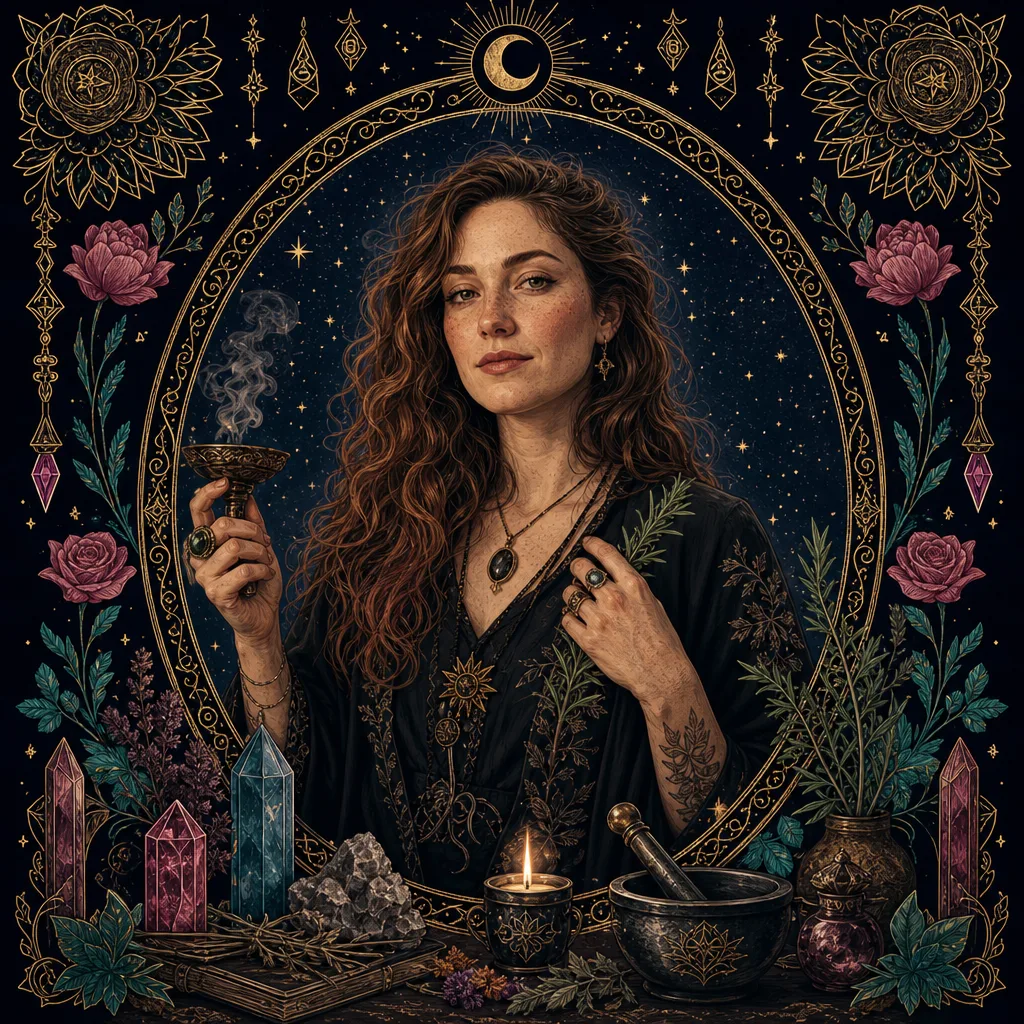
Witches & Their Paths
Secular Witch
Also called Atheist Witch, Non-Theistic Witch
A secular witch is a practitioner who works with magical methods and witchcraft traditions without a theistic or supernatural belief framework, treating magic as a psychological, symbolic, or practical technology rather than as a spiritual or religious practice.
- Tradition
- Contemporary witchcraft, particularly as practised in secular or post-religious contexts
- Standing
- Open
A profile of the Secular Witch
A clear-eyed and practically minded practitioner who uses the full toolkit of witchcraft because it genuinely works, and has no need of supernatural explanations to know that it does.
- Loves
- the psychology of ritual and symbolic thought, herbalism backed by botanical research, the wheel of the year as a thinking framework, honest record-keeping of what works and what doesn't.
- Hobbies and pastimes
- reading the research literature on placebo, suggestion, and ritual, kitchen witchcraft with real culinary craft alongside it, seasonal journaling and reflection, tarot as a structured thinking tool, foraging and plant identification.
- Dream familiar
- A fox who is not mythological but simply very clever, and who evaluates every situation on its merits.
- Found in their element
- At a well-organised kitchen altar, or at the desk where the journal lives, always within reach of both the herb jars and the bookshelf.
- Signature objects
- a well-annotated tarot deck, a kitchen windowsill herb garden, a seasonal journal with moon phase notes, a collection of natural objects arranged with intention, a black or white altar cloth with no deity imagery.
A secular witch is a practitioner who works with the methods, tools, and traditions of witchcraft without holding theistic or supernatural beliefs as the framework for that work. Magic, for the secular witch, operates through mechanisms that can be understood without invoking gods, spirits, or forces beyond the natural world: psychology, symbolism, focused intention, the placebo effect at its most sophisticated and intentional, the genuine power of ritual to reorganise consciousness and behaviour. The practice is real; the metaphysical frame is naturalistic.
This is a growing and significant path in contemporary witchcraft, reflecting both the increasing proportion of the population that holds no religious belief and the recognition that magical methods have genuine value and psychological coherence regardless of the metaphysical system used to explain them. A secular witch can practice the full breadth of witchcraft, from herbalism to divination to spellwork to seasonal ritual, and often does so with considerable skill and depth.
The work
Secular witch practice looks externally similar to other witchcraft paths. The altar, the candles, the herbs, the timing by moon phase and season, the careful ritual structure, all of these are present and used with the same care that religious practitioners apply. The difference lies in the internal understanding of what is happening.
Spellwork, for the secular witch, is often understood as deliberate self-programming: using symbol, ritual, and focused intention to make a change in the practitioner”s own psychology and therefore in their subsequent behaviour and perception of opportunity. A money spell does not summon wealth from nowhere; it adjusts the practitioner”s orientation toward abundance, clears self-sabotaging thought patterns, and focuses attention on practical steps that were always available but not clearly seen.
Divination is approached as a tool for reflective thinking rather than as prophecy. Drawing tarot cards and meditating on their imagery is a structured way to access intuition, examine a situation from multiple angles, and surface assumptions the conscious mind has not articulated. This framing does not diminish the practice; it explains why experienced diviners provide genuinely useful guidance regardless of the metaphysical framework they hold.
The seasonal calendar of witchcraft, the wheel of the year, is observed by secular witches as a meaningful connection to natural cycles and as a framework for deliberate self-reflection. Samhain is a real confrontation with mortality and memory even when the ancestors are honoured as psychological presences rather than literal surviving souls. Midsummer is a real celebration of abundance and light even without invoking a sun god.
Herbalism, protective charms, and kitchen magic within a secular framework emphasise what is demonstrably real: the genuine medicinal properties of plants, the placebo and psychological benefits of protective ritual, the mood and motivation shift that comes from cooking with intention and attention.
History and tradition
Secular witchcraft as a named and self-conscious identity is contemporary, emerging most visibly in online communities from the 2010s onward as more practitioners who had been drawn to witchcraft”s practices but not its theology found each other and found language for their approach.
However, the idea that magic works through natural causes rather than supernatural ones has old roots. The educated practitioners of natural magic in the Renaissance, including Giambattista della Porta and Francis Bacon in early writings, positioned their work as the study of hidden natural properties of things rather than as interaction with spirits or demons. This tradition of naturalistic magic has always coexisted with more explicitly religious approaches.
Many historical folk magic practitioners likely held beliefs closer to pragmatic naturalism than to formal theology: the charm works because that is what charms do, the herb heals because that is what herbs do, without elaborate supernatural framework beyond the conviction that the world is shot through with correspondences and powers that a skilled practitioner can learn to use.
Walking this path
The secular witch begins exactly as any other witch begins: choosing methods and practices that feel true, studying their sources carefully, keeping records of what is done and what follows, and developing discernment about what works. The difference is a particular emphasis on honest self-observation and on testing explanatory frameworks against experience rather than accepting them on faith.
Engaging with the psychology of magic is rewarding for secular practitioners: the work of William James on religious experience, Jungian thought on archetypes and symbol, the research literature on placebo effects, suggestion, and the relationship between ritual and wellbeing all provide frameworks that secular witches find genuinely illuminating.
The secular witch path sits comfortably alongside eclectic witchcraft, green witchcraft, kitchen witchcraft, and almost every other path. The only friction is with paths that require specific supernatural beliefs as a condition of practice. Since most contemporary witchcraft is pluralistic in this regard, the secular witch generally finds ample space and good company.
In myth and popular culture
The secular or naturalistic magician has predecessors in Renaissance natural philosophy, where the tradition of magia naturalis, natural magic, insisted that apparent wonders could be explained through the hidden properties of natural things rather than through demonic or divine intervention. Giambattista della Porta’s “Magia Naturalis” (1558, expanded 1589) is the most famous example, cataloguing optical illusions, chemical reactions, and botanical properties under the heading of natural magic. Francis Bacon engaged with similar ideas in his early work, and the boundary between natural magic and what would become experimental science remained productively blurred for much of the seventeenth century.
In fiction, the secular or rationalist practitioner appears whenever a writer wants to acknowledge the psychological and social power of ritual without committing to a supernatural explanation. Terry Pratchett’s witch characters, particularly Granny Weatherwax in the Discworld novels, operate on a philosophy close to secular witchcraft in some respects: Granny understands that most of what she does works through what she calls “headology,” the skilled manipulation of perception and expectation, and she is entirely unsentimental about this. The witchcraft in Pratchett’s hands is both real, in that it produces effects, and explicable through human psychology and social dynamics.
In academic writing, the secular witch’s instinct to understand magic through a naturalistic lens has found serious support. The anthropologist Stanley Tambiah’s work on ritual, and the sociologist Randall Collins’s research on interaction rituals, provide frameworks that secular practitioners find genuinely useful for understanding why their practice works without requiring supernatural premises. Tanya Luhrmann’s “Persuasions of the Witch’s Craft” (1989), an anthropological study of British magical practitioners, examines how people learn to think magically and what that mode of cognition does for them, offering the kind of empirically grounded, sympathetic analysis that secular witches often find more valuable than either credulous acceptance or dismissive scepticism.
People also ask
Questions
Can you really be a witch without believing in the supernatural?
Yes, and many people are. Secular witches use the tools and methods of witchcraft, spellwork, ritual, herbalism, divination, and calendar practice, while understanding these as working through psychological, neurological, or social mechanisms rather than through supernatural agency. The efficacy of the practice is real; the explanation for it differs from that of religious witches.
What are the main frameworks secular witches use to explain how magic works?
Common frameworks include psychological magic, in which spell and ritual work on the practitioner's own mind and motivation rather than on external reality directly; symbolic action, in which ritual creates meaningful personal and communal narratives that shift behaviour and perception; and probabilistic thinking, in which magical work is understood to work with natural probabilities rather than override them. Many secular witches hold their explanatory framework loosely and focus on results.
How does a secular witch relate to deities, spirits, and the fae?
Many secular witches work with these figures as archetypes, as useful symbols with deep psychological and cultural roots, rather than as literally existing beings. Others bracket the question entirely and work with whatever proves effective. Some secular witches discover over time that their understanding of what is real shifts with experience, and they update their framework accordingly. The path does not require commitment to a fixed metaphysical position.
Is secular witchcraft less effective than religious witchcraft?
No evidence supports a difference. Practitioners on both sides of the secular or religious divide report meaningful results from their work. Different explanatory frameworks describe the same observed outcomes differently. What appears to matter most is the practitioner's engagement, consistency, and skill, not the metaphysical frame they apply to it.
Is secular witchcraft the same as chaos magic?
They share some intellectual territory, particularly the pragmatic approach to belief. Chaos magic is a specific postmodern magical system that treats all magical systems as equally valid tools and belief itself as a manipulable technology. Secular witchcraft is a broader identity that does not require the specific chaos magic framework or its particular practices. Some secular witches are also chaos magicians; others are not.