Witches & Their Paths
Solitary Witch
Also called Solitaire, Hedgewitch
A solitary witch is a practitioner who works alone rather than in a coven or organised group, developing and maintaining their practice through personal study, direct experience, and independent ritual.
- Tradition
- Universal across witchcraft paths; the default mode for the majority of contemporary practitioners
- Standing
- Open
A profile of the Solitary Witch
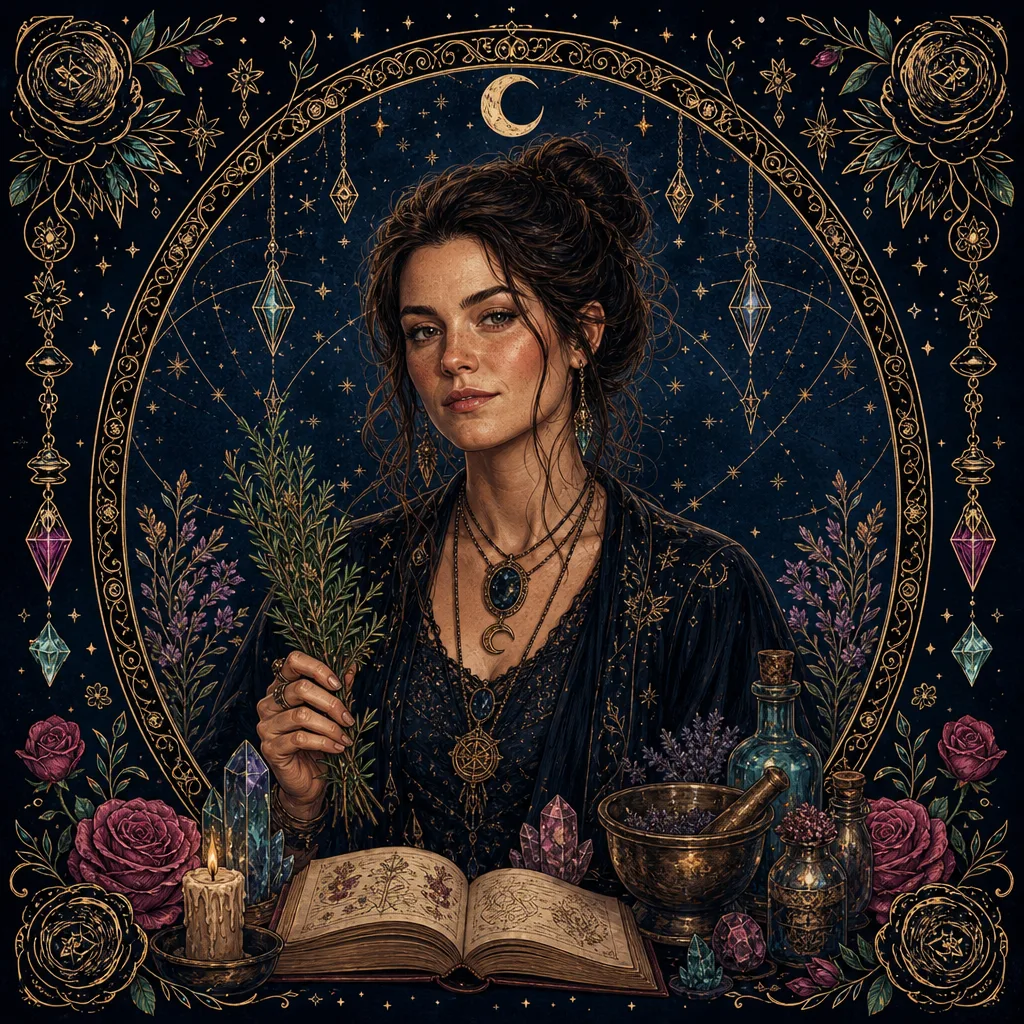
The solitary witch is the self-taught master of her own system, answerable only to the moon, the turning year, and the honest record of her own grimoire.
- Loves
- the undisturbed ritual space, new moon nights, a well-organised grimoire, wild-gathered herbs drying overhead, the specific silence of private ceremony.
- Hobbies and pastimes
- seasonal nature walks, illuminating the grimoire, kitchen alchemy and herb-drying, tarot journaling, stargazing from the back garden.
- Dream familiar
- A small black cat who understands the value of silence and sits beside the altar without being asked.
- Found in their element
- Found in their own kitchen or garden at an unconventional hour, or at a forest edge with a notebook and no one else in sight.
- Signature objects
- a personal grimoire filled over years, a single candle for the working altar, a collection of gathered stones and feathers, a well-used tarot deck, herbs hung to dry from kitchen hooks.
A solitary witch is a practitioner who works alone, maintaining and developing their magical practice outside a coven, grove, or organised group structure. They design their own rituals, determine their own calendar, and rely on their own study and discernment rather than on the shared frameworks and mutual accountability that group practice provides. The solitary path is the most common mode of witchcraft practice in the contemporary world, and it has deep roots in the pre-modern tradition of the lone village wise woman or cunning man who served their community from a position of individual knowledge rather than group membership.
“Solitary” describes a structural feature of the practice, not a personality type or a level of commitment. Some solitary witches are deeply introverted and value the privacy of working alone; others would prefer a coven but have not found one that fits. Both are equally valid expressions of the solitary path.
The work
The solitary witch designs and performs their own rituals, from simple daily practices to elaborate seasonal ceremonies. Without a group”s shared structure to carry some of the ritual weight, the solitary practitioner develops skills in all areas: writing and memorising invocations, casting the circle alone, calling quarters, working with altar and tools, and grounding and closing the working when it is complete. This full-spectrum skill development is one of the solitary path”s genuine advantages.
Daily practice for the solitary witch typically includes some combination of meditation, divination, journaling in the grimoire, tending the altar, and working small magic appropriate to the season and the practitioner”s current needs. The moon cycle often provides the primary ritual calendar, with new moon workings for new beginnings, full moon workings for matters at their peak, and dark moon time for shadow work and introspection.
The grimoire is particularly central to solitary practice, serving not only as recipe book and record but as the practitioner”s main source of continuity and self-accountability. Many solitary witches develop elaborate and beautiful grimoires over years of practice, recording experiments, results, seasonal observations, dreams, divination notes, and evolving understanding of their own magical system.
Relationship with spirits, deities, or the land is often the strongest source of external reality-check that a solitary practitioner has. These relationships, developed through consistent devotional practice and honest attention, ground the work in something beyond the practitioner”s own internal narrative and provide the kind of companionship and feedback that group practice provides socially.
History and tradition
The solitary practitioner is, historically, the norm rather than the exception in folk magic. The cunning man of early modern England worked alone, serving clients individually from a personal repertoire of spells, charms, and divinations. The village wise woman of European folklore practiced alone, transmitting knowledge through family or individual apprenticeship rather than through group initiation.
The coven as a formal structure is most strongly associated with Wicca as it developed in mid-twentieth-century Britain. Gerald Gardner”s system was explicitly coven-based, and early Wicca spread through initiated lineages working in small groups. The idea that witchcraft is necessarily a group practice is a twentieth-century development that the earlier folk tradition did not share.
Scott Cunningham”s 1988 book Wicca: A Guide for the Solitary Practitioner was influential in formalising the identity of the solitary practitioner within the neopagan movement, offering a coherent and dignified framework for those who practiced alone. It has remained one of the most widely read witchcraft books because it addressed a real need.
Walking this path
The solitary witch”s primary work is self-knowledge and self-discipline. Without external structure, the practitioner must create their own: committing to regular practice even when motivation is low, keeping honest records, returning to the grimoire to review what was done and what followed, and periodically stepping back to assess whether the practice is coherent and growing.
Finding community, even without joining a coven, is worth doing. Online forums, local open circles, workshops, and festivals connect solitary witches with the wider community of practice without requiring the commitment of group membership. These connections guard against insularity and provide reality-checks on ideas and methods that can become overly idiosyncratic in isolation.
The solitary path is compatible with every other path described in this collection. A solitary practitioner may be a hedge witch, a kitchen witch, an eclectic, or someone working in a specific folk tradition; “solitary” describes how they work, not what they work with. Many people who begin as solitaries eventually explore group practice and find it enriching, while remaining primarily independent; the solitary identity is a description of practice, not a wall.
In myth and popular culture
The solitary practitioner has a longer and deeper literary history than the coven-based witch, because the image of a single person alone with their knowledge and their craft predates the organised group structure that Wicca brought to prominence in the twentieth century. The cunning woman or wise man of European folklore is almost always alone: the wisewoman of fairy tale who lives at the forest edge, the herbalist who is consulted in secret, the elder who knows what no one else does. These figures appear across European narrative tradition as functional community resources rather than threatening outsiders, though the line between respected cunning woman and feared witch was always contextual and reversible.
In literature, the solitary witch as a sympathetic protagonist became a significant presence in the second half of the twentieth century. T.H. White’s The Once and Future King (1958) gives Merlin qualities of the solitary magician-hermit that influenced many subsequent portrayals. Diana Wynne Jones’s work, particularly the Chrestomanci series beginning with Charmed Life (1977) and the standalone novel Howl’s Moving Castle (1986), centres practitioners who work independently and whose power grows from individual relationship with their craft rather than institutional membership. Ursula K. Le Guin’s Earthsea novels, beginning with A Wizard of Earthsea (1968), trace a practitioner’s solitary growth in skill and wisdom across a lifetime and remain among the most thoughtfully written treatments of magical development in fiction.
In the broader contemporary landscape, the solitary practitioner is the dominant figure in popular witchcraft media. The character of Willow Rosenberg in Buffy the Vampire Slayer (television, 1997 to 2003) begins as an effectively solitary practitioner developing personal ability through self-study, though the series later places her within group structures. The Practical Magic novel by Alice Hoffman (1995), and its 1998 film adaptation, centres two women whose practice is familial and independent rather than organisationally structured. The mainstream popularity of witchcraft on platforms such as TikTok and Instagram in the 2010s and 2020s has largely been a solitary phenomenon, with individual practitioners sharing personal practice rather than representing any group tradition, reflecting the historical norm the role has always embodied.
People also ask
Questions
Is a solitary witch less powerful or serious than a coven member?
No. Solo practice and group practice have different qualities, but neither is inherently superior. Solitary witches often develop a very personal relationship with their practice because they must rely entirely on their own discernment, and many accomplished practitioners work primarily alone throughout their entire magical lives.
Can a solitary witch also attend circles or events with other witches?
Yes, and many do. "Solitary" describes the default mode of practice, not an absolute prohibition on group work. A solitary witch might join a community for seasonal celebrations or open rituals while maintaining their personal practice independently.
How does a solitary witch learn without a teacher?
Through reading, experimentation, careful record-keeping in a grimoire, and developing discernment about what works and why. Online communities, correspondence courses, and local open circles can supplement self-directed study. The solitary path rewards curiosity, patience, and the willingness to accept that learning continues indefinitely.
What are the challenges of working alone?
Without external accountability, a solitary practitioner must supply their own structure, motivation, and standards. The absence of a teacher means that errors in understanding can go unnoticed for longer. Ritual work done alone lacks the energy amplification that group practice can generate. These are real challenges rather than insurmountable obstacles, and most solitary witches develop their own strategies for addressing them.
Did solitary witchcraft exist before the modern era?
Yes. The village wise woman or cunning man of folk tradition almost always worked alone or within a small family context, not in a coven. Organised covens as a formal structure are associated primarily with Wicca in the twentieth century. Solitary practice is, historically, the older and more common form.