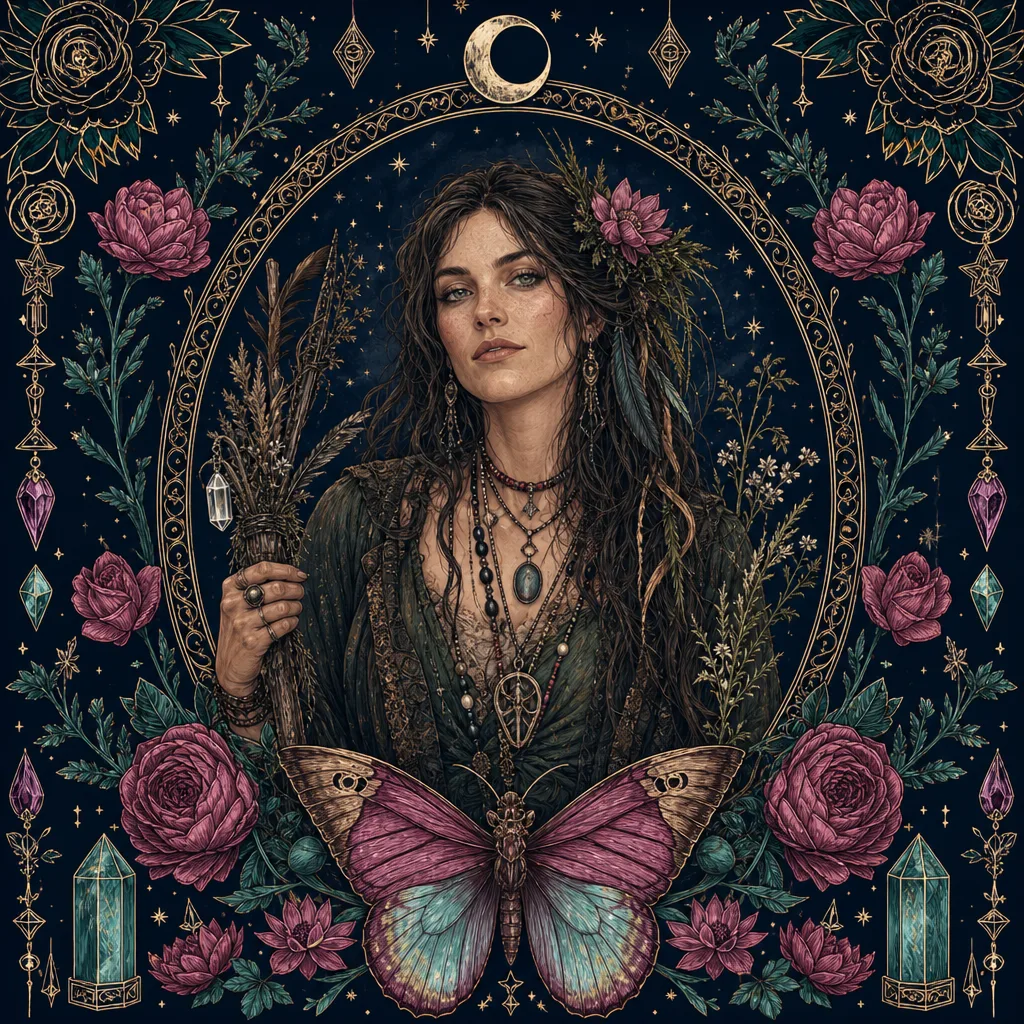
Witches & Their Paths
Swamp Witch
Also called Bayou Witch, Marsh Witch
A swamp witch is a practitioner who draws magical power from wetland landscapes, working with the liminal, murky, and generative qualities of marshes, swamps, and bayous as their primary sacred environment.
- Tradition
- Southern American folk magic and broadly animist wetland practice, with eclectic contemporary development
- Standing
- Open
A profile of the Swamp Witch
The swamp witch is the practitioner who knows that the most powerful transformations happen in the mud, not in the clean and ordered places where people prefer to look.
- Loves
- the smell of black water in summer, Spanish moss moving in slow air, the specific call of a barred owl at dusk, cypress knees rising from dark stillness, rain on a bayou in August.
- Hobbies and pastimes
- wetland species identification, gathering and preparing swamp materia, photographing the wetland across seasons, studying the folk magic of the American South.
- Dream familiar
- A great blue heron who stands utterly still in the shallows and only moves when you have finally stopped watching.
- Found in their element
- Found knee-deep in a marsh at an hour when sensible people are inside, or sitting on a cypress root beside water that has not reflected anything clean since long before she arrived.
- Signature objects
- a jar of swamp mud from a significant location, dried Spanish moss for binding work, a collection of cypress knee fragments, alligator or turtle bones from the landscape, a weathered root gathered from standing water.
A swamp witch is a practitioner who draws magical power and orientation from wetland landscapes, working with the specific character of marshes, swamps, bogs, and bayous as sacred and deeply powerful places. The swamp is not merely a setting for this practitioner”s work; it is an active participant, a landscape of extraordinary life and death, of murk and emergence, of decomposition and transformation, whose qualities shape every aspect of the magic practiced there.
The swamp witch label is contemporary, spreading through online witchcraft communities in the 2010s with a particular association with American Southern and bayou aesthetics. But the landscape that generates this practice is ancient, and the folk magic traditions of swamp and wetland regions, particularly in the American South, have genuine depth and particularity that gives this path real content beyond its evocative visual vocabulary.
The work
The swamp witch works with the landscape itself as the primary teacher and power source. Regular time in wetland environments, learning the species that live there, the seasonal changes, the specific feel of the light through cypress and Spanish moss, and the quality of standing water at different times of year, is the foundational practice. This is not recreational; it is attention given to a living, intelligent place that returns the attention with knowledge and power.
Plants of the wetland are primary materia. Spanish moss, in the American South particularly, has a long history as a stuffing for charm bags and poppets, its fibrous entangling nature used for binding and holding. Cattail has traditional protective uses. Cypress trees are widely associated with longevity, endurance, and the presence of spirits, and their distinctive knees rising from black water carry their own haunting character. Water-growing plants such as iris and lily have deep folkloric associations with the boundary between realms.
Mud, silt, and dark water from the swamp are used in much the same way that other witches use graveyard dirt: as materials charged by the specific power of their place of origin. Swamp mud carries the accumulated decay, life, and transformation of the wetland; working with it requires the same respectful protocols as working with graveyard soil, including asking the landscape”s permission, offering something, and using it intentionally.
Spirit work in the swamp is abundant. Wetlands are liminal in every physical sense, and liminality invites spirit presence. Many swamp witches develop relationships with the spirits of specific trees, waterways, and areas within their home wetland, learning to distinguish different presences and work with them appropriately. The quality of spiritual activity in a genuine wetland at dusk is not subtle.
Transformation is the swamp”s deepest teaching. Things decompose in the swamp so that other things can live; what looks like death is actually conversion. The swamp witch works with this principle magically, using decay and compost symbolism in release work, understanding that what must end becomes the ground of what comes next.
History and tradition
The American South”s wetland regions are home to several of the richest folk magic traditions in the United States. Louisiana, with its unique Creole culture and the proximity of African, French, Spanish, and Indigenous influences, produced the distinctive traditions of Louisiana Voodoo and the syncretic practice associated with figures like Marie Laveau. The Carolina Low Country and Georgia Sea Islands sustained Gullah Geechee culture with its own rich body of folk belief and practice rooted in both African tradition and the specific coastal wetland landscape.
More broadly, wetland landscapes have been significant magical and religious sites across many cultures. The peat bogs of northern Europe yielded the bog bodies, individuals sacrificed or committed to the bog in practices that spoke to the wetland as a site of communication with the divine. Celtic peoples deposited votive offerings in lakes, rivers, and bogs on a massive scale, understanding these watery, liminal places as openings to the otherworld.
The Mississippi and its associated bayous and backwaters are woven through American folk tradition with the quality of liminal power: the place where things happen that cannot happen in ordinary geography, where deals are made at crossroads that happen to be also the crossing of water, where blues music developed its supernatural mythology in the same landscape that hosted generations of root-workers, conjurers, and swamp healers.
Walking this path
The swamp witch begins by spending real time in a wetland, whether that is a Louisiana bayou, a Carolina marsh, a Florida cypress dome, or any authentic wetland available. Sitting with the landscape, learning its smells and sounds and the quality of its light at different hours and seasons, is the irreplaceable foundation. A practice built on actual landscape relationship is fundamentally different from one built on the aesthetic of wetlands without embodied contact.
Learning the specific regional folk magic of any swamp-and-water tradition the practitioner is drawn to, while maintaining respectful awareness of cultural boundaries, provides historical depth and practical technique. The American Southern folk magic record is rich and increasingly well-documented in scholarship.
The swamp witch path combines naturally with death witchcraft (the swamp”s relationship with decay and transformation), hedge witchcraft (its quality of liminality and spirit crossing), and sea witchcraft (the coastal wetland where freshwater and saltwater meet). It is among the more demanding landscape-based paths precisely because it requires regular contact with a specific kind of wild and difficult place rather than the more managed beauty of a garden or the accessible rhythms of the night sky.
In myth and popular culture
The swamp and its inhabitants have occupied a specific imaginative space in American culture since the colonial period, partly because the wetlands of Louisiana, the Carolinas, and Florida were genuinely difficult and powerful places that resisted settlement and harboured people and practices outside the reach of ordinary social control. Marie Laveau, the New Orleans Voodoo practitioner who was the most famous magical figure of nineteenth-century America, worked in a city whose back country was bayou and wetland, and the landscape infuses the tradition she embodied. Accounts of her practice, though filtered through journalism and mythology, consistently place her in intimate relationship with the natural world of the Louisiana delta. Her historical reality is well documented; the tradition she represents, rooted in the swamp country of the Gulf Coast, is one of the richest in North America.
In the literary record, the swamp as a site of power and transformation appears consistently in American Southern writing. Zora Neale Hurston’s ethnographic and literary work, particularly Mules and Men (1935) and Their Eyes Were Watching God (1937), documents the folk magic practices of the American South with firsthand knowledge, and the wetland landscape is a constant presence in both the practice and the setting. William Faulkner’s Yoknapatawpha cycle returns repeatedly to the Mississippi bottomlands as places where the ordinary rules are suspended and older, more powerful logics operate. More recently, the Louisiana-set horror fiction of Poppy Z. Brite and the work of Southern Gothic writers has maintained the tradition of treating the swamp as a space where liminal power is available to those who know how to read it.
On screen, the swamp and bayou have generated some of American popular culture’s most sustained engagements with folk magic. The television series True Blood (2008 to 2014), set in Louisiana, drew on the landscape’s magical associations while mixing them with fictional vampire mythology. More grounded is the television series Treme (2010 to 2013), which documents New Orleans culture in the aftermath of Hurricane Katrina with attention to the spiritual and magical traditions of the city and its surrounding wetland environment. The animated film The Princess and the Frog (2009), set in 1920s New Orleans, engages with the city’s Voodoo traditions through the character of Dr. Facilier, drawing on the historical landscape of bayou and swamp power even within a family entertainment context.
People also ask
Questions
Is swamp witchcraft a real tradition or just an aesthetic?
Both the tradition and the aesthetic are real. The wetlands of Louisiana, the Carolina Low Country, Florida, and other regions have sustained rich folk magic traditions that are genuinely rooted in their specific landscapes. The swamp witch identity today synthesises elements of these regional traditions with personal animist practice centered on wetland landscapes. The aesthetic of Spanish moss, dark water, and cypress trees reflects a real landscape relationship, not costume.
What plants does a swamp witch work with?
Swamp witches work with the plants of their specific wetland region. In the American South this includes Spanish moss used for binding and stuffing charm objects, cattail as a protection plant, cypress and its knees as spirit dwelling places, various aquatic plants with healing and magical properties, and kudzu and other aggressive growers worked with for tenacity and boundary magic. Water lily and lotus have long magical associations with transformation and emergence.
How does the swamp as a liminal space factor into this practice?
The swamp is the ultimate liminal landscape: neither fully water nor fully land, neither clearly alive nor clearly dead (since wetlands are simultaneously teeming with life and full of decay), neither open nor penetrable. This in-between quality makes the swamp one of the most powerful landscapes for magic that works at boundaries: between life and death, between the ordinary and the spirit world, between what is seen and what is hidden. Swamp witches work deliberately with this liminal quality.
Is the swamp witch connected to Hoodoo or Louisiana Voodoo?
The wetland regions of the American South are home to rich traditions including Hoodoo, Louisiana Voodoo, and the folk magic of the Creole communities. A swamp witch working in the American South may draw on or overlap with some elements of these traditions, but should be careful to distinguish between the landscape-centred practice of swamp witchcraft and the culturally specific and partially closed traditions of Hoodoo and Louisiana Voodoo. The latter have community custodians and deserve approach with appropriate respect.
What if I don't live near a swamp?
Swamp witch practice is most naturally rooted in actual wetland landscapes, but practitioners who live away from wetlands may work with whatever body of standing water or liminal landscape is available: a marshy area, a slow river, a pond surrounded by reeds. The quality of water-and-land liminality is what the practice draws on, and that quality can be found in many landscapes beyond the obvious cypress swamp.