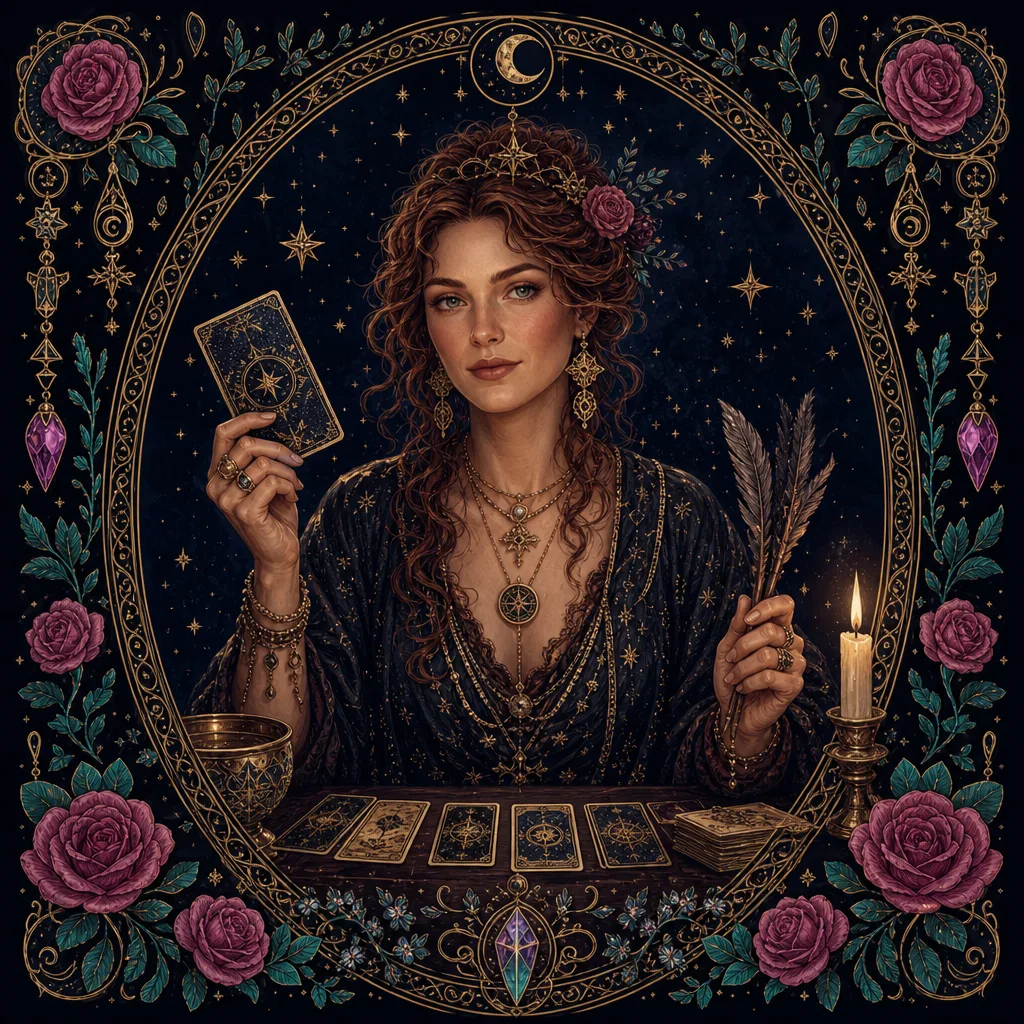
Diviners & Seers
Tarot Reader
Also called cartomancer, tarotist
A tarot reader is a diviner who uses a deck of 78 illustrated cards to interpret symbolic imagery as guidance, insight, or reflection. They read the cards as a living language of archetypes and energies that speak to present circumstances and possible futures.
- Tradition
- European, rooted in 15th-century card games and later esoteric revival through the 18th and 19th centuries
- Standing
- Open
A profile of the Tarot Reader
A patient interpreter of symbolic images who reads the living language of the cards to help others find clarity in the tangled present.
- Loves
- illustrated card symbolism, quiet mornings with a fresh deck, the moment a reading lands for someone, a well-worn journal full of card reflections, shadow work and honest self-inquiry.
- Hobbies and pastimes
- daily single-card journaling, collecting decks with distinctive art, studying Kabbalistic correspondences, attending tarot swap meets and reading circles.
- Dream familiar
- A silver-grey barn owl who perches on the card table and tilts her head knowingly at every reversed card.
- Found in their element
- Found at a small cloth-covered table in a candlelit corner, cards already shuffled, waiting for the next question.
- Signature objects
- a personal reading deck wrapped in silk, a spread cloth with position markings, a dedicated tarot journal, a reference copy of the Pictorial Key to the Tarot, a candle lit before every reading.
A tarot reader is a diviner who interprets a structured deck of 78 illustrated cards as symbolic guidance for questions about life, relationships, choices, and inner development. The practice treats each card as a carrier of archetypal meaning, and the reader’s work is to translate the language of those images into insight that is genuinely useful to the person sitting across from them. Tarot reading sits comfortably alongside many other spiritual paths and requires no single religious allegiance.
The role draws on both studied knowledge and cultivated intuition. A skilled reader knows the traditional meanings of each card and its reversed position, understands how the four suits and the court cards map onto human experience, and has developed the perceptual sensitivity to notice what a card is saying in the particular context of a particular reading. The two capacities reinforce each other: knowledge gives structure, and intuition gives life to that structure.
The work
The reader’s primary tool is the deck itself. Most readers develop a personal relationship with one or several decks, keeping them wrapped in cloth or stored in a dedicated box, and handling them regularly to establish a working rapport with the cards. Before a reading the reader typically creates a quiet, focused atmosphere, shuffles the cards while the querent holds their question in mind, and selects a spread appropriate to the question’s scope.
A spread assigns meaning to each card position before the cards are drawn. A simple three-card spread might assign past, present, and future. A Celtic Cross spread uses ten positions to map a situation from multiple angles. The reader lays the cards, then builds an interpretation that attends to each card in its position, to relationships between cards, and to the overall pattern of the spread. Reversed cards, which appear upside down when laid, often indicate blocked or internalized energy.
Journals play an important role for many readers. Daily single-card draws with written reflections sharpen both memory and interpretive sensitivity over time. Many readers also use oracle cards alongside tarot, though oracle decks are not tarot and follow their own internal systems.
History and tradition
The cards that became tarot first appeared in northern Italy around 1430 as playing cards for a trick-taking game called tarocchi. The suits and court structure descended from earlier Islamic and North African playing card traditions. The elaborate trump cards, which became the Major Arcana, were painted for wealthy patrons and carried allegorical imagery drawn from the symbolic culture of late medieval and Renaissance Europe.
Tarot did not enter the world of divination until the late 18th century, when French occultists, most notably Antoine Court de Gebelin and later Etteilla, claimed the cards encoded ancient Egyptian wisdom. That claim was historically inaccurate, but it generated an enormously productive esoteric tradition. In the 19th century the Hermetic Order of the Golden Dawn systematically mapped the 78 cards onto Kabbalistic, astrological, and elemental correspondences. The deck most readers use today, the Rider-Waite-Smith, was designed in 1909 by Arthur Edward Waite and illustrated by Pamela Colman Smith. Its fully illustrated pip cards made the symbolism accessible in a new way and set the visual vocabulary that most subsequent decks inherit.
The late 20th century saw an explosion of decks designed for feminist, queer, multicultural, and nature-based perspectives. Modern tarot is a genuinely plural tradition, holding both rigorous esoteric systems and more intuitive, psychological approaches.
Walking this path
Most tarot readers begin with study: learning the 78 cards, their elemental and astrological attributions, and the numerological logic of the suits. A good beginning practice is to draw one card each morning, sit with its image, write down what you notice, then look back at the end of the day to see where the card’s themes appeared. This process is slow and genuinely effective.
Reading for others is a distinct skill that develops through practice. Early readers often start with willing friends, offering readings freely in exchange for feedback. Reading for someone you do not know is a deepening practice, because you cannot fill in meaning from personal familiarity. Most readers develop ethical guidelines for their work, including how they handle questions about health, death, or third parties, and many find that clearly stated intentions before a reading improve its quality noticeably.
Tarot reading pairs naturally with astrology, numerology, and intuitive or psychic development practices. Many readers incorporate meditation, shadow work, or journaling as complementary disciplines. The path has no gatekeepers and no formal lineage, which means your development is largely self-directed, and the community of readers online and in person is wide, generous, and active.
In myth and popular culture
The figure of the card-reading seer appears memorably in the Western literary imagination long before modern tarot practice consolidated its present form. In Fyodor Dostoevsky’s novel “The Idiot” (1869), fortune-telling with cards punctuates the story’s fevered social gatherings, reflecting the widespread practice of cartomancy in nineteenth-century Russian society. Charlotte Bronte gives Rochester the guise of a fortune-telling gypsy woman in “Jane Eyre” (1847), staging a scene in which he reads Jane’s character through a performance that sits precisely at the border between theatrical deception and genuine insight, a tension that has followed the card reader in popular culture ever since.
The tarot reader as a figure of atmospheric mystery became a fixture of twentieth-century cinema and television. Ida Lupino’s role in the noir film “The Bigamist” (1953) is not a reader, but the decade’s genre habit of framing mysterious women with occult knowledge set the visual vocabulary that later productions would draw on. More directly, the tarot scene in the James Bond film “Live and Let Die” (1973) introduced the Rider-Waite-Smith imagery to a massive popular audience, with Jane Seymour’s Solitaire reading the cards as a tool of political prophecy within a plot that treated divination as a kind of power that could be neutralized by sexual compromise, reflecting the ambivalent and often condescending attitude popular entertainment has long taken toward the practice.
Literary tarot received more sympathetic and sophisticated treatment in Italo Calvino’s “The Castle of Crossed Destinies” (1969), in which characters stranded in a mysterious castle tell their life stories by laying out tarot cards rather than speaking, each card a narrative element in a sequence of interlocking tales. Calvino worked with both a Visconti-Sforza deck and a Marseille deck across the book’s two parts, treating the cards with genuine structural imagination rather than as mere atmosphere. Rachel Pollack’s “Seventy-Eight Degrees of Wisdom” (1980 and 1983), though a practice guide rather than a novel, achieved something like canonical status in the tarot reading community as a deeply intelligent and humanistic account of what the cards mean and how to work with them.
Contemporary popular culture has rehabilitated the tarot reader from sinister fortune-teller to thoughtful counsellor with notable speed. The Netflix series “The OA” (2016) and the character of Marie Laveau in “American Horror Story: Coven” (2013) use cards and visionary practice as markers of genuine spiritual authority rather than fraudulence. The explosion of tarot content on social media platforms, particularly through readers such as Benebell Wen, Kelly-Ann Maddox, and Sasha Graham who blend scholarly depth with accessible presentation, has further shifted public perception of the role toward something practitioners might recognize as closer to the actual experience of serious reading.
People also ask
Questions
Do tarot readers predict the future?
Most contemporary tarot readers describe the cards as reflecting energies, patterns, and probabilities rather than fixed fate. A reading shows one or several possible futures shaped by present choices. You remain the author of your own story.
Do you need a gift or special ability to read tarot?
Reading tarot is a learnable skill rooted in symbolic literacy, intuition, and practice. Many accomplished readers develop their craft through study, journaling, and daily draws rather than innate psychic ability.
What does a full tarot reading involve?
A reader typically shuffles the deck while holding a question, lays cards into a spread (a pattern where each position has a meaning), and interprets how each card speaks to its position and to the surrounding cards. Readings can be brief single-card reflections or elaborate multi-card spreads.
What is the difference between the Major and Minor Arcana?
The 22 Major Arcana cards represent large archetypal forces and life themes, such as The Tower or The Star. The 56 Minor Arcana are divided into four suits and address everyday situations, relationships, and the texture of daily life.
Can anyone use any tarot deck?
Yes. While the Rider-Waite-Smith deck is the most widely studied, hundreds of decks exist across many aesthetics and traditions. Readers often choose a deck whose imagery speaks to them instinctively.