Ceremonial & High Magicians
Thelemite
Also called Thelemite Magician, Servant of the Law
A Thelemite is a practitioner of Thelema, the spiritual and magickal system founded by Aleister Crowley following the reception of The Book of the Law in 1904. Thelema holds that each person has a True Will, a unique purpose that is their correct expression in the universe, and that the aim of all magickal practice is to discover and enact that will.
- Tradition
- Thelema, developed by Aleister Crowley from Hermetic, Kabbalistic, and Golden Dawn foundations
- Standing
- Open
A profile of the Thelemite
A disciplined self-scientist of the will, committed to discovering the single great purpose that the whole of their nature is built to fulfil.
- Loves
- the Gnostic Mass performed with full attention, Crowley's prose at its most lucid, the silence after a banishing ritual, the Kabbalistic Tree of Life as a map of everything, a magical diary kept without self-deception.
- Hobbies and pastimes
- daily Liber Resh adorations at the four solar stations, pathworking on the Tree of Life, study of 777 and its correspondences, ritual construction and testing.
- Dream familiar
- A great golden hawk who circles overhead at noon as the Resh adoration is spoken, silent and unhurrying.
- Found in their element
- Found at the altar before dawn or after midnight, performing the adorations with the precision and regularity of a practitioner who genuinely means it.
- Signature objects
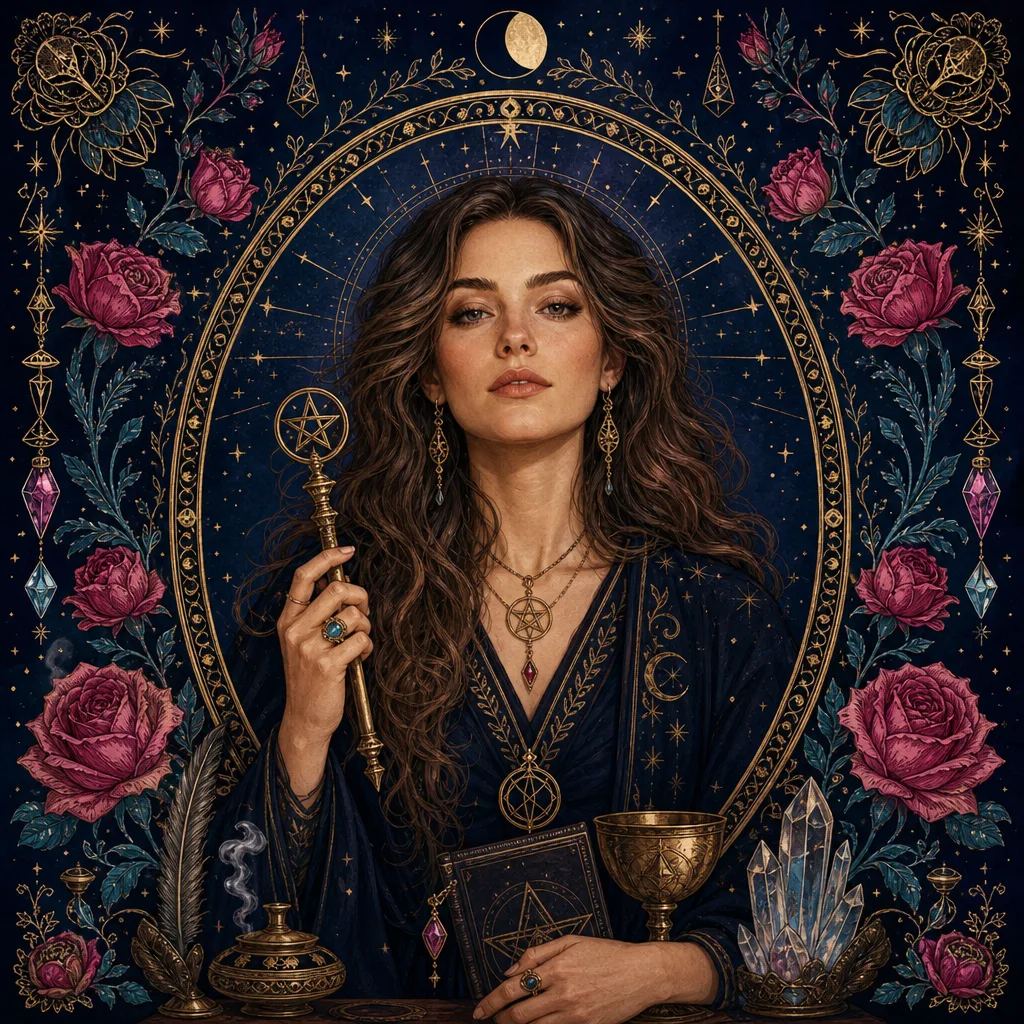
- a magical diary in a stiff-bound journal, a wand consecrated to the True Will, a copy of The Book of the Law, a Star Ruby performed before any working, a Thoth Tarot deck, a rose-cross lamen.
A Thelemite is a practitioner of Thelema, a spiritual and magickal philosophy founded by Aleister Crowley in the early twentieth century and built upon the foundation of a text called The Book of the Law, received in Cairo in April 1904. Thelema holds that the cosmos has entered a new aeon, the Aeon of Horus, in which the governing spiritual principle is the discovery and fulfilment of individual True Will rather than the submission to a divine authority from outside the self. The central ethical statement of the tradition is “Do what thou wilt shall be the whole of the Law,” paired with “Love is the law, love under will.”
The Thelemite”s magickal work is oriented toward a single supreme goal: the Knowledge and Conversation of the Holy Guardian Angel, a term Crowley took from the Abramelin operation but redefined as the conscious union with one”s own higher self or true genius. This achievement is understood as the prerequisite for all higher magickal and mystical work, because it is only when one knows and enacts one”s True Will that the deeper stages of the path become accessible and safe.
The work
Thelemic practice is richly systematic and draws extensively on the ceremonial magick of the Hermetic Order of the Golden Dawn, which Crowley encountered as a young man and extended considerably. The daily practice of a committed Thelemite typically includes morning and evening adorations to the sun, formal banishing using the Star Ruby or Lesser Banishing Ritual of the Pentagram, and some form of invocation or devotional work.
The Liber Resh vel Helios adorations are performed four times daily, at sunrise, noon, sunset, and midnight, and serve as a constant renewal of the practitioner”s orientation toward their Will and their awareness of the solar current. Liber Jugorum and other Crowley-prescribed practices train the will through the deliberate cultivation of attention and restraint. The magical diary is kept with greater care than in perhaps any other tradition, because Crowley insisted that the practitioner treat themselves as a scientific observer and record everything scrupulously so that results can be evaluated without the distortion of wishful thinking.
Invocation of the gods of the Thelemic pantheon, principally Nuit, Hadit, and Ra-Hoor-Khuit as described in The Book of the Law, forms the devotional heart of the system. The Gnostic Mass, Liber XV, is the central public and communal rite, performed in Ecclesia Gnostica Catholica congregations worldwide and available for private performance as well. Higher workings may involve the practices of sex magick transmitted through the Ordo Templi Orientis degrees, though these are not a prerequisite for serious Thelemic practice.
History and tradition
Crowley encountered the Golden Dawn in 1898 and rose rapidly through its grades before parting from its leadership and pursuing his own path of accelerating initiation. In 1904, while in Cairo with his wife Rose Kelly, Crowley received a transmission over three successive days that he recorded as The Book of the Law, a text written in a voice he identified as Aiwass, his own Holy Guardian Angel. The Book announced the end of the Aeon of Osiris, the age of the dying and rising god, and the beginning of the Aeon of Horus, the crowned and conquering child.
Crowley spent the following decades systematizing a vast practical curriculum, producing major works including Magick in Theory and Practice, The Book of Thoth, 777, and the instructions for the A.:A.: grade system. He also became Grand Master of the English-speaking branch of the Ordo Templi Orientis and reformed its rituals into a Thelemic framework. His controversial public persona, cultivated in part deliberately, made him a figure of enormous notoriety in his own lifetime and continued influence after his death in 1947.
The O.T.O. and A.:A.: both survived his death and today have active branches worldwide. Crowley”s published works are all available and form one of the most extensive practical magickal libraries in the Western tradition. Contemporary Thelema continues to develop through scholarship, new commentary, and the lived experience of its practitioners.
Walking this path
Thelema asks a great deal of its practitioners in terms of both self-knowledge and practical commitment, because the central aim of discovering the True Will requires sustained honest self-inquiry that cannot be faked or rushed. The practices Crowley prescribed, particularly the magical diary, the will-training exercises, and the daily adorations, are designed to build the kind of self-awareness that makes progress toward Knowledge and Conversation possible.
Many new practitioners begin by reading Crowley”s introductory texts, particularly Magick Without Tears, which is written as a series of letters to a beginning student, and Liber ABA (Magick in Theory and Practice). Joining an O.T.O. lodge or an A.:A.: working group provides community and transmission, but the primary texts are all publicly available and a solitary practice is fully possible. The A.:A.: by design works one-to-one, student and superior, and many students work through the curriculum without ever attending a lodge.
The Thelemite role overlaps naturally with the ceremonial magician, the Hermeticist, and the Kabbalist, because these traditions share common sources and tools. Thelema is explicitly non-exclusive: it has room for practitioners from any background and asks only that you pursue your True Will with sincerity.
In myth and popular culture
Aleister Crowley himself became one of the most significant figures in twentieth-century popular mythology about the occult, and his public notoriety has shaped how Thelema appears in culture as much as the system’s actual teachings. Tabloid newspapers in Britain dubbed him “the wickedest man in the world” during his lifetime, a label he appeared to cultivate strategically, and this notoriety gave him a persistent afterlife in popular imagination. He appears as a character in numerous novels, including as the basis for the magician Oliver Haddo in W. Somerset Maugham’s “The Magician” (1908), written from life after Maugham encountered Crowley in Paris, and his influence can be felt in the figure of Aleister Crowley-influenced villains and initiates across twentieth-century horror fiction.
The Gnostic Mass, Liber XV, has been performed in Ecclesia Gnostica Catholica congregations since the early twentieth century and has occasionally attracted literary attention. Crowley’s extensive body of published work, particularly the instructional letters collected as “Magick Without Tears” (posthumously published 1954) and the practice manual “Magick in Theory and Practice” (1929), has been read continuously since publication and has influenced practitioners far outside formal Thelemic circles. The novelist and occultist Dion Fortune, who knew Crowley and had complicated views of his work, drew on the broader Golden Dawn and Thelemic current in her own magical fiction, including “The Goat-Foot God” (1936) and “Moon Magic” (1956).
In film and television, Thelema has attracted treatment ranging from the sensationalist to the thoughtful. Kenneth Anger, a filmmaker closely associated with the Thelemic current, made a series of short experimental films including “Inauguration of the Pleasure Dome” (1954) and “Lucifer Rising” (1972) that constitute genuine artistic expressions of Thelemic imagery and cosmology rather than exploitation. Jimmy Page of Led Zeppelin was a well-documented collector of Crowley’s manuscripts and memorabilia, and his interest contributed to a wave of Crowley’s renewed cultural visibility in the 1970s. More recently, the television series “Preacher” (2016 to 2019) included a version of the Grail Order with Thelemic overtones, though loosely interpreted, and Crowley appeared as a named character in the Neil Gaiman and Terry Pratchett adaptation “Good Omens” (2019), where his name is given to the demon Crawly as a winking historical allusion.
People also ask
Questions
What does "Do what thou wilt shall be the whole of the Law" mean?
This phrase, from The Book of the Law, is the central statement of Thelemic philosophy. It means that each individual has a True Will, a specific purpose or nature that is their correct expression in the cosmos, and that living in full accordance with that True Will is the highest ethical act. It is not a license for arbitrary selfishness; Crowley was explicit that the True Will is not the whim of the ego but the deep authentic current of one's being, which when followed brings the practitioner into harmony with the universe rather than into conflict with it.
Who is Aleister Crowley and how important is he to Thelema?
Aleister Crowley (1875-1947) was a British occultist, poet, and ceremonial magician who systematized Thelema following the reception of The Book of the Law, which he understood as a transmission from a discarnate intelligence called Aiwass. Crowley developed an enormous body of practical and philosophical writing, including the magickal curriculum of the A.:A.:, the grade structure of the Ordo Templi Orientis, and major works such as Magick in Theory and Practice and The Book of Thoth. He remains central to the tradition, though contemporary Thelemites engage with his legacy critically and not all accept every aspect of his teachings.
What is the difference between the A.:A.: and the O.T.O.?
The A.:A.: (Argentum Astrum or Silver Star) is the initiatory order that Crowley established for the transmission of the Thelemic magickal curriculum, organized as a series of grades through which the practitioner works largely in solitude with a single superior. The Ordo Templi Orientis (O.T.O.) is a fraternal order that works Thelemic initiatory rituals in lodge format and has a broader community and social dimension. Many Thelemites are members of one or both.
Is Thelema a religion?
Thelema has characteristics of a religion, including a sacred text, a theology, a priesthood (the Ecclesia Gnostica Catholica, which performs the Gnostic Mass), and initiatory orders, but many Thelemites prefer to describe it as a philosophy or a spiritual system rather than a religion. The Gnostic Mass is open to all and is the central public rite of the O.T.O. Thelema does not require the abandonment of other religious commitments, though its cosmology and ethics are comprehensive enough to stand alone.
What magickal practices does a Thelemite undertake?
Thelemic practice draws heavily on the Golden Dawn ceremonial system: banishing rituals, invocations, pathworking on the Kabbalistic Tree of Life, and the use of ritual tools and correspondences. The central personal practice is the Knowledge and Conversation of the Holy Guardian Angel, the establishment of a conscious relationship with one's own higher self or divine genius, which Crowley described as the supreme aim of magick. Many Thelemites also practise yoga, sex magick, divination, and the study of Crowley's extensive published system.