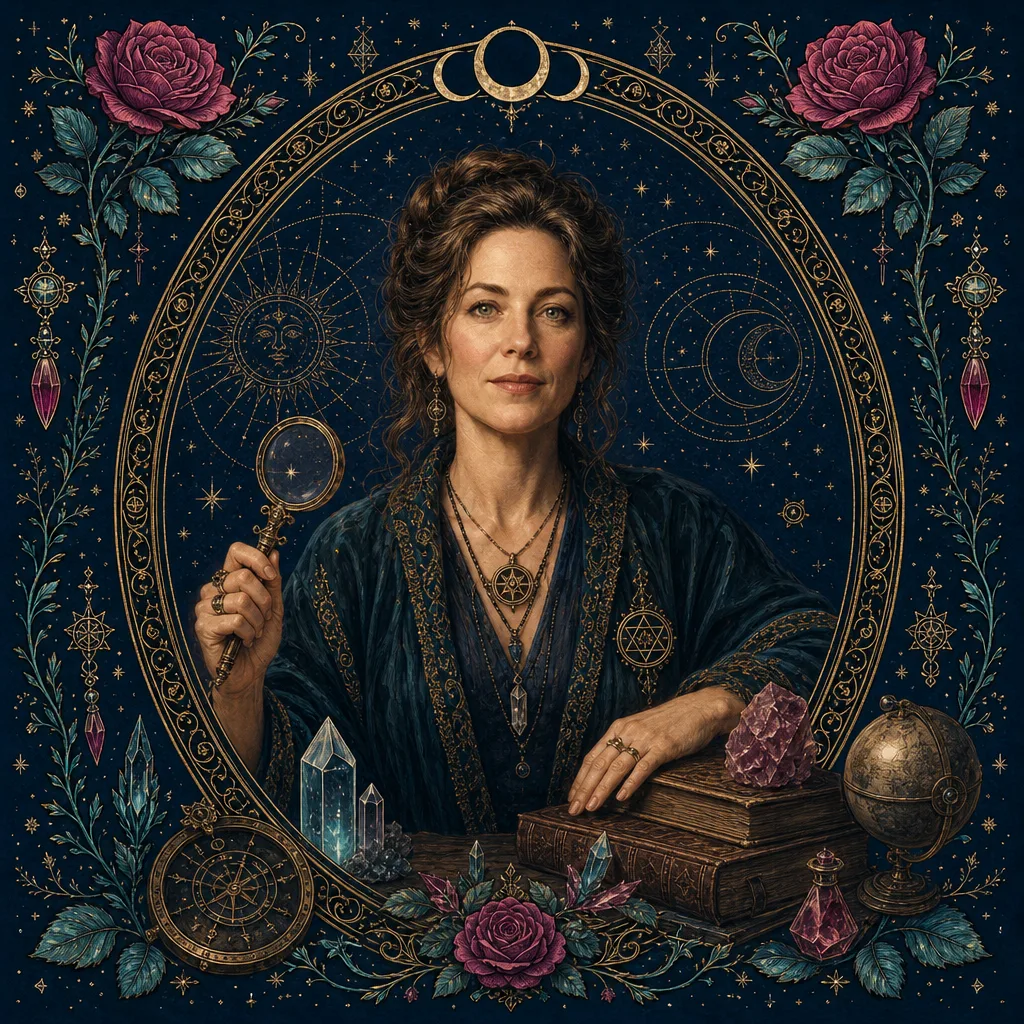
Scholars & Mystics
Theosophist
Also called Theosophical student, Theosopher
A Theosophist is a practitioner and student of Theosophy, the spiritual philosophy founded by Helena Petrovna Blavatsky and Henry Steel Olcott in 1875, which holds that all religions share an inner Ancient Wisdom and that human consciousness is on an evolutionary journey through successive incarnations toward divine perfection.
- Tradition
- Theosophy, founded 1875 in New York; principal expression through the Theosophical Society with centres worldwide
- Standing
- Open
A profile of the Theosophist
A devoted student of the Ancient Wisdom who reads across the whole of humanity's spiritual heritage in search of the single thread running through all of it.
- Loves
- comparative religious study across traditions, the hidden esoteric core of world religions, Blavatsky's formidable scholarship, the Adyar library and its holdings, a good Theosophical study circle.
- Hobbies and pastimes
- deep reading in Blavatsky and Besant, tracing correspondences between Eastern and Western philosophy, contemplative meditation on the planes of existence, attending Theosophical lodge lectures.
- Dream familiar
- A wise old elephant who carries the accumulated knowledge of many lifetimes and knows when to move slowly.
- Found in their element
- Found in a comfortable chair in a lodge library, deep in a volume of comparative religion, with a notepad full of cross-references beside them.
- Signature objects
- a well-annotated copy of The Secret Doctrine, a chart of the planes of existence, the seal of the Theosophical Society, Leadbeater's illustrated chakra diagrams, a globe showing the Society's worldwide centres.
A Theosophist is a practitioner and student of Theosophy, the spiritual philosophy founded by Helena Petrovna Blavatsky and Henry Steel Olcott in New York in 1875. Theosophy holds that beneath the diverse surface of the world’s religious and philosophical traditions lies a single Ancient Wisdom, a body of spiritual knowledge that describes the nature of the cosmos, the laws governing human evolution, and the inner dimensions of consciousness. The Theosophist studies this wisdom, applies its principles to their own inner development, and works toward the universal brotherhood that Theosophy holds as its highest practical ideal.
Theosophy is not a religion in the sense of demanding specific doctrinal assent or ritual practice. The Theosophical Society itself, the primary institutional expression of the movement, holds no dogma and requires its members to affirm only the first of its three objects: universal brotherhood without distinction of race, religion, sex, caste, or colour. Within this broad embrace, members hold widely varying views on the specific teachings, and the Society’s tradition is one of inquiry and study rather than orthodox belief.
The work
A Theosophist’s practice is primarily one of study, reflection, and the application of spiritual understanding to daily life. The primary texts of the Theosophical tradition, Blavatsky’s “The Secret Doctrine” and “Isis Unveiled,” along with works by Annie Besant, C. W. Leadbeater, and subsequent Theosophical writers, provide the core of the intellectual and philosophical work. Study circles, in person and online, bring students together to read these texts carefully and explore their implications.
Beyond study, Theosophy encourages the development of altruism as a practical spiritual discipline. The cultivation of genuine concern for others, the practice of living in accordance with the law of karma, and the work of contributing positively to human welfare are understood as more important than any particular meditation technique or ritual practice. Blavatsky was emphatic that the development of spiritual powers without a corresponding foundation of ethical purity was dangerous and counterproductive.
Many Theosophists also engage with meditation as a means of developing the inner perception that Theosophy describes. Some work with the system of inner development described in Leadbeater’s writings, which includes detailed descriptions of the chakras, auras, and subtle bodies; others engage more simply with contemplative prayer or silent sitting. The goal in either case is the unfoldment of the inner faculties that allow esoteric knowledge to be verified through direct experience rather than accepted on authority.
History and tradition
Helena Petrovna Blavatsky (1831 to 1891) was a Russian noblewoman who claimed to have spent years studying with teachers, Mahatmas or Masters, in Tibet and elsewhere before founding the Theosophical Society with Olcott and Judge in New York. Her “Isis Unveiled” (1877) established her as a formidable esoteric scholar, and “The Secret Doctrine” (1888) presented an elaborate cosmology and account of human evolution that drew on Sanskrit, Buddhist, Egyptian, Kabbalistic, and Western esoteric sources.
After Blavatsky’s death in 1891, the Society experienced significant schism. William Quan Judge separated the American section; Katherine Tingley subsequently led what became the Theosophical Society Pasadena. The main body, based in Adyar, India, passed to Annie Besant, whose long leadership (1907 to 1933) expanded the Society’s reach and influence enormously. She and C. W. Leadbeater produced a prolific body of clairvoyant investigations and wrote extensively on topics including the inner planes, the lives of great spiritual teachers, and the nature of the chakras.
Rudolf Steiner was a significant figure in the German Section of the Theosophical Society before departing to found his own movement, Anthroposophy, in 1912. Alice Bailey, another influential figure in the broader Theosophical world, channelled an extensive body of teachings attributed to the Master Djwhal Khul between 1919 and 1949, producing what many consider a third major expression of the Theosophical impulse.
Walking this path
The Theosophical Society is welcoming to newcomers and maintains active lodges and study groups in many countries. Beginning students are encouraged to read “The Key to Theosophy,” which Blavatsky wrote specifically as an accessible introduction, alongside Annie Besant’s “The Ancient Wisdom,” before approaching “The Secret Doctrine.” The study is genuinely demanding: Blavatsky’s magnum opus is a vast, densely allusive work that rewards patient, sustained engagement rather than quick reading.
Community is an important part of the Theosophical path. Study circles provide both structure for learning and the fellowship of others engaged in the same inquiry. The Theosophical Society’s libraries and archives, accessible at many lodges and online, contain extensive resources for the serious student.
The Theosophist”s path ultimately asks not only for intellectual engagement with its vast teachings but for the living practice of its core values: universal brotherhood expressed in daily dealings with all people, the cultivation of genuine compassion, and the patient inner work that gradually brings esoteric principles from the level of concept into the texture of perception and action.
In myth and popular culture
Theosophy exerted an extraordinary influence on twentieth-century art, literature, and spiritual culture, an influence that has been substantially underestimated in mainstream cultural history. The painter Wassily Kandinsky read Blavatsky’s “Thought Forms” (1905, co-authored with Annie Besant and C. W. Leadbeater) and took its visual representations of mental states as a direct inspiration for the development of abstract art; his foundational theoretical essay “Concerning the Spiritual in Art” (1911) draws explicitly on Theosophical ideas about the relationship between colour, form, and inner reality. Piet Mondrian was a member of the Theosophical Society and his move toward geometric abstraction was inseparable from his Theosophical understanding of spiritual evolution toward unity. The Theosophical current was, in this sense, quietly present at the birth of modern abstract painting.
In literature, William Butler Yeats was deeply involved with the Theosophical Society in the 1880s and 1890s, attending meetings with Blavatsky herself in London. His later esoteric system, developed with his wife Georgie Hyde-Lees and published in “A Vision” (1925 and 1937), carries substantial Theosophical influence alongside its Golden Dawn and spiritualist elements, particularly in its cyclical view of history and the soul’s evolution through repeated incarnations. L. Frank Baum, author of “The Wonderful Wizard of Oz” (1900), was a Theosophist and member of the Theosophical Society, and scholars including Michael Patrick Hearn have explored the Theosophical cosmology that arguably underlies the Oz series, with its hierarchies of beings, its evolutionary understanding of consciousness, and its insistence that the power each character seeks is already present within them.
Theosophy’s direct cultural representations have been less frequent than its diffuse influence, but several notable examples exist. The Order of the Star, which Annie Besant and C. W. Leadbeater organized around the young Jiddu Krishnamurti, whom they declared the vehicle for a coming World Teacher in the 1910s, became one of the more dramatic public events in modern religious history when Krishnamurti dissolved the Order in 1929 and renounced the role they had assigned him. Krishnamurti’s subsequent independent teaching career, documented in works such as “The First and Last Freedom” (1954) and captured in his recorded dialogues with David Bohm, reached a wide international audience and remains influential in contemporary philosophical spirituality, even as he consistently rejected the Theosophical framework from which he emerged. The Theosophical Society itself has continued to publish, organize, and educate through the twentieth and twenty-first centuries, maintaining lodges and study groups worldwide and preserving one of the largest specialized esoteric libraries in existence at Adyar, Chennai.
People also ask
Questions
What does Theosophy teach?
Theosophy teaches that there is an Ancient Wisdom underlying all religious traditions, that the universe and the human soul are engaged in an evolutionary process through successive cycles, that human beings reincarnate and carry the karma of previous lives, and that highly evolved Masters or Mahatmas guide human spiritual development. It emphasises the brotherhood of humanity across racial, religious, and national divisions.
What is the Theosophical Society?
The Theosophical Society, founded in New York in 1875 by H. P. Blavatsky, Henry Steel Olcott, and William Quan Judge, is the primary institution of the Theosophical movement. It has three stated objects: universal brotherhood without distinction, the comparative study of religion, philosophy, and science, and investigation of the unexplained laws of nature and the powers latent in humanity. It has branches worldwide and its international centre is in Adyar, Chennai, India.
What are Blavatsky's major works?
"Isis Unveiled" (1877) was Blavatsky's first major work, a critique of both materialist science and dogmatic religion from the standpoint of Hermetic philosophy. "The Secret Doctrine" (1888) is her masterwork, a vast synthesis of cosmogenesis and anthropogenesis that claims to reveal the esoteric foundation of all religious symbolism. "The Key to Theosophy" (1889) offers a more accessible introduction to Theosophical teaching.
How does Theosophy relate to Buddhism and Hinduism?
Blavatsky and Olcott publicly took Pali Buddhist precepts in Sri Lanka in 1880, and Theosophy draws heavily on Hindu and Buddhist concepts including karma, reincarnation, planes of existence, and the chakra system. However, Theosophy is not Buddhism or Hinduism but its own synthetic tradition that uses these sources alongside Western esoteric, Neoplatonic, and Hermetic materials.
Who was Annie Besant and what was her role in Theosophy?
Annie Besant was one of the most influential Theosophical leaders after Blavatsky, serving as president of the Theosophical Society from 1907 to 1933. A former socialist and women's rights campaigner, she brought considerable public prominence to Theosophy and collaborated with C. W. Leadbeater in producing clairvoyant investigations of the atomic world, the historical Jesus, and other subjects.