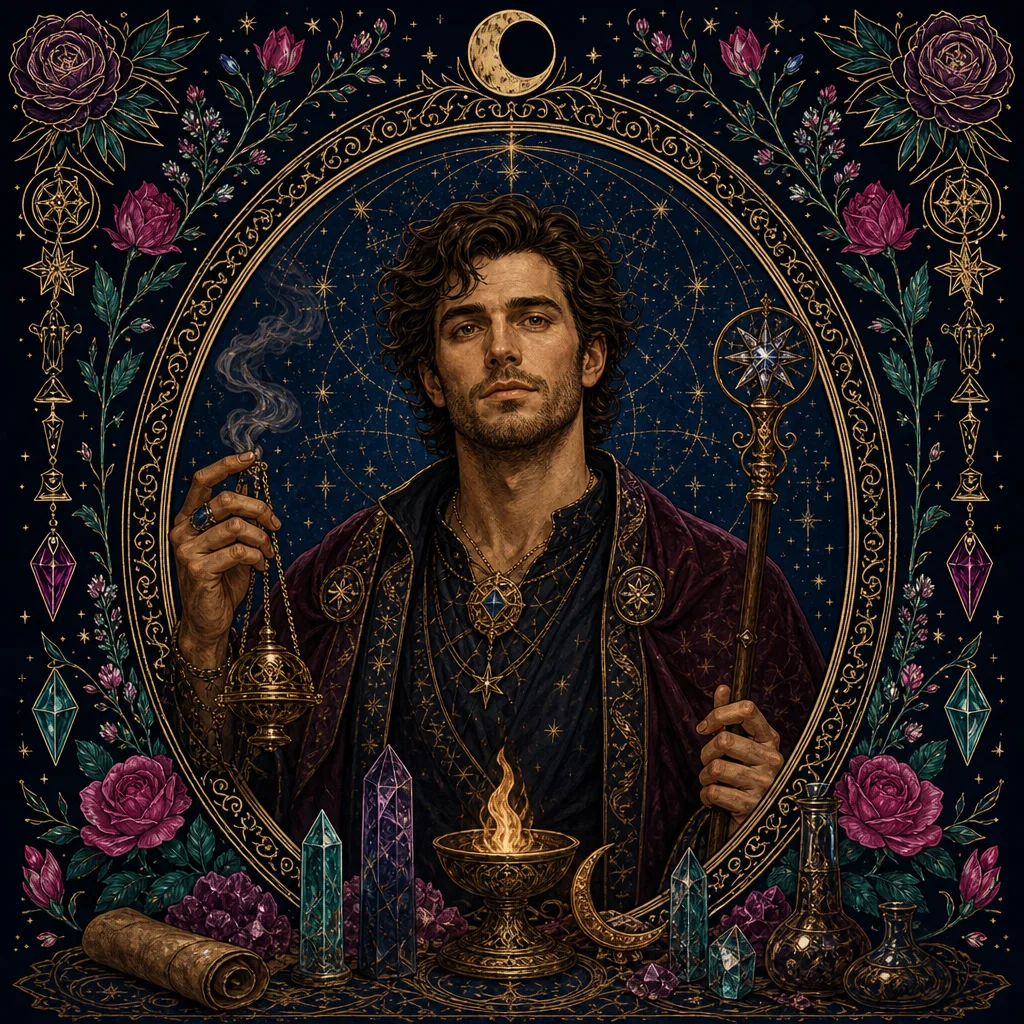
Ceremonial & High Magicians
Theurgist
Also called Divine Operator, Theurgic Magician
A theurgist is a practitioner who uses ritual action and symbolic performance to draw the soul upward toward union with the divine, working not primarily to influence the material world but to purify and elevate the self through participation in the divine activities of the gods. Theurgy holds that ritual correctly performed enacts on earth what the divine performs in the cosmos.
- Tradition
- Late Neoplatonic theurgy, associated with Iamblichus and the Chaldean Oracles; continued in Western ceremonial and Hermetic traditions
- Standing
- Open
A profile of the Theurgist
A reverent ritualist who understands ceremony as a means of being lifted toward the divine rather than a tool for bending the world to personal ends.
- Loves
- the Chaldean Oracles in Greek, Iamblichus's De Mysteriis read slowly and seriously, ritual composed to honour rather than command, sacred geometry and its cosmic ratios, the quality of stillness after a theurgic invocation.
- Hobbies and pastimes
- translating Neoplatonic texts with commentary, constructing planetary talismans by traditional method, contemplation of geometric and light-based symbola, composing original hymns to divine principles, studying Proclus and Gregory Shaw.
- Dream familiar
- A white ibis who walks beside the altar in silence, attending the rite with the grave composure of a being who has seen many souls begin their return.
- Found in their element
- Found in a dedicated oratory at twilight, lamp lit and planetary incense rising, performing a slow invocatory prayer composed in the spirit of Proclus.
- Signature objects
- a theurgic lamp of pure beeswax, a consecrated lamen bearing divine names, a copy of De Mysteriis with marginalia, Chaldean Oracles in a scholarly edition, a set of planetary symbola in their proper metals.
A theurgist is a practitioner who understands ritual action as a means of participating in divine activity, elevating the soul upward through the hierarchies of being toward union with its source. The word theurgy comes from the Greek theourgia, meaning divine working or god-working, and it names the specific approach to ritual developed by the late Neoplatonic philosophers of the third and fourth centuries of the common era, above all Iamblichus of Chalcis, who argued that genuine spiritual ascent requires not merely philosophical contemplation but ritual action performed with materials and words that the divine itself recognizes and responds to.
Where the magician working for material ends directs the forces of the cosmos toward a practical outcome, the theurgist directs the whole ritual enterprise upward, seeking to be lifted rather than to acquire. This does not mean theurgy is passive: it requires the same precise knowledge of correspondences, the same care in preparation and execution, and the same disciplined attention as any other ceremonial work. The difference lies in orientation and aim, with the theurgist holding that the soul”s return to its divine source is the only work ultimately worth doing.
The work
Theurgic practice in its classical form rested on the use of symbola and synthemata, material objects understood to participate in divine realities by virtue of their nature. A particular stone, plant, animal, or geometric figure associated by its inherent qualities with a specific deity or divine principle was placed within a ritual context designed to activate that correspondence. The theurgist did not create the relationship between the symbol and the divine; they discovered and engaged a relationship that already existed in the nature of things.
Contemporary theurgists work with these same principles through the system of correspondences developed in the Western esoteric tradition: planetary attributes and metals, elemental qualities and their symbols, colours and incenses associated with divine names, and geometric forms understood to embody specific divine ratios. Ritual is composed to honour and address divine principles devotionally rather than to command them, and the practitioner”s aim throughout is to orient the self as a vessel for divine action rather than as an independent agent pursuing personal ends.
The invocatory practices of ceremonial magick, when directed toward higher divine principles rather than toward practical results, function theurgically. The work of the Knowledge and Conversation of the Holy Guardian Angel as Crowley described it has a clearly theurgic character: the aim is union with the practitioner”s own higher divine aspect, not the acquisition of occult power. Contemplative practices drawn from Neoplatonic sources, such as the meditation on light described in the Chaldean Oracles, accompany the ritual work and deepen its effects.
Study of the philosophical framework is inseparable from practice for the serious theurgist, because understanding why the ritual works as it does, in the theurgic model, is itself part of what makes it effective. Iamblichus argues in De Mysteriis that the efficacy of theurgy does not depend on the practitioner”s intellectual understanding, but most contemporary theurgists find that philosophical study and ritual practice reinforce one another.
History and tradition
The philosophical foundations of theurgy were laid by Plotinus (204-270 CE), whose Enneads describe the procession of all things from the One and the soul”s potential return to its source through philosophy and contemplation. Plotinus himself was skeptical of ritual as a means of ascent, preferring the purely intellectual approach. His student Porphyry occupied a middle position. It was Iamblichus (c. 245-325 CE) who made the definitive case for theurgy as necessary for souls embodied in matter, arguing in De Mysteriis that the human soul, entangled in the material world, cannot lift itself by philosophical thought alone and requires the help of the gods themselves, which theurgy provides by enacting the divine order in material form.
The Chaldean Oracles, which Iamblichus and his successors regarded as revealed scripture, provided the theological architecture for classical theurgic practice. Proclus (412-485 CE) systematized the Neoplatonic philosophy and theurgic cosmology in his Platonic Theology and other works, and his writings have become increasingly accessible to modern scholars and practitioners.
The Renaissance Neoplatonism of Ficino and Pico della Mirandola revived the theurgic tradition alongside the Hermetic corpus, and through these channels theurgic principles entered the Western ceremonial tradition. The Golden Dawn, the A.:A.:, and other twentieth-century ceremonial orders carry these principles forward, typically without using the word theurgy explicitly, but with an understanding of ritual elevation toward the divine that is continuous with the Iamblichan tradition.
Walking this path
The theurgic orientation is more an attitude toward practice than a fixed set of techniques, and it can inform work within many different systems. A practitioner who approaches their ceremonial work with the intent of elevation and purification rather than material acquisition is working theurgically, regardless of the specific system they use.
Serious study of the Neoplatonic sources enriches theurgic practice considerably. Iamblichus”s De Mysteriis, translated by Emma Clarke, John Dillon, and Jackson Hershbell, is the primary text. Gregory Shaw”s Theurgy and the Soul provides an excellent scholarly and philosophical orientation. Contemporary writers such as Jeffrey Kupperman and Algis Uzdavinys have made Neoplatonic theurgy increasingly accessible to modern practitioners.
The theurgist role sits at the elevated end of the ceremonial spectrum and overlaps substantially with the Hermeticist, the Enochian magician working the higher Aethyrs, and the mystic who seeks divine union through contemplative practice. It is a path that asks genuine self-transcendence, not merely the acquisition of new skills, and that asks it consistently and without compromise.
In myth and popular culture
Theurgy as a specific philosophical and ritual tradition is less directly represented in popular culture than the broader category of the magician, but several literary and historical figures have been portrayed in ways that approximate the theurgic ideal. The late antique philosopher and holy man Apollonius of Tyana, whose biography Philostratus composed in the early third century, operates in that text as something very close to a theurgist in Iamblichus’s sense: a person whose extraordinary effects in the world follow from an inner purity and divine alignment rather than from sorcerous technique. The biography was well known in the Renaissance and contributed to the image of the philosopher-magician whose power flows from wisdom rather than from command.
The Renaissance magus, as the figure was theorized by Marsilio Ficino in his “Three Books on Life” (1489) and by Giovanni Pico della Mirandola in his “Oration on the Dignity of Man” (1486), carries theurgic themes at its heart: the idea that the human being, positioned between the material and divine worlds, can ascend through the hierarchy of being by aligning with higher forces rather than by coercing lower ones. Christopher Marlowe’s “Doctor Faustus” (c. 1592) stages a pointed counter-example, a magician who inverts the theurgic orientation entirely, seeking power and pleasure through a downward pact rather than elevation through devotion, and the tragedy of his end reflects the tradition’s conviction that magic pursued without theurgic orientation leads to destruction.
In twentieth-century fiction, the closest sustained approximation of theurgic practice appears in Charles Williams’s supernatural novels, particularly “Descent into Hell” (1937) and “All Hallows’ Eve” (1945), in which ritual and spiritual practice function as means of genuine participation in divine realities rather than as instruments of personal power. Williams was a member of the Fellowship of the Rosy Cross and deeply engaged with Christian mystical theology, and his fiction reflects an understanding of ritual elevation that has genuine structural continuity with Iamblichan theurgy even when it does not use that vocabulary. The contemporary novelist and occultist John Michael Greer, himself a practitioner in the Golden Dawn and Druidic currents, has written extensively on theurgic practice in his non-fiction work including “The Celtic Golden Dawn” (2013), making the theurgic orientation more explicitly available to a contemporary popular audience than it has been at any point since the Renaissance.
People also ask
Questions
What is the difference between theurgy and magic?
The distinction was articulated by ancient Neoplatonists, particularly Iamblichus, who argued that theurgy (divine working) operates through the gods themselves acting through the theurgist, while magic (goetia or lower forms of wonder-working) operates through the practitioner's own will and skill. Theurgy aims at the elevation and purification of the soul rather than at practical material ends; its goal is assimilation to the divine rather than the acquisition of power or goods. In practice the line is not always sharp, and many practitioners use the word theurgy to describe any ritual work oriented toward spiritual ascent rather than material result.
What are the Chaldean Oracles and why do they matter to theurgy?
The Chaldean Oracles are a collection of Greek hexameter verses, composed in the late second century of the common era and attributed to a Julian the Theurgist, that describe a Neoplatonic cosmology of fire, light, and divine emanations. They became foundational for late Neoplatonic philosophers, particularly Iamblichus and Proclus, who regarded them as revealed theology comparable to the Hermetica. The Oracles provide the theological backdrop for classical theurgy and are still studied by contemporary theurgists who work in the Neoplatonic tradition.
Can a modern person practise theurgy without the ancient context?
Yes, and many do. The theurgic principles of alignment with divine will, of ritual as participation in cosmic activity rather than mere human wish-fulfilment, and of the elevation of consciousness toward its source appear across many traditions, and contemporary practitioners draw on Iamblichus and the Chaldean Oracles alongside Hermetic texts, Western ceremonial magick, and their own contemplative experience. The Neoplatonic framework is the most articulate historical expression of theurgic principles but is not the only vehicle for the underlying spiritual orientation.
What does a theurgic ritual actually look like?
Classical theurgy involved the use of material symbols (called symbola or synthemata) understood to participate in divine realities: stones, plants, animals, and geometric forms each associated with specific divine principles. The theurgist placed these in ritual context to create a kind of earthly reflection of celestial reality that the divine could recognize and through which it could act. In contemporary practice this translates into the careful use of correspondences, planetary timing, sacred geometry, and invocatory prayers composed to address divine principles rather than merely to command them. The orientation is devotional and receptive rather than dominating.
Is theurgy available outside an initiatory order?
The primary sources for Neoplatonic theurgy are available in translation, and the Hermetic and ceremonial traditions that carry theurgic principles forward are extensively documented in published form. Serious study of Iamblichus's De Mysteriis, the Chaldean Oracles, and Proclus's writings, alongside a structured ceremonial practice, gives the solitary student a substantial foundation. Some contemporary orders, particularly those in the Golden Dawn and Thelemic streams, carry theurgic work as part of their advanced curricula.