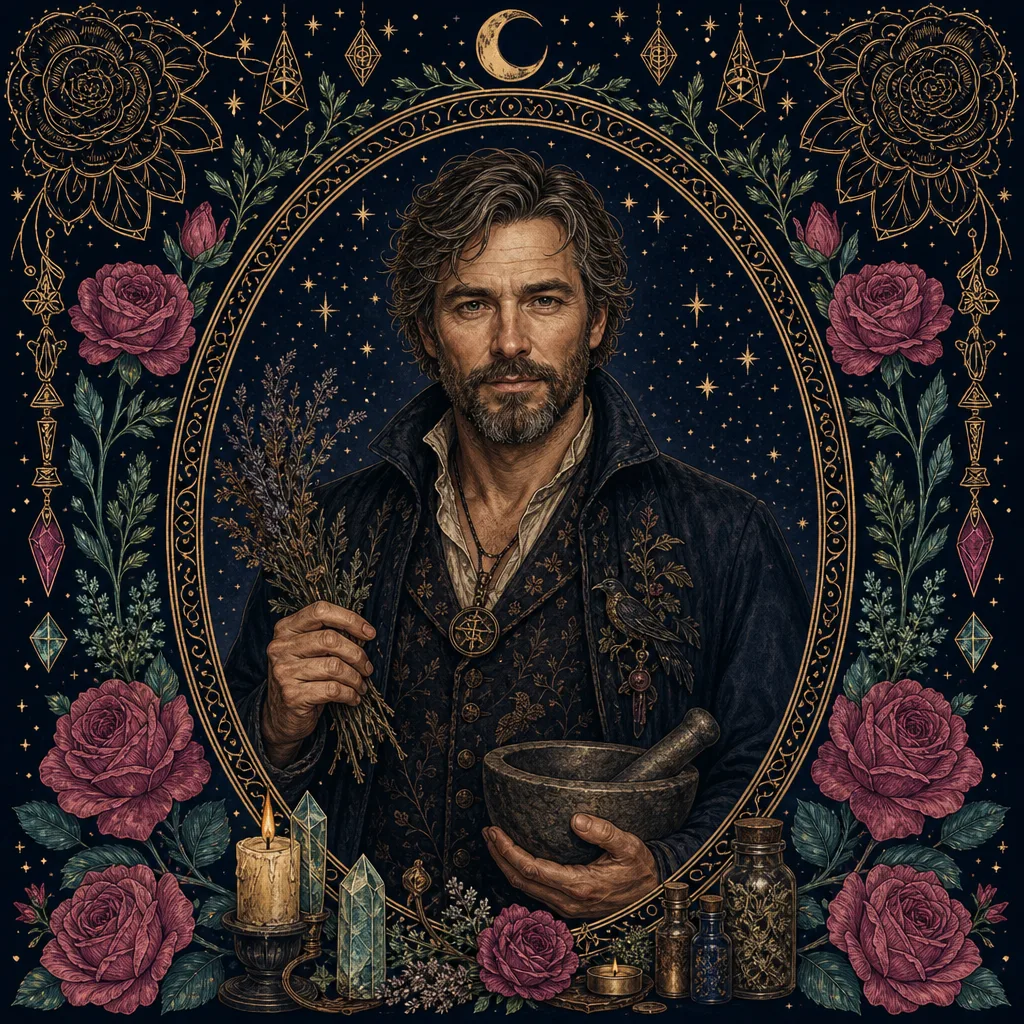
Healers & Wise Folk
Wise Man
Also called Cunning Man, Pellar, White Witch
A wise man is a male or male-presenting community practitioner who holds traditional knowledge of healing, divination, the detection and removal of witchcraft, and the protection of persons and property. The wise man occupied a recognized social role in European communities as a practical magical specialist whose work complemented both official medicine and religious ministry.
- Tradition
- British and European folk tradition; the term "cunning man" is particularly associated with England and Wales
- Standing
- Open
A profile of the Wise Man
A known figure in the community who can find the lost, lift the crossed, and identify the source of harm that no physician or parson can explain.
- Loves
- divinatory methods that have documentary history, the Cornish pellar tradition and its records, Keith Thomas and Owen Davies on the historical shelf, the relationship between spirit familiars and practical work, a good reference collection of regional folklore.
- Hobbies and pastimes
- making and burying witch bottles, learning traditional herbal preparations, studying cunning-folk case records, land-based divinatory practices.
- Dream familiar
- A dog-headed spirit who appears as an ordinary terrier until the moment something needs to be tracked, and then is something else entirely.
- Found in their element
- Found in his home at any hour, because clients come when they need him, not when it is convenient for him.
- Signature objects
- a sieve and shears for detection work, a filled and sealed witch bottle, a scrying glass or dark mirror, a collection of protective herbs and roots, a charm book in his own hand, the skull of a significant animal kept as a spirit vessel.
A wise man is a community practitioner who holds and applies traditional knowledge of healing, divination, witchcraft detection and removal, and practical protective magic for the benefit of his neighbours and clients. The role is most specifically documented in British and European folk tradition under names including cunning man, pellar, white witch, and charmer, and it represents the male counterpart of the wise woman, though the social dynamics and areas of specialization of the two roles sometimes differed in practice.
What makes the wise man a distinct figure in the history of magic is his recognized social function: he occupied a real position in the community ecology of pre-industrial England and Wales, known to his neighbours, consulted by people from considerable distances, and operating openly enough to appear in church records, court documents, and the accounts of diarists and folklore collectors who recorded what people in his community thought of him and what they sought from him. He was not hidden or marginalized but present, and his work addressed real problems that his community recognized as genuinely requiring his particular combination of practical knowledge and spiritual competence.
The work
The wise man”s practice centred on several interconnected specialties. The most frequently documented in the historical record is the detection and countering of witchcraft: the cunning man was consulted when a person or their livestock fell sick in ways that suggested supernatural interference, when milk refused to come or butter refused to form, when a run of misfortune seemed too consistent to be natural. He would diagnose whether the trouble was witchcraft and, if so, attempt to identify its source and reverse or neutralize the harm.
Detection of thieves and location of lost or stolen property was another major specialty. The cunning man would use a variety of divinatory methods for this purpose: the turning sieve and shears (suspended scissors and a sieve that were believed to indicate the direction of the thief), the magic mirror or crystal, the consultation of spirits, or simply an informed intuition about local social dynamics. Many clients sought this service, and the cunning man”s reputation depended substantially on his ability to produce results that his community found credible.
Healing through herbal preparations, verbal charms, and ritual action, and the provision of protective objects for persons, homes, and livestock were constant elements of the practice. Protective bottles (witch bottles) filled with pins, hair, and urine and buried beneath the threshold were widely used in the English tradition. Written charms, prayers, and specific herbal remedies accompanied these material protections. Divination for the purposes of the client”s own situation, including the provision of love charms and the identification of a future spouse, completed the range of services offered.
History and tradition
The cunning man as a recognized social figure is attested in English records from at least the fifteenth century and appears consistently through to the early twentieth. Keith Thomas”s 1971 study Religion and the Decline of Magic drew on extensive archival research to document the cunning folk of England and Wales as a genuine historical stratum, distinct from both the educated ceremonial magicians of the learned tradition and from the village witches of local accusation. Owen Davies”s subsequent work, particularly Popular Magic: Cunning-folk in English History (2003), extended this picture with additional detail.
The Cornish pellar tradition is one of the most distinctive regional variants, with a documented history of practitioners who specialized in the expulsion of witchcraft and who maintained their own professional identity distinct from the ordinary cunning man. The famous Peller of Helston, James Thomas, worked well into the nineteenth century and was consulted by clients from across Cornwall and beyond.
Some historians, particularly Emma Wilby in Cunning Folk and Familiar Spirits (2005), have argued for a deeper continuity between the cunning tradition and the spirit-familiars documented in witch trial records, suggesting that the cunning man”s relationship with spirits may have been as genuine a part of his practice as his herbal and divinatory work, and that the line between the wise man who helped through spirits and the witch who harmed through them was thin and contextual.
The contemporary revival of the cunning tradition has been carried forward particularly through British traditional witchcraft, where figures such as Robert Cochrane, Evan John Jones, and Andrew Chumbley developed a practice they understood as rooted in the indigenous English magical tradition of the cunning man.
Walking this path
The wise man”s role is entered through sustained engagement with the tradition”s knowledge and through the gradual building of a community relationship in which that knowledge is put to use. Study of the historical record, including the scholarly accounts of Thomas, Davies, and Wilby, provides an unusually solid historical foundation, and the primary practices of the tradition, divination, protective work, herbal healing, and the management of spiritual harm, are documented in enough detail that a thoughtful practitioner can begin to work with them.
Contemporary practitioners in the British traditional witchcraft current often point to the cunning man tradition as a primary ancestor and source, and engagement with these currents through published works, community, or direct contact with established lineages provides living context for the historical material. The wise man role does not require any particular initiation or lineage connection, though the living tradition enriches it considerably.
The role sits naturally alongside the folk healer, the wise woman, and the magickal herbalist, and most practitioners who identify with the wise man tradition also hold at least some of these other identities.
In myth and popular culture
The cunning man as a recognized community figure has left clear traces in English literature and folklore documentation even when the role is not named directly. Chaucer’s Franklin’s Tale and the figure of the clerk of Orleans in “The Canterbury Tales” (c. 1400) presents a learned practitioner of natural magic who can make the rocks of Brittany appear to vanish, employing his skill at a client’s request for payment, an arrangement structurally identical to the historical cunning man’s practice. The clerk is portrayed with some sympathy as a man of genuine knowledge rather than mere fraud, which reflects the actual ambivalence of medieval and early modern communities toward their local magical specialists.
In Victorian and Edwardian folklore collection, the cunning man appears directly and in detail. John Harland and T. T. Wilkinson’s “Lancashire Legends” (1873) and M. A. Denham’s “Denham Tracts” (1892 to 1895) record the practices and reputations of specific cunning men in the north of England with the kind of concrete detail that makes it possible to reconstruct something of the actual experience of consulting them. The Edwardian folklorist Walter Johnson described cunning men in the Midlands as still active in the early twentieth century, working alongside licensed medicine with clients who saw no contradiction in consulting both. These records are among the primary sources that contemporary practitioners draw on when attempting to reconstruct or work within the tradition.
In fiction the figure of the wise man as community magical practitioner has attracted less direct portraiture than the dramatic witch, but Alan Garner’s novels, particularly “The Weirdstone of Brisingamen” (1960) and its sequels, present a version of the cunning practitioner in the character of Cadellin, a figure whose knowledge of the land and its spirits is practical, ancient, and embedded in specific geography rather than generically mystical. Thomas Hardy’s “The Mayor of Casterbridge” (1886) includes the character of Fall, a conjuror consulted about the weather, who operates with exactly the matter-of-fact pragmatism of the historical cunning man without any novelistic distortion. The historical novelist Mary Renault, though working primarily with ancient Greek material, created in her Theseus novels (“The King Must Die,” 1958, and “The Bull from the Sea,” 1962) male ritual specialists embedded in their communities whose practical magical function resembles the cunning man’s even when the cultural context is entirely different.
People also ask
Questions
What is a cunning man?
A cunning man is the English term for a male community practitioner of folk magic and healing, where "cunning" derives from the Old English cunnan, meaning to know or to be able. The cunning man was distinguished from both the village priest and the licensed physician by the practical magical nature of his knowledge: he could identify thieves and lost property by divination, detect and reverse witchcraft, provide protective charms, and treat illness through herbal and ritual means. The term was in active use from at least the fifteenth century through the nineteenth, and practitioners describing themselves in these terms appeared in court records and parish documents throughout this period.
What is a pellar?
A pellar is a specific term for a cunning man in Cornwall, England, believed to derive from the word "expeller," reflecting the pellar's primary function of expelling witchcraft and spiritual harm. The most famous documented pellar was James Tregeagle in the seventeenth century, though the best historically attested is James Thomas, the Pellar of Helston, who worked in the nineteenth century. The Cornish pellar tradition is one of the best-documented regional strains of the English cunning man tradition and has informed contemporary Cornish traditional witchcraft.
How did people find and consult a wise man?
The wise man or cunning man was a known figure in his locality, and communities typically knew who to consult through word of mouth. Some practitioners held their knowledge openly and ran essentially what we would recognize as a practice, receiving clients and taking payment or gifts for their services. Clients came for a wide range of concerns: to identify a thief, to recover stolen goods, to determine whether their illness had a natural or supernatural cause, to obtain protective charms for people or livestock, and to learn who had ill-wished them and how to undo it. Journeys of considerable distance to consult a renowned practitioner were not uncommon.
Did cunning men face persecution as witches?
Less frequently than cunning women, because the social dynamics of witchcraft accusation in early modern Europe systematically disadvantaged women more than men. However, cunning men were not immune: some were prosecuted, particularly when their practice brought them into conflict with church authority or when clients who felt cheated or unsatisfied turned to the courts. The legal position of cunning folk was always ambiguous, because the same laws against witchcraft that were used against harmful practitioners could technically apply to beneficial ones, and authorities were inconsistent in applying them.
Is the wise man tradition still alive?
Contemporary practitioners who identify with the cunning man tradition exist, particularly within British and Cornish traditional witchcraft. Robert Cochrane, Evan John Jones, and later Andrew Chumbley and others have carried forward and developed what they understand as a living stream of the cunning tradition. The historical record of the cunning man's practice has been extensively researched by scholars such as Keith Thomas, Emma Wilby, and Owen Davies, making the tradition better understood historically than it was even a generation ago, and providing contemporary practitioners with a much richer documented basis for their work.