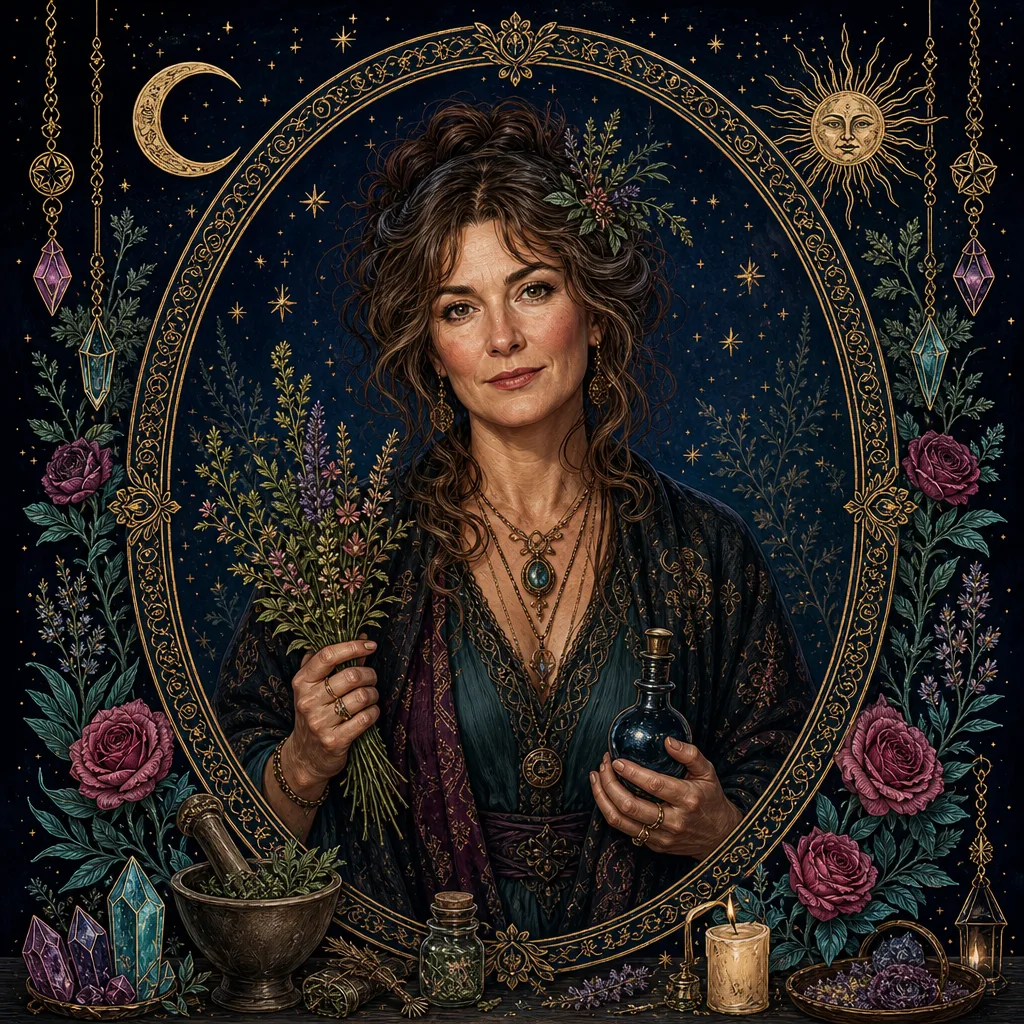
Healers & Wise Folk
Wise Woman
Also called Cunning Woman, Wisewoman, Good Witch
A wise woman is a community practitioner, typically but not exclusively a woman, who holds and transmits traditional knowledge of healing, herbs, midwifery, divination, and the management of spiritual harm. The wise woman serves as a resource for the whole community, addressing needs that fall between ordinary medicine, religious ministry, and the practical magic of protective and remedial charms.
- Tradition
- European and British folk tradition, with equivalents in virtually every pre-industrial culture worldwide
- Standing
- Open
A profile of the Wise Woman
The woman the whole village knows to call when the doctor has failed, the priest has no answer, and the situation is genuinely beyond ordinary remedy.
- Loves
- the herb garden in all weathers, traditional midwifery knowledge, the evil-eye diagnosis and water ritual, a good collection of regional charm texts, the community trust built across many years of honest practice.
- Hobbies and pastimes
- gathering and drying medicinal plants by season, learning the charm traditions of specific regions, tending to neighbours through illness and grief, reading historical witch trial records for what they reveal about actual practice.
- Dream familiar
- A tortoiseshell cat who knows which patients need company and which need silence, and arranges herself accordingly without being told.
- Found in their element
- Found in the kitchen or the herb garden in daylight, and at a bedside or at the threshold of a difficult situation after dark.
- Signature objects
- a bunch of dried herbs hung from the kitchen beam, a ceramic bowl for the water-and-oil evil-eye rite, a collection of protective amulets made from local materials, a handwritten remedy book in an old format, a mortar and pestle used daily, the red thread of protection.
A wise woman is a practitioner who holds and applies traditional knowledge of healing, plant medicine, midwifery, divination, and the management of spiritual harm for the benefit of her community. The role is ancient, found across virtually every pre-industrial culture, and it names the person in a community to whom you go when you need something that falls between the authority of the priest, the skill of the physician, and the protection of the law: when you are ill and medicine has not helped, when you suspect spiritual interference in your affairs, when a child has been harmed by an evil eye, when you need to know something that cannot be found out by ordinary means.
The wise woman is distinguished by the integration of her knowledge and by her community function. She is not a specialist in one narrow field but a generalist whose breadth of practical and spiritual knowledge makes her useful across an enormous range of situations. She knows which herbs help which conditions. She knows how to prepare protective charms and how to undo harmful ones. She can divine the source of misfortune and often knows what to do about it. And she holds all of this within a fabric of community relationships and trust that gives her interventions their practical authority.
The work
The wise woman”s work begins with listening. People come to her with problems that do not fit neatly into the categories of any professional practice: a cow that has stopped giving milk after a neighbour”s visit, a child with a wasting illness that the doctor has not been able to explain, a run of bad luck following a quarrel, a persistent sense of spiritual unease. She listens to the whole situation, not just the presenting complaint, and she responds to what she hears with the full range of her knowledge.
Herbal preparations are typically at the centre of healing work: teas, poultices, washes, and infused oils prepared with attention to the plant”s properties, the timing of preparation, and the words said over them. Most traditions hold that the preparation of the remedy is inseparable from the spiritual intention put into it, and the wise woman who works her remedies carelessly or mechanically is understood to be producing something less effective than one who works with full attention and prayer.
Protective and remedial charms address the spiritual dimensions of illness and misfortune. Diagnosing the evil eye and treating it through water-based rituals, eggs, or iron is a standard element of many wise woman traditions across southern Europe and Latin America. Binding harmful forces, reversing crossed conditions, and identifying the source of deliberate spiritual interference fall within the wise woman”s repertoire where the tradition includes those concerns. Prayer, spoken formulae, and the invocation of divine or ancestral protection accompany all of these practices.
Midwifery and reproductive knowledge, including fertility support, pregnancy care, and the full range of life-cycle transitions, have historically been a major part of the wise woman”s knowledge base. Birth and death, in most pre-industrial communities, fell within the wise woman”s remit as naturally as illness.
History and tradition
The wise woman has been documented in every European culture with historical records adequate to the question. In England the cunning woman (and her male counterpart, the cunning man) served parishes throughout the medieval and early modern periods, typically operating openly and with the community”s recognition, handling requests ranging from lost property to the identification of thieves, from healing to the removal of witchcraft. Keith Thomas”s Religion and the Decline of Magic provides an extensive account of these practitioners in English history.
The witch trials of the fifteenth through eighteenth centuries placed the wise woman in an extremely dangerous position, because the same knowledge that made her valuable to her community could also be reframed by accusers or authorities as evidence of diabolism. Many of the women prosecuted for witchcraft in the early modern period were in fact community healers whose relationships had deteriorated or who had become vulnerable to accusation through poverty, social marginalization, or conflict with powerful neighbours. This history is important to understand honestly: the witch trials were not primarily a persecution of Pagan religion but a persecution that entangled many people in many social roles, of whom community healers were a significant and particularly vulnerable group.
The twentieth century saw a strong revival of interest in the wise woman tradition, particularly through the women”s movement, the midwifery revival, and the broader folk medicine renaissance. Barbara Ehrenreich and Deirdre English”s Witches, Midwives and Nurses (1973), though subsequently criticized for some of its historical claims, helped bring the connection between wise women, healers, and persecuted witches into public consciousness and gave the archetype renewed cultural resonance.
Walking this path
Most contemporary wise women come to their practice through some combination of inherited family knowledge, sustained self-study in herbalism and traditional healing practices, and community engagement that gives their work its social dimension. The role is not primarily defined by what you know but by how you put what you know into service for others, and the community relationship, the trust built through years of helpful, careful, and honest practice, is as much a part of the role as any specific skill.
Study in herbalism, traditional healing, midwifery, and the folk magical traditions of your own or an adopted heritage provides practical foundation. Working with an established practitioner, where possible, offers transmission of a living tradition that books and courses cannot fully replace. And the practice of offering what you know in service to others, however small the start, begins to build the community relationship within which the wise woman role becomes real.
The wise woman role overlaps with the folk healer, the magickal herbalist, and the witch in most people”s experience of it. Many practitioners hold all these descriptions simultaneously and experience no contradiction between them.
In myth and popular culture
The wise woman as literary and mythological archetype is one of the oldest figures in European narrative, appearing in roles that range from the helpful crone of fairy tale to the demonized hag of witch panic. In the Grimm brothers’ collection “Kinder- und Hausmarchen” (first published 1812), the ambivalent old woman who aids or tests the protagonist is ubiquitous: she is the godmother with genuine power, the forest crone who demands courtesy before giving help, and the dangerous witch whose gifts come with conditions. Bruno Bettelheim, in “The Uses of Enchantment” (1976), argued that these figures embody the archetype of the woman who possesses transformative knowledge and who uses it according to the moral conduct of those who seek her out, a reading that aligns closely with how the historical wise woman actually operated.
In English literature, Shakespeare’s figure of the Weird Sisters in “Macbeth” (c. 1606) collapses the wise woman and the malevolent witch into a single disturbing image, but his Paulina in “The Winter’s Tale” (c. 1610) presents a more sympathetic model: a woman who holds knowledge, performs what appears to be magical restoration, and uses it in the service of justice and healing, operating in the space between miracle and magic that was precisely the wise woman’s social location. George Eliot’s novels frequently include figures who carry the wise woman’s integrated knowledge of plants, illness, and community dynamics: Silas Marner’s Dolly Winthrop, and more explicitly the herb gatherer Hetty Sorrel’s aunt in “Adam Bede” (1859), embody rural female authority of a kind that the wise woman’s tradition made legible.
The twentieth-century revival of the wise woman image has been substantial and has come from several distinct directions. Barbara Ehrenreich and Deirdre English’s “Witches, Midwives and Nurses” (1973) gave a political feminist framing to the persecution of women healers that made the wise woman figure central to feminist historical consciousness, even though subsequent historians found the work’s claims about organized medical suppression of female healers to be overstated. Clarissa Pinkola Estes’s “Women Who Run With the Wolves” (1992) drew on folk tale and Jungian analysis to reconstruct an archetype of the wild knowing woman that resonated with enormous numbers of readers and contributed to the wise woman’s rehabilitation as a model for contemporary feminine spiritual authority. More recently, the explosion of interest in herbalism, traditional medicine, and community healing practice has produced a broad contemporary wise woman culture that is often explicitly aware of its historical roots, visible in the work of practitioners and writers such as Rosemary Gladstar, Susun Weed, and Robin Wall Kimmerer, each of whom carries and transmits integrated plant knowledge in ways that continue the wise woman tradition’s essential character.
People also ask
Questions
What is the difference between a wise woman and a witch?
In historical European communities the distinction was primarily moral and social rather than practical. The wise woman used her knowledge to help neighbours: healing the sick, delivering babies, identifying the source of misfortune, undoing harmful magic, and providing protective charms. The witch used similar knowledge to harm. In practice the same person might be called one or the other depending on the outcome of her work and the political dynamics of the accusation, and many women prosecuted as witches in the early modern period were in fact community healers whose relationships with neighbours had soured. The wise woman is the healer face of the same knowledge that could in other circumstances be labelled as witchcraft.
Is the wise woman role still active today?
Yes. While the social role of the village wise woman as the de facto community resource for healing, midwifery, and spiritual matters has been largely displaced in urbanized societies by professional medicine, mental health services, and organized religion, practitioners who hold this integrated knowledge continue to work in many communities. Contemporary wise women may practice as herbalists, birth workers, grief counsellors, grief ritualists, community witches, or traditional healers, often combining several of these roles in ways that reflect the original integrated character of the wise woman's function.
Did wise women actually practice magic?
By any reasonable definition, yes. The charms spoken over remedies, the protective objects made against the evil eye, the divination performed to identify the source of illness or misfortune, the work of reversing harmful magic directed at a client: all of these fall within the modern understanding of magical practice. The wise woman did not typically use this language herself; she would have described her work in the religious terms of her own culture, praying to saints, invoking divine protection, working within a thoroughly Christian (or pre-Christian, or syncretic) framework. The magickal character of the work is a modern analyst's description.
How does the wise woman tradition relate to modern witchcraft?
Modern witchcraft, particularly in its folk revival form, draws explicitly on the image and tradition of the wise woman as a model and ancestor. Many contemporary witches understand their practice as a recovery or continuation of the wise woman's role, and the skills they cultivate, herbal knowledge, divination, protective magic, healing work, are substantially the same. The contemporary witch typically practises more openly and within a more explicitly magical or Pagan framework than her historical predecessors would have used, but the underlying orientation toward serving self and community through practical magical knowledge is continuous.
Can men hold the wise woman role?
The equivalent role for men is the wise man or cunning man, and both roles have been held by people across the gender spectrum throughout history. The gendered names reflect the most common social pattern, in which women dominated community healing and men dominated certain other aspects of the cunning tradition, but exceptions were common. Contemporary practitioners use both terms flexibly, and some prefer gender-neutral language like "folk healer" or "cunning folk" to describe the integrated role regardless of the practitioner's gender.